Key Highlights
- Bitcoin plunged to $75K, wiping out over $510 billion from crypto market cap, hitting leveraged traders hardest as markets reacted to failed support.
- With the crash, the total crypto market cap plunged from $3.05 trillion to $2.54 trillion in just a week, highlighting the scale of the sell-off.
- Ethereum and other altcoins also suffered, while the total crypto market cap fell 3%, signaling extreme investor fear.
Bitcoin fell sharply to $75,000 range on February 2, 2026, triggering one of the largest single-day losses in the past few years. The sharp decline erased over 10% from recent highs, pushing the asset below $80,000 for the first time since April 2025.
As of writing, according to CoinMarketCap, the price of Bitcoin is trading at $75,413.39, with a volume of $65.9 billion in 24 hours. This has led to a sudden fall in the market wiping out $510 billion in just a week. Altcoins took even bigger hits, as many leveraged traders betting on Bitcoin’s rise were forced to sell.
The fall in Bitcoin price follows another country-wide shutdown in the U.S. while the crypto failed to hold its support level of $82,500. Once it slipped through that level, BTC started to fall through the thin liquidity zones quickly.
Massive liquidations hit crypto markets
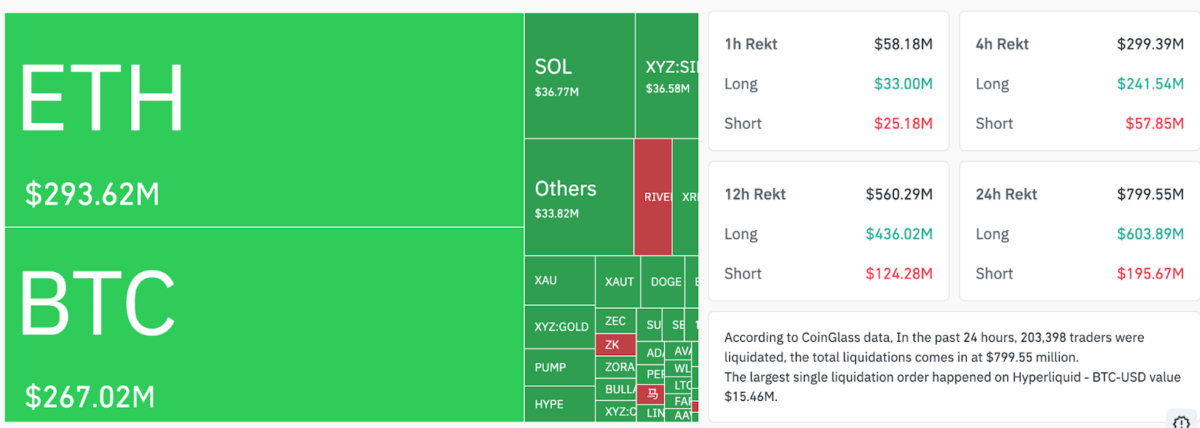
As per the Coinglass data, there have been almost $800 million in liquidations in 24 hours, adding to the collective liquidations nearing $3 billion in the past three days.
In the past 24 hours, Ethereum was at the forefront of liquidations with $293.6 million wiped out from ETH leverage markets, followed by Bitcoin with $267 million. Other altcoins like Solana, XRP, DOGE and various other also experienced the same fate.
Altcoins and broader market trends
Other major cryptocurrencies also moved noticeably. CoinMarketCap data shows Ethereum trading at $2,222.61, up slightly by 1.6% in the short term but down 20% over the past week.
Binance Coin (BNB) trades at $747.44, XRP at $1.58, and Solana (SOL) at $100.60, all of which have fallen in double digits from their January highs.
The total crypto market cap plunged from $3.05 trillion to $2.54 trillion in just a week, highlighting the scale of the sell-off. As of now, the market sits at $2.57 trillion, down 3% in a single day, while daily trading activity has dropped nearly 9% to $174 billion. Investor fear is running high, with the Fear and Greed Index hitting just 15, signaling extreme caution across the market.
The short-term chart also shows Bitcoin firmly under pressure. According to TradingView data on the 4-hour chart, the price slid from the mid-$90,000s to the mid-$70,000s, confirming a bearish trend.
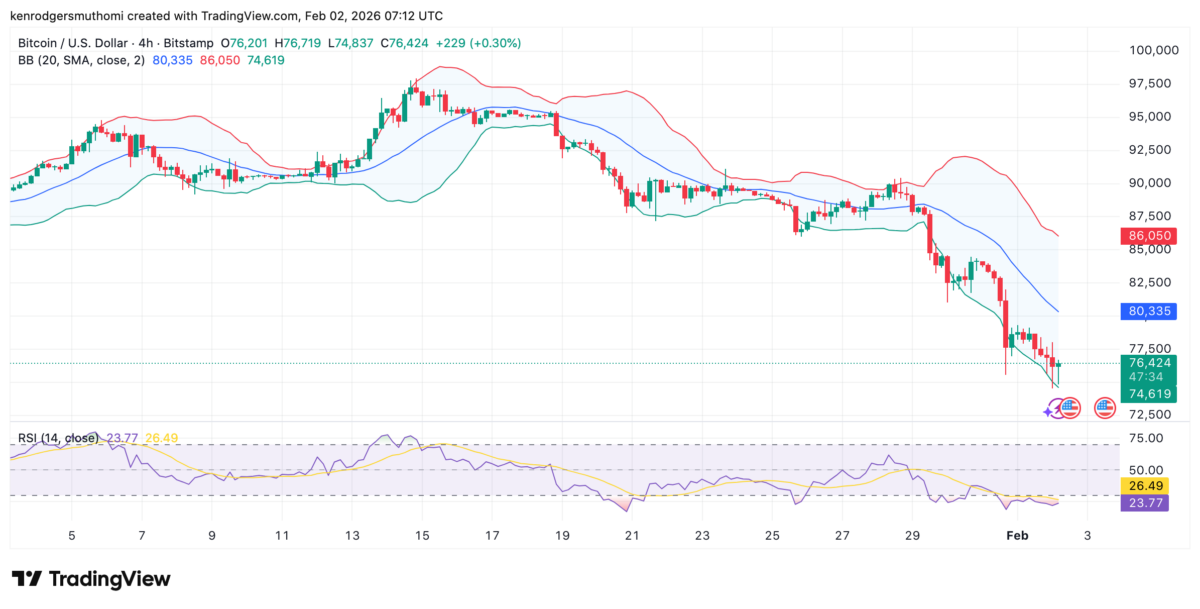
Bollinger Bands are expanding downward, indicating rising volatility, while RSI is deep in oversold territory below 30. For context, Bollinger Bands show how much a price is moving up or down, while RSI signals if an asset is overbought or oversold.
It is worth noting that key catalysts for the crash include the partial U.S. government shutdown, trade-war headlines, rising long-dated Japanese government bond yields, and geopolitical tensions, including the ongoing war in Iran and brewing friction in the South China Sea.
Market Leaders Weigh In
Plan C, a crypto analyst on X, noted, “$75,000–$80,000 is a 37% to 40% correction. This could be the deepest pullback in this Bitcoin bull run.” The analyst, however, noted that 35%-40% corrections are historically not unheard of for a Bitcoin bull run.
He also noted that the Binance ‘glitch’ black swan, occurred on October 10, “brought us down much lower than we would have gone otherwise.”
In one of his recent analyses, Raoul Pal, the founder and CEO of Global Macro Investor (GMI), explained that this crash has nothing to do with fundamentals but it’s a pure ‘liquidity squeeze.’ “That factor is that US liquidity has been held back due to the 2 shutdowns and issues with US plumbing,” Pal notes.
Bitcoin’s recent drop shows how risky the market can be when people borrow to trade. Short-term traders face big losses, but those holding for the long run are distant to such serious danger. For patient investors, this dip could even be a chance to buy at lower prices.
Also Read: Japan’s Largest Wealth Manager Cuts Crypto Exposure Amid Market Turmoil