Key Highlights
- The decentralized exchanges (DEXs) ecosystem has evolved into aggregators that route trades across multiple venues to guarantee the best execution prices.
- Traders must actively manage slippage tolerances and utilize MEV-protection tools to block predatory sandwich attacks.
- Concentrated liquidity maximizes capital efficiency but demands active monitoring to mitigate the risks of impermanent loss.
- Users should simulate transactions to detect scams and regularly revoke token approvals to secure their wallets against exploits.
The financial landscape has shifted irreversibly. By 2025, the distinction between “crypto trading” and decentralized finance or “DeFi” has blurred, with decentralized trading volumes on high-performance chains like Solana and Layer 2 solutions such as Base and Arbitrum frequently rivaling those of major centralized giants. For the modern investor, the decentralized exchange (DEX) is no longer an experimental playground but a primary venue for accessing new assets, maximizing yield, and maintaining sovereignty over their wealth.
However, the freedom of a DEX comes with the responsibility of being your own bank, risk manager, and execution trader. Unlike a centralized exchange (CEX) like Binance or Coinbase, which holds your funds in custody and matches orders via a central engine, a DEX operates as a peer-to-contract protocol. You retain full control of your private keys until the moment of the trade. This eliminates the risk of an exchange insolvency freezing your assets, but it exposes you to distinct on-chain execution risks—from the “invisible tax” of slippage and failed transactions to the predatory algorithms of miner-and validator-extractable value (MEV) bots.
This guide aims to go beyond the simple “buy” button. We will deconstruct the engine room of Automated Market Makers (AMMs), dissect the mathematics of liquidity provision, and equip you with the advanced security hygiene required to navigate the decentralized markets of 2025 safely.
How DEXs actually work
To master DEX trading, one must first understand the machinery that drives price discovery. While CEXs rely on the traditional Central Limit Order Book (CLOB), where buyers and sellers list specific prices, most DEXs operate on a fundamentally different model: the Automated Market Maker (AMM).
Order Books vs. AMMs
In a CLOB system (used by CEXs and some high-speed DEXs like dYdX or Hyperliquid), a trade only happens when a buyer’s bid matches a seller’s ask. This provides precision but requires massive active participation to ensure liquidity.
The AMM revolutionized DeFi by replacing the “counterparty” with a “smart contract.” You do not trade against another person; you trade against a Liquidity Pool (LP)—a pile of tokens locked in a contract. The price is set mathematically. The foundational formula, popularized by Uniswap V2, is the Constant Product Formula:
x . y = k
Where:
- x is the quantity of Token A.
- y is the quantity of Token B.
- k is a constant value.

When you buy Token A from the pool, you remove x and add y. To keep k constant, the relative price adjusts.
Price impact increases non-linearly as liquidity is depleted, meaning large trades become progressively more expensive.
The aggregator revolution
In the early days, traders had to check Uniswap, SushiSwap, and Curve individually to find the best price. Today, trading directly on a specific AMM is rarely the optimal strategy.
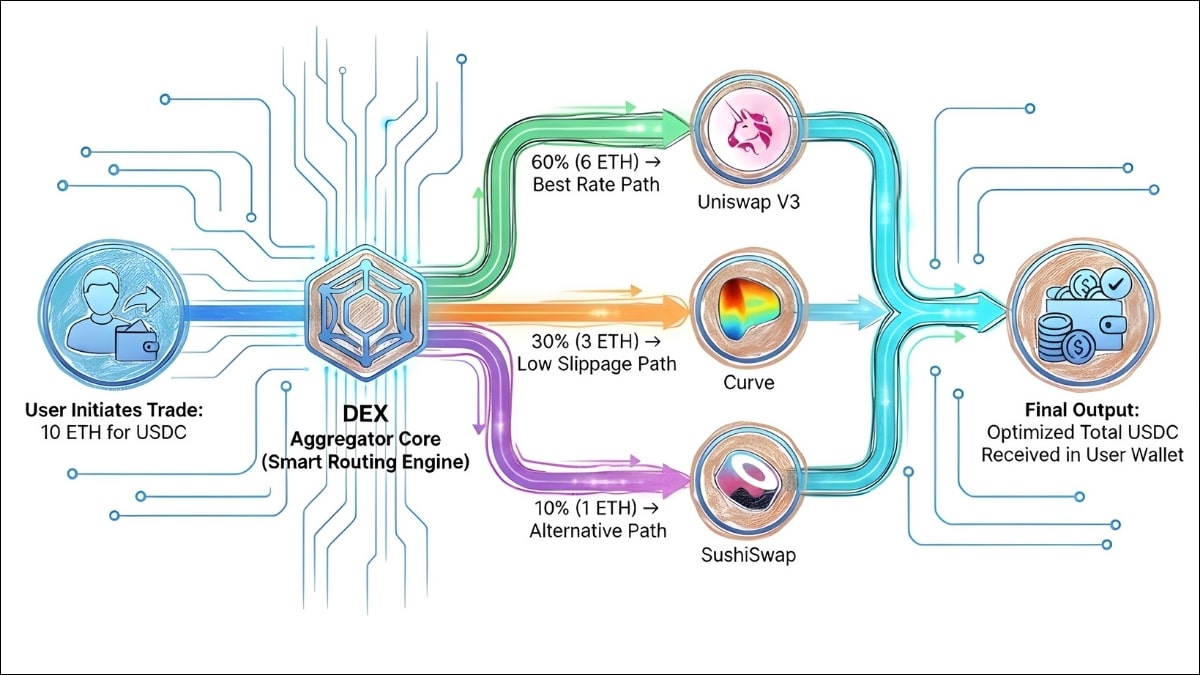
DEX Aggregators like 1inch, Jupiter (on Solana), and CowSwap have become the default interface for execution interface. These protocols act as intelligent routers. They check liquidity across dozens of venues and use “Split Routing” to break a single order into smaller chunks, executing them across multiple pools simultaneously.
For example, a swap of 100 Ethereum (ETH) to USDC might be routed 60% through Uniswap V3, 30% through Curve, and 10% through a private market maker, ensuring the user receives the highest possible output.
The art of the “Swap”: Execution and hidden costs
Clicking “Swap” initiates a transaction lifecycle that is transparent yet perilous. Understanding this process is key to avoiding hidden costs.
The transaction lifecycle
When you sign a transaction, it does not execute immediately. On EVM-based chains, it enters the mempool (memory pool), which is a waiting room for unconfirmed transactions. Validators pick transactions from this pool to include in the next block, usually prioritizing those with higher gas fees.
Other chains may handle transaction propagation and ordering differently, but the core risk remains the same: if your transaction is visible before execution, it can be targeted.
Slippage explained
Slippage is the difference between the price you see on the screen (Quoted price) and the price at which the trade actually executes (Executed price).
- Market slippage: Occurs when your trade size is large enough to shift the pool’s ratio (x vs. y), pushing the price up as you buy.
- Volatility slippage: Occurs when the market price moves while your transaction is pending in the mempool.
Actionable advice: Most interfaces allow you to set “Slippage Tolerance.”
- Too low (e.g., 0.1%): In volatile markets, your transaction will likely fail (revert) because the price moved beyond your limit. You lose the gas fee.
- Too high (e.g., 5%): You risk overpaying significantly or, worse, inviting predatory attacks.
The dark forest: MEV and sandwich attacks
If you set a high slippage tolerance (e.g., 3% or more), you become a target for Maximal Extractable Value (MEV) bots.
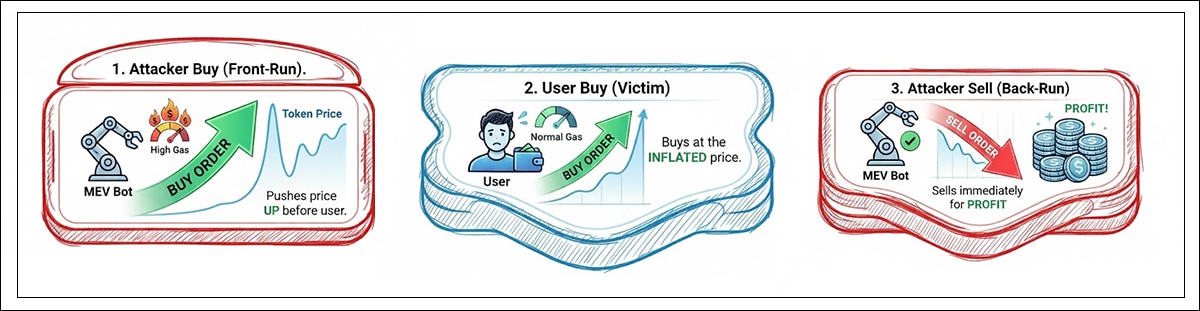
The anatomy of a sandwich attack:
- Spotting: A bot scans the mempool and sees your pending order to buy say 10 ETH with high slippage tolerance.
- Front-run: The bot bribes the validator to place their buy order immediately before yours. This pumps the price of ETH up to your maximum tolerance.
- Victim execution: Your trade executes at this artificially inflated price.
- Back-run: The bot immediately sells the ETH they bought. They profit from the price increase caused by your trade, while you receive significantly fewer tokens than you should have.
Defense strategies:
- MEV-protected RPCs: You can use tools like MEV Blocker or Flashbots Protect. These route your transaction directly to validators, bypassing the public mempool where bots lurk.
- Intent-based trading: Protocols like CowSwap or UniswapX use batch auctions. You sign an “intent” (e.g., “I want 10 ETH for at least 30,000 USDC”), and professional “solvers” compete to fill it. The risk of sandwich attacks is entirely outsourced to the solvers.
Liquidity provision (LPing): The economics of market making
Liquidity providers (LPs) are the backbone of DeFi. By depositing assets into a pool, LPs facilitate trading for others and earn a cut of the trading fees (typically 0.05% to 0.3% per swap).
Evolution of liquidity
- Uniswap V2 (Standard): LPs deposited tokens in a 50/50 ratio. Liquidity was spread across the entire price curve (0 to ∞). This was “set and forget” but highly inefficient, as most capital sat idle.
- Uniswap V3 (Concentrated liquidity): This changed the game by allowing LPs to allocate capital only within a specific price range (e.g., ETH between $2,500 and $3,000). This concentration can increase capital efficiency by up to 4000x, generating massive yields, but it requires active management. If the price leaves your range, you stop earning fees.
- Uniswap V4 (The future): V4 introduces “Hooks”—custom plugins that allow pools to have dynamic fees, on-chain limit orders, or time-weighted average market making (TWAMM), further professionalizing the LP landscape.
The great risk: Impermanent Loss (IL)
The most misunderstood risk in DeFi is Impermanent Loss. It is the opportunity cost of holding tokens in a liquidity pool versus simply holding them in your wallet.
IL occurs because the AMM constantly rebalances your portfolio. As the price of one asset rises, the AMM sells it (to buyers) and buys the cheaper asset. You effectively sell your winners early.
The Math of Impermanent Loss: The formula for IL based on the price ratio change (d = Pnew / Pold ) is:
Impermanent Loss = (2 √d ∕ 1 + d) – 1
Example Scenario: Imagine you deposit ETH and USDC into a pool. If the price of ETH doubles (d=2):
- HODL value: If you held outside the pool, your portfolio would grow significantly.
- LP value: Your pool position grows, but less than the HODL portfolio.
- The loss: You suffer a loss of approximately 5.7% compared to holding.
If the price does not return to the entry ratio, this “impermanent” loss becomes permanent upon withdrawal.
Advanced strategies and tools
As LPing has become more complex, a new layer of tools has emerged to help users compete with professional market makers.
Active Liquidity Managers (ALMs)
Protocols like Gamma, Arrakis, and DefiEdge offer automated vaults. You deposit your assets, and their smart contracts automatically manage the Uniswap V3 price ranges for you, rebalancing as the market moves. This restores the “passive” experience of V2 while attempting to capture V3 yields.
Cross-chain swapping
The ecosystem is now multi-chain. Moving assets between Ethereum, Solana, and Arbitrum has historically been dangerous due to bridge hacks.
- Native swaps (ThorChain): Allows you to swap native Bitcoin for native Ethereum without “wrapped” assets (like wBTC). It uses decentralized vaults to perform atomic swaps on Layer 1 chains.
- Interoperability protocols: LayerZero and Stargate solve the “fractured liquidity” problem, allowing for unified liquidity pools across chains. Aggregators like Jumper (powered by Li.Fi) or Bungee scan all available bridges to find the cheapest route for your cross-chain transfer.


Security hygiene for DEX users
The irreversibility of blockchain transactions means there is no “undo” button. Security is paramount.
Token approvals: The silent killer
Before trading, you must “Approve” the DEX to spend your tokens. Many UIs request an “Infinite Approval” for convenience. This is a critical vulnerability. If that DEX contract is ever exploited, the attacker can drain all the tokens in your wallet, not just the ones you intended to trade.
Best practice: Always edit the “Spending Cap” in your wallet (e.g., MetaMask or Rabby) to match the exact amount of your trade.
Transaction simulation
Never sign a transaction blindly. Use browser extensions like Pocket Universe or Fire. These tools simulate the transaction in a safe environment and show you exactly what will happen in plain English (e.g., “You are giving 1,000 USDC and receiving 0 ETH”). They are the best defense against phishing scams and wallet drainers.
Revoking permissions
Periodically audit your wallet. Use tools like Revoke.cash or Etherscan’s Token Approval tool to sweep and remove old approvals for protocols you no longer use.
Conclusion
Decentralized exchanges offer unparalleled access to the financial frontier, right from the latest memecoins on Solana to sophisticated yield-bearing strategies on Arbitrum. However, they demand a shift in mindset. In this environment, you are the custodian, the trader, and the security officer.
By understanding the mechanics of AMMs, protecting yourself against MEV and slippage, and respecting the mathematics of Impermanent Loss, you can navigate the DeFi ecosystem of 2025 with confidence. The golden rule remains: verify, simulate, then sign.