When you first log into an exchange, it can look like the cockpit of a fighter jet. There are flashing numbers, red and green bars, and words like “Volume” and “Liquidity” everywhere.
Don’t let the “techy” look scare you. At its heart, an exchange is just a very organized digital ledger. It has a specific structure designed to make sure trades happen fairly and safely.
The Structure: What’s Under the Hood?
Every exchange, no matter how big or small, has three main parts that work together:
- The User Interface (The Dashboard): This is what you see. It shows your balance, the price charts, and the buttons to buy or sell.
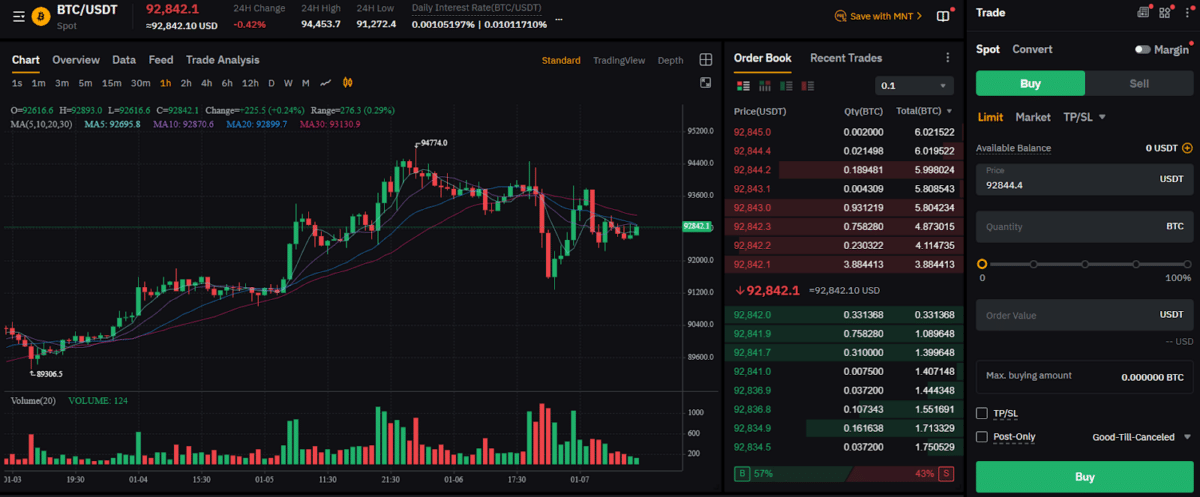
- The Matching Engine (Order Book): This is the “brain” of the exchange. It lives in the background and matches buyers with sellers. If you want to buy 1 Bitcoin for $90,000, the engine scans all orders to find someone selling 1 Bitcoin for that price.
- The Wallet/Custody: This is the “vault.” It’s where the exchange keeps your assets until you decide to move them.
The Buzzword Breakdown
To trade like a pro, you need to speak the trading language. Let’s translate these common “buzzwords” into plain English.
1. Trading Pairs: The “X for Y” Rule
In the real world, you don’t just “buy.” You swap. If you buy an apple, you are trading “Money for Apple.”
In crypto, we call this a Trading Pair. It looks like this: BTC/USDT.
- The first coin (BTC) is what you are buying.
- The second coin (USDT) is what you are using to pay.
If the price says $90,000, it means you need $90,000 USDT to buy 1 Bitcoin.
2. Volume: The “Crowd” Meter
Imagine two coffee shops. One has a line out the door (High Volume), and the other is empty (Low Volume).
Volume tells you how much money has been traded in the given hours.
- High Volume is good! It means the market is active, and you can buy or sell instantly.
- Low Volume is a warning sign. It means nobody is trading, and you might get stuck with a coin you can’t sell.
3. Liquidity: The “Ease” Factor
Liquidity is closely tied to volume. It describes how easily you can turn your crypto back into “real” money without changing the price.
Think of a swimming pool. If it’s full of water (High Liquidity), you can jump in without hitting the bottom. If it only has an inch of water (Low Liquidity), you’re going to get hurt when you try to jump!
4. The Order Book: The “Auction” List
This is the list of everyone waiting to trade.
- The “Bids” (Green): People waiting to buy at a certain price.
- The “Asks” (Red): People waiting to sell at a certain price.

The space between the highest buy price and the lowest sell price is called the Spread. In a healthy exchange, this gap is very tiny.
Trading Bots: The Robots in the Room
You might notice prices constantly moving in markets. While it essentially comes from order placing, most of the time it’s generated by Trading Bots.
These are software programs that traders use to buy and sell automatically based on rules.
- The “Arbitrage” Bot: It looks for a coin that is $100 on one exchange and $101 on another. It buys on the cheap one and sells on the expensive one instantly.
- The “Safety” Bot: It can be told, “If the price drops by 10%, sell everything immediately so I don’t lose more money.”
Bots aren’t “cheating”—they actually help the market by providing more Liquidity and keeping prices stable across different platforms.
A Note for the Student: Why This Matters
Understanding the structure and the buzzwords helps you avoid common mistakes.
For example, a beginner might try to buy a coin with “Low Volume” and realize they paid 5% more than the market price because of “Low Liquidity.” By checking the Order Book and the Volume first, you become a smarter, safer participant in the market.
Teacher’s Summary:
- Pairs tell you what you’re swapping.
- Volume tells you if the “party” is active.
- Liquidity tells you if you can leave the “party” whenever you want.
- Bots are the robots keeping the party running 24/7.
Disclaimer:
Some elements of this content may have been enhanced with the help of our artificial intelligence (AI) assistants for purposes such as basic refinement, review, image generation, and translation to deliver high-quality news in a shorter time frame. However, all AI-assisted content is reviewed and approved by our team to ensure accuracy, fairness, and editorial integrity.