The 2025 bull run is in full swing, and a new wave of centralized exchanges (CEXs) has risen to compete for a share of the market’s staggering $160 billion in daily volume.
According to data from Messari, CEX trading volume has consistently dwarfed that of decentralized exchanges (DEXs). Recent figures show CEXs handling over 90% of the total trading volume, with daily volumes often exceeding $40 billion on most days past this month.
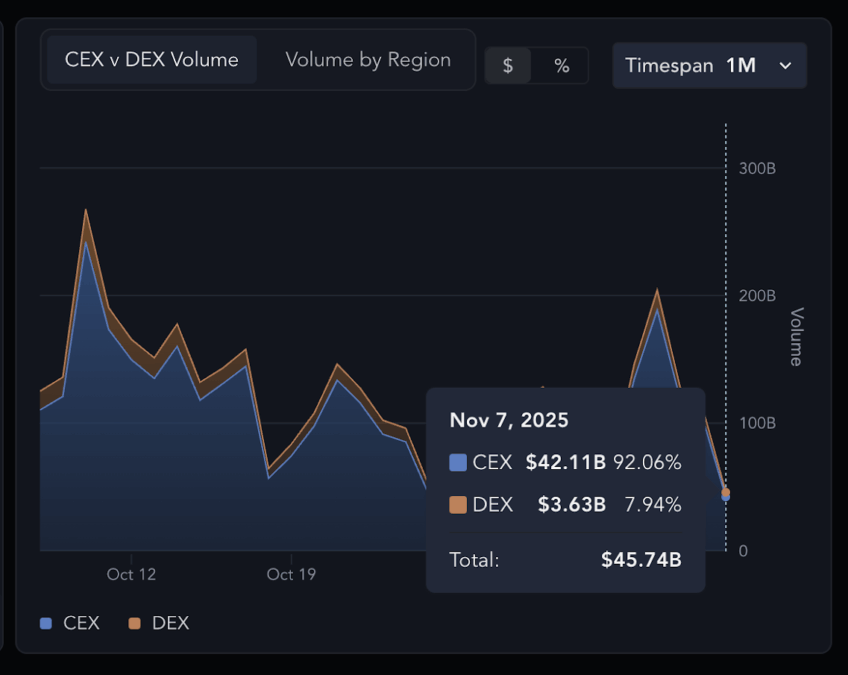
This trend is clearly visible in the monthly volume charts, demonstrating the enormous scale and liquidity of the centralized exchange market. Even during market dips, daily CEX trading volume has consistently held above $50 billion, highlighting its sustained dominance.
While giants like Binance and Kraken still dominate, the latest class of “newcomer” exchanges is battling to attract a new generation of traders. But this is not 2021. The shadow of the 2022 market crash, and the catastrophic collapse of FTX, has fundamentally changed the game. The old way of choosing an exchange—based on low fees, high leverage, and a vast selection of tokens—is dead.
Today, the only metric that matters is trust.
For a new trader, choosing an exchange is the single most important and high-stakes decision they will make. How can you tell a legitimate, secure platform from the next potential disaster? This guide will provide a professional framework for evaluating any exchange, using three distinct newcomers—Bitunix, Bitso, and Bitbank—as real-world case studies.
The A+ “Trust Test”: A 5-Point Framework for 2025
Before we look at any specific brand, we must establish our standards. A modern exchange is not just a trading engine; it’s a financial institution you are trusting with your assets. Here is the 5-point “Trust Test” every user must apply.
1. Regulation & Licensing (The Most Important Test)
This is the new, non-negotiable standard. “Compliance” is the most important word in crypto.
- A+ Standard: The exchange is licensed by a major, high-trust financial regulator (e.g., Japan’s FSA, Germany’s BaFin, or a U.S. state). This is an extremely strong signal of institutional-grade security and oversight.
- B-Grade Standard: The exchange is licensed, but in a “light-touch” offshore jurisdiction (e.g., Seychelles, BVI). This is better than nothing, but it also leaves users with far less protection.
- F-Grade (Red Flag): The exchange is unlicensed or operates with no clear corporate headquarters. Avoid!
2. Verifiable Proof of Reserves (PoR)
After the FTX fiasco, “trust me” is a dead concept. A trustworthy exchange must prove its solvency.
- A+ Standard: The exchange provides a real-time, auditable Merkle Tree Proof of Reserves dashboard. This allows any user to verify that their specific assets are included in the audit and that the exchange’s total assets match its total liabilities.
- B-Grade Standard: The exchange publishes a “snapshot” or a blog post claiming its reserves are “1:1.” This is a marketing statement, not an audit, and is not a substitute for verifiable proof.
- F-Grade (Red Flag): The exchange provides no PoR or refuses to discuss its reserves. Avoid.
3. Security & Custody Track Record
Where are your assets actually held?
- A+ Standard: The exchange publicly states that 95%+ of user assets are held in multi-signature, geographically-distributed cold storage. It has a clean, blemish-free security record and a top-tier rating from independent security auditors like CER.live.
- B-Grade Standard: The exchange claims “bank-level security” but provides few specific details.
- F-Grade (Red Flag): The exchange has a history of multiple “hacks” or “unexplained losses.” Avoid it.
4. Liquidity & Market Health
A high trading volume number can be a lie. A liquid market is a real, tangible thing.
- A+ Standard: The exchange has deep liquidity (tight bid/ask spreads) on its major trading pairs (like BTC/USD). This means you can sell your assets instantly at a fair market price.
- C-Grade Standard: The exchange boasts a massive 24-hour volume, but it is all concentrated in a handful of obscure memecoins or futures contracts. This is a sign of a “casino” platform, not a stable exchange.
- F-Grade (Red Flag): The order book is “thin,” with huge gaps between buy and sell orders. This means a single large trade could crash the price.
5. Business Model & Niche
Who is this exchange built for? A platform’s features reveal its true focus. A platform that heavily promotes 200x leverage on memecoins is a high-risk casino. While a platform that focuses on spot trading, secure custody, and fiat on-ramps is a utility-focused on-ramp. You must choose the one that matches your risk profile.
Applying the Framework: A Comparative Look at 3 New Contenders
Let’s apply our A+ Trust Test to the three exchanges to see how they stack up.
1. Bitbank: The “Security & Compliance” Play
Bitbank is a respected, Japan-based exchange that has built its entire brand on trust and regulatory compliance.
The Analysis:
- Regulation: Bitbank is licensed by Japan’s Financial Services Agency (FSA), one of the strictest and most respected regulatory bodies on earth. This is a massive, top-tier trust signal.
- Security: It has a long, proven track record of security and compliance, having survived multiple bear markets.
The Trade-Off: This iron-clad security comes at a cost. Bitbank is a “walled garden.” It offers a very limited selection of vetted assets and fewer high-risk features like high-leverage derivatives. It is not a platform for degen traders.
Verdict: Bitbank is a conservative, dependable choice for investors in Asia who prioritize safety, security, and regulatory peace of mind above all else.
2. Bitso: The “Regional Specialist” Play
Bitso is a Latin America (LATAM)-focused exchange that has become a dominant player in the LATAM market.
The Analysis :
- Business Model: Bitso’s “killer feature” is not its trading engine; it’s its regional fiat on/off-ramps. It has deep integrations with local banking systems in Mexico, Brazil, and Argentina, solving a massive, real-world problem for users in those countries.
- Regulation: It has strong local compliance and is a registered, regulated entity in its key markets, but it does not have the same global-tier license as a platform like Bitbank.
The Trade-Off: Bitso is a purpose-built tool. It is arguably one of the best crypto exchanges in Latin America. However, it is not a global liquidity hub and has a more limited selection of assets than a global competitor.
Verdict: Bitso is a prime example of a “regional specialist” that provides immense utility for its target audience.
3. Bitunix: The “Global Features” Play
Bitunix is a newer, global-facing exchange competing directly with the industry’s giants by offering a massive feature set.
The Analysis:
- Business Model: This is the classic “all-in-one” platform. It competes by offering a vast selection of assets (565+ coins) and high-risk, high-reward products like 125x leverage on over 200 perpetual contracts. This is a platform built for active, high-frequency traders.
- Security: The platform claims transparent Proof of Reserves and multi-sig cold wallets. This is good. However, a critical analysis is necessary to verify this. A search on CER.live (a top security auditor) does not show a top-tier rating, and its PoR is not as easily verifiable as some competitors.
The Trade-Off: The core value proposition is maximum features and access. The risk is that it is a newer entity in a crowded market. Its regulatory footing is less established than Bitbank’s, and its user-protection claims are not as battle-tested.
Verdict: Bitunix is built for the active, risk-tolerant trader who wants a “crypto casino” experience with the widest possible selection of assets and tools.
The Verdict: There is No “Best” Exchange
As our analysis shows, asking “What is the best newcomer exchange?” is the wrong question. The right question is, “What is the best exchange for my specific needs and risk tolerance?”
The answer depends entirely on who you are:
- Are you a conservative investor who prioritizes safety and compliance above all else? A platform like Bitbank is your clear choice.
- Are you a user in LATAM whose primary need is a reliable bridge to your local currency? A regional specialist like Bitso is your purpose-built tool.
- Are you an active, experienced trader who wants deep liquidity, high leverage, and the widest possible selection of new altcoins? A global “features” platform like Bitunix is built to compete for your business.
In the post-FTX world, “trust, don’t verify” is a dead mantra. The new standard is “Verify, then Trust.” Use this framework to do your own research, understand the trade-offs, and choose the platform that truly aligns with your financial goals.
Also Read: CEX vs. DEX: How DeFi Trading is Beating Binance, Coinbase?
Disclaimer:
Some elements of this content may have been enhanced with the help of our artificial intelligence (AI) assistants for purposes such as basic refinement, review, image generation, and translation to deliver high-quality news in a shorter time frame. However, all AI-assisted content is reviewed and approved by our team to ensure accuracy, fairness, and editorial integrity.