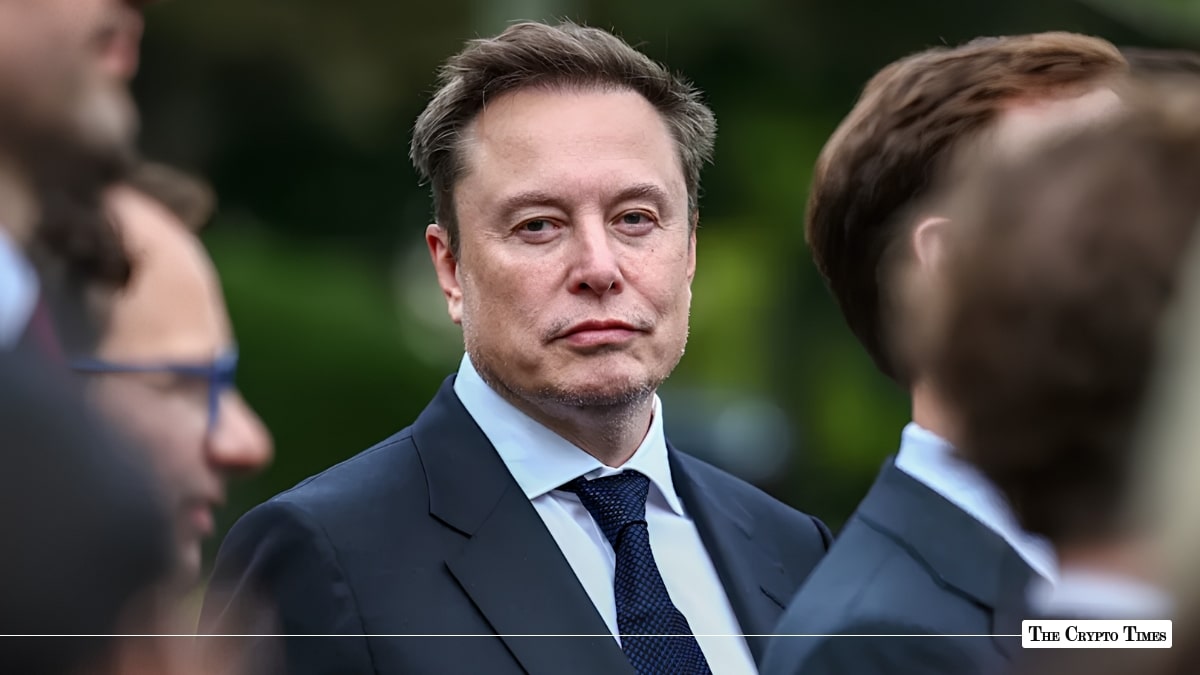
In a post on October 19, Elon Musk wrote on X: “Next year, I will give one of my SpaceX shares to every kid in America. This will be the first of many.” The pledge points to a potential 2027 distribution, but Musk has not publicly detailed its eligibility rules, funding arrangements, or delivery mechanism.
Using the US Census Bureau’s estimate of 73.1 million Americans under 18 in 2024 and an illustrative share price of about $146, the distribution would be worth roughly $10.7 billion. The Census Bureau published the child-population estimate in its 2024 population estimates, while Nasdaq provides the market data for SpaceX shares under ticker SPCX. The calculation is an estimate, not a confirmed valuation of the proposed giveaway: the share price can change, and the final number of eligible recipients has not been specified.
A free asset, broadcast to tens of millions of recipients in a single coordinated distribution, will sound familiar to anyone in crypto. The word for it is an airdrop; and while the comparison has real limits, because Musk is proposing to hand out company shares rather than digital tokens, it is the clearest lens for why a rocket-company giveaway lands on a crypto site.
The ‘Airdrop’ Framing, and Where It Breaks Down
In crypto, an airdrop is the free distribution of a token to a large group of users at once, often to bootstrap a community or reward early participants. Musk’s giveaway is similar in its proposed mass distribution of an asset at no cost to recipients. The framing is useful because it captures the idea of extending ownership of a high-profile asset to a broad population, rather than routing the gift through funds, foundations or institutional philanthropy. Musk himself has leaned toward that logic, saying in a separate X post that companies should “give the shares directly to the public” while reacting to Anthropic’s Public Benefit Fund.
But the analogy is a lens, not an equivalence, and the differences matter. What Musk is proposing is an equity distribution, not a token airdrop. A SpaceX share represents ownership in a publicly listed company, with rights determined by the class of share and applicable terms; a typical airdropped token does not necessarily confer equity or shareholder rights. Shares gifted to minors could raise questions about account ownership, custodianship, securities rules, and tax treatment. And where a token airdrop can often be executed on-chain, Musk’s plan is, for now, a public pledge with no published distribution mechanism and a 2027 target. Calling it an “airdrop” is a way to understand the ambition; it is not a crypto launch, and we’re not suggesting it is.
The SpaceX and Crypto Backstory
SpaceX spent 2026 as one of the assets featured in crypto’s experimental “pre-IPO” markets. Before the company listed, crypto traders could already bet on its valuation without owning a share, through a synthetic “pre-IPO perpetual” — a perpetual futures contract that tracks an asset’s implied price with no expiry and no ownership of the underlying. On Hyperliquid, a derivatives blockchain, a project called Ventuals ran a SpaceX contract (SPACEX-USDH) under Hyperliquid’s permissionless HIP-3 framework, which allows third parties to deploy perpetual markets. The contracts provided price exposure, not ownership of SpaceX shares, as The Crypto Times explained in its coverage of SpaceX-linked markets on crypto exchanges.
That experiment exposed both the appetite and the fragility of the format. On May 28, 2026, the SpaceX perp collapsed about 45% in roughly half an hour, from around $2,277 to a low near $1,254 before recovering to about $2,169, after Ventuals said an off-chain data provider, or oracle, returned incorrect data, triggering liquidations. The incident liquidated 484 users and $1.74 million in notional value; Ventuals said it would compensate affected users within 48 hours. The Crypto Times’ report on the incident provides further detail.
Crypto-adjacent prediction markets such as Kalshi and Polymarket, meanwhile, ran their own SpaceX contracts on when it would list and how many launches it would complete.
From Synthetic Perp to Nasdaq
Those synthetic markets were overtaken by the public listing. SpaceX priced its IPO at $135 per share, with trading beginning on Nasdaq on June 12, 2026, under ticker SPCX. The company confirmed the pricing in its June 11 IPO announcement, and Nasdaq documented the start of trading in its IPO announcement.
The listed stock changed the context for crypto’s synthetic contracts: traders could now reference a publicly traded share price, although a derivative contract still does not provide the same rights as owning the stock. SpaceX shares could also become part of the tokenized-equity products crypto firms are developing to represent or provide exposure to traditional securities on blockchain networks. Any such product would need to be assessed on its own structure, including whether it represents the underlying share, a contractual claim or price exposure only. The through-line is valuation discovery: crypto venues tried to price SpaceX before its public listing, using derivatives and infrastructure that carried their own risks, and the IPO then provided a public-market reference price.
The Open Questions on the ‘Drop’
For all the ambition, the execution is undefined. It is unclear who would administer the distribution, whether shares would sit in custodial accounts until recipients reach adulthood, how children who become eligible or age out during the rollout would be handled, whether the giveaway would recur, and how eligibility would be verified. The funding route matters too: issuing new shares, buying them on the open market, or transferring shares from Musk’s own stake would have different implications for dilution, funding, and tax treatment. Musk has not specified which route he intends to use, and the legal and tax consequences would depend on the final structure.
There is also a smaller precedent. SpaceX President Gwynne Shotwell and her husband said in July that they planned to gift a SpaceX share to each of more than two million children’s Trump Accounts, focusing on children aged 11 to 17 in lower-income areas. That pledge was described as a targeted contribution through the US savings-account programme; Musk’s proposed nationwide distribution would be substantially broader if carried out as stated. Neither the scale nor the mechanics of Musk’s plan have yet been publicly detailed.
Why It Matters
The lasting point for crypto isn’t whether 73 million children get a SpaceX share in 2027. It’s that SpaceX became a live test of crypto’s ambition to trade and distribute equity exposure at scale — from Ventuals’ perp on Hyperliquid to prediction markets around its listing — and that the idea of giving shares directly to the public rhymes with the mass-distribution logic crypto has experimented with for years. The distinction is that a share giveaway requires a workable legal and custodial structure, while a token airdrop may be distributed through a blockchain protocol. Musk’s pledge is a headline about philanthropy and ownership; the crypto story is the infrastructure and ideas around it. The Crypto Times does not forecast whether the distribution will happen, how it would be structured, or where SPCX trades next.
Also Read: ARK’s Cathie Wood Links Bitcoin Q3 Rally to Bessent, Praises Warsh’s Fed & Flags Anthropic, SpaceX