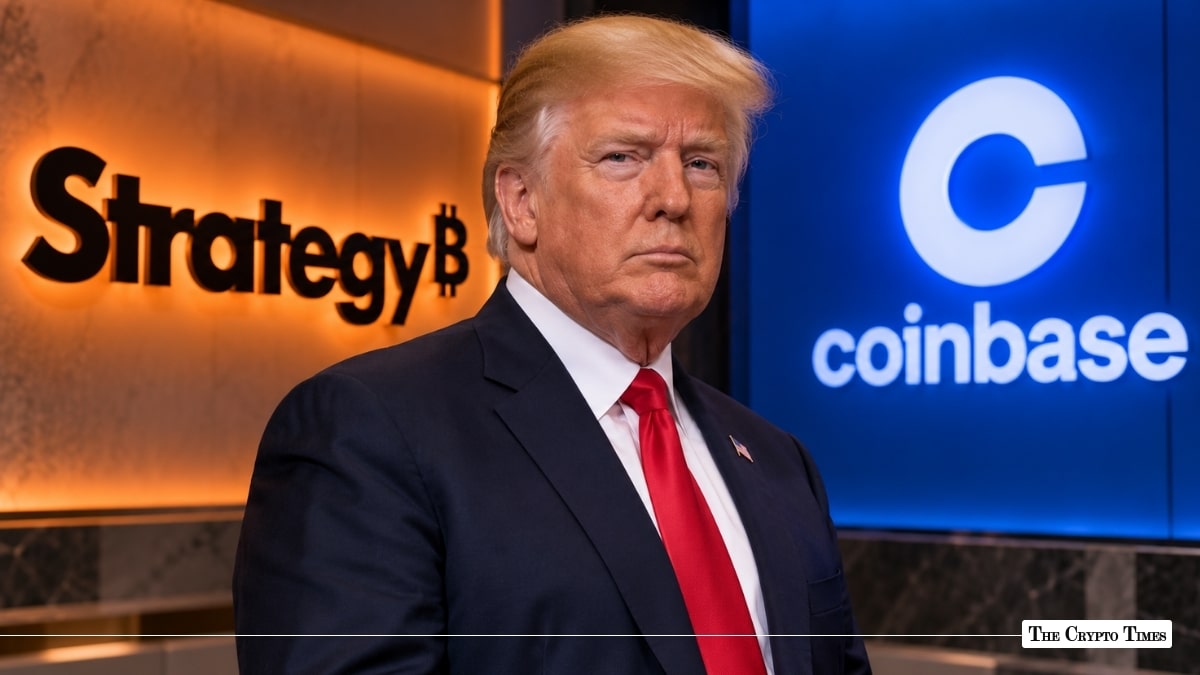
President Donald J. Trump’s latest OGE Form 278-T periodic transaction report, received by the U.S. Office of Government Ethics on September 14, 2026, lists several securities trades executed in July on behalf of his accounts.
The 37-page filing discloses purchases of Strategy Class A shares (MSTR) and Coinbase Global Inc. Class A stock (COIN), along with sales of shares in two Bitcoin mining companies.
The report is a required public financial disclosure under the Ethics in Government Act and the STOCK Act. It records purchases, sales, or exchanges of securities valued above $1,000 that occurred on behalf of the filer, a spouse, or a dependent child. Amounts appear only in statutory ranges rather than exact figures.
July Transactions Listed in the Filing
According to the periodic transaction report, accounts associated with Trump purchased Strategy Class A shares in two July transactions: one in the $1,001–$15,000 range on July 24 and another in the $50,001–$100,000 range on July 27. Combined, those two purchases reach a maximum reported value of $115,000. The same filing also records an earlier sale of Strategy Class A shares in the $1,001–$15,000 range on July 8.
On July 24 the accounts purchased Coinbase Global Inc. Class A shares in the $1,001–$15,000 range. On July 29 the accounts sold shares of MARA Holdings and CleanSpark, each in the $15,001–$50,000 range.
Strategy, formerly known as MicroStrategy, is a publicly traded software company that has accumulated a large Bitcoin treasury. Coinbase operates a major U.S. cryptocurrency exchange. MARA Holdings and CleanSpark are among the larger publicly listed Bitcoin miners. The filing itself does not explain the rationale for any individual trade or identify which specific brokerage account executed it.
The document covers a broader set of July activity that includes municipal bonds, corporate notes, and other equities. Crypto-linked names represent a small portion of the listed transactions. Readers can review the complete itemized list in the official PDF posted by the Office of Government Ethics.
How the Accounts Are Structured
The White House public disclosures page publishes the president’s periodic transaction reports alongside annual filings. The OGE Form 278-T does not name the investment managers or describe the decision-making process for any given trade. It simply records that the transactions occurred on behalf of the filer.
In prior statements the Trump Organization has said the relevant stock-and-bond holdings sit in fully discretionary accounts overseen by independent third-party financial institutions. Those firms, according to the organization, hold sole authority over asset allocation, trading, and rebalancing and do not accept direction from the president or his family. The latest OGE filing neither confirms nor contradicts that description; it is limited to the statutory transaction data.
Federal ethics rules require timely reporting of covered trades so the public can see potential conflicts. The form uses value bands precisely to balance transparency with personal financial privacy. Because the bands are wide, the exact size of any position cannot be determined from the document alone.
Strategy’s most recent company filings show it held 846,000 Bitcoin as of mid-September. That treasury position is the primary reason market participants treat MSTR shares as a leveraged proxy for Bitcoin price moves.
Coinbase’s results remain tied to trading volume and regulatory developments affecting U.S. digital-asset markets. The July sales of the two mining stocks reduced exposure to companies whose revenues depend more directly on hash-rate economics and energy costs.
The September 2026 disclosure adds one more data point to a year of frequent reporting. Earlier 278-T filings covering the first half of 2026 already documented thousands of individual trades across many sectors.
Also read: Robinhood CEO Tenev Sells $32.5M of HOOD Stock as His Third 2026 Disposal