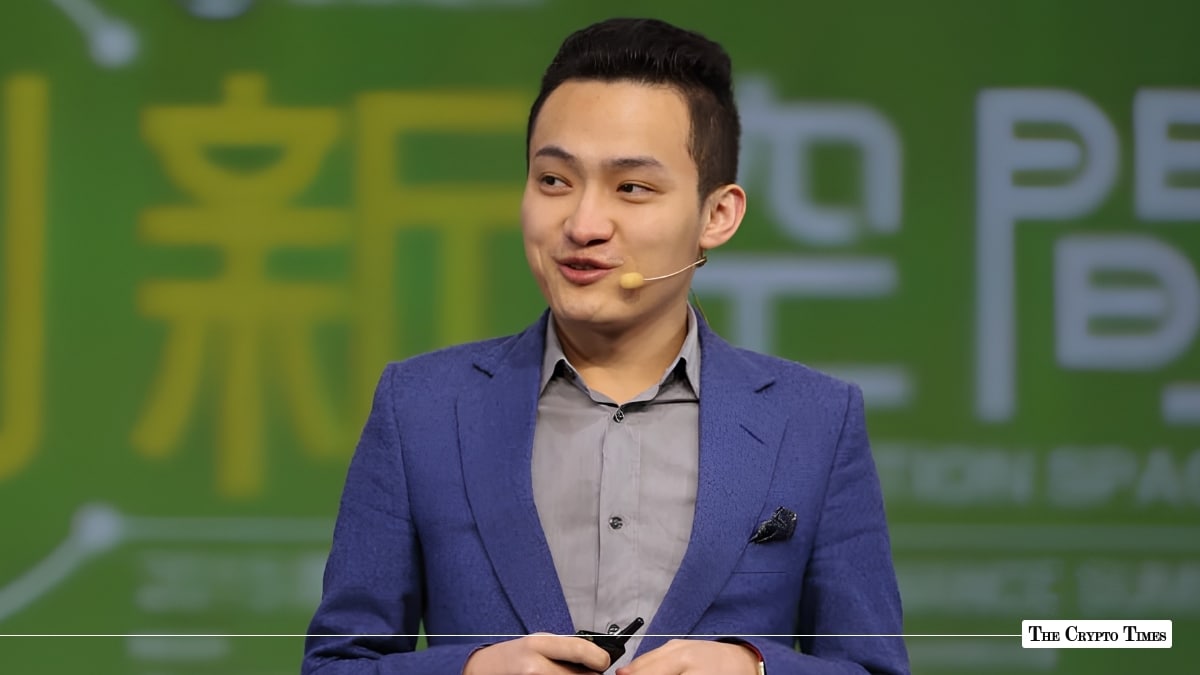
TRON founder Justin Sun on Tuesday morning published a sequence of posts on X arguing that a crypto founder’s personal fortune is the wrong question, listed four on-chain and exchange metrics as his substitute answer, and closed the thread with an open letter to Chinese commentator Hu Xijin that generalized his ongoing bride-price lawsuit against actress Jing Tian into a debate on marriage costs and birth rates in China.
The reserves thread and the letter landed within roughly two and a half hours of each other, while a wallet attributed to Sun by on-chain monitors submitted a fresh Lido redemption in the same window. Sun did not disclose a dollar figure for his personal wealth in any of the posts.
The Four Metrics Sun Cited Instead of a Wealth Number
At 05:25 GMT, on September 1, 2026, Sun quoted a TRONSCAN post and wrote only that TRON had passed 401 million total accounts, a figure confirmed by TRON DAO in materials from its Bitcoin Asia 2026 appearance a day earlier. He returned at 07:29 GMT with the central statement: people had recently been asking how much money he has, but his personal wealth “has never been what this industry should care about,” and he did not intend to answer that question with a number.
In place of a figure, he listed four items he said were what “the chain says.” First, HTX proof of reserves, which the exchange has published on a monthly Merkle Tree basis for 44 consecutive months as of its most recent June 2026 update, with reserve ratios for BTC, ETH, TRX and stablecoins above 100%. Second, more than $94 billion of USDT is circulating on the TRON network, a figure that matches the supply disclosure on Tether’s official transparency page and Sun’s own remarks at Bitcoin Asia 2026.
Third, about $9 billion of WBTC on-chain reserves against roughly 116,499 WBTC in circulation, according to the WBTC transparency dashboard, backed 1:1 to Bitcoin held by the WBTC custodians. Fourth, about $1.5 billion of USDD in circulation, checkable on-chain, with the TRON DAO Reserve stablecoin sitting near 1.499 billion tokens on its official dashboard.
Sun added that his operating principle had not changed, that he stood by “root in the internet” and instant deposits and withdrawals, and closed the post with “As for me personally, I’m fine. Thanks for the concern.”
Five Minutes Later: DeFi as an Ideology
Five minutes after the reserves post, Sun quoted his own tweet and wrote that the essence of decentralised finance is a system that does not depend on any person or institution and runs on mathematics and cryptography.
He said Bitcoin was designed that way from the first day and that public ledgers, verifiable reserves and anytime redemption are “steps toward that direction.” He called that his “ultimate goal” and “original intention.”
“Not Negligence, a Choice”: The Case Against Cashing Out
At 07:45 GMT Sun addressed why the vast majority of his personal assets remain in crypto after fourteen years in the industry. He described the concentration as “not negligence, a choice,” said he entered the sector because he believes crypto is “the most promising category of human financial assets,” and argued that “cashing out” of the asset a holder considers the best is internally inconsistent.
He cited holders who did not sell early Tesla in 2012, early Bitcoin, Nvidia in 2016 and memory chips in 2024. He said he understood the advice to rotate into houses, stocks and cash but did not accept the logic, and that he was not advising anyone to copy him.
The 20% and 30% Haircut He Agrees With, Then Inverts
At 07:50 GMT, Sun turned to wealth rankings. He said Bloomberg and Forbes apply a 20% or 30% haircut to his crypto assets when they estimate his fortune, and that he understands the method as a way to handle concentration, volatility and assets that do not count as “certain” under their standards. “That is their methodology, and it has nothing to do with me,” he wrote, before inverting the discount.
The portion the wealth trackers discount, he said, is where his entire judgment sits. “They see risk; I see opportunity.” Forbes currently pegs Sun’s net worth at about $8.5 billion and lists him as the world’s 411th richest person as of April 2026.
The Open Letter to Hu Xijin, and the Numbers Behind It
At 08:07 GMT on Sunday, Sun published a separate post titled “To Teacher Hu Xijin”, replying to recent criticism from the former Global Times editor. Engagement on that post ran well ahead of the reserves thread within hours.
Sun opened by placing himself in demographic terms: born in 1990, aged 36, in the “marriage and childbearing” cohort of 200 million Chinese men aged 20 to 40. He listed questions he said he could not answer on his own, including whether a Chinese man should pay a high bride price, whether it should be a fixed sum or a share of assets, whether he could recover the money in court if the woman leaves after unmet demands, and whether he had the right to state his view in public after “a long breakup, unreturned money, and a person who cannot be found.”
He said he would “unconditionally respect” a final court judgment on bride price and separated paper rules from the “rules at the dinner table,” writing that a bride price “will be paid anyway” and that the difference across the country is 30,000, 300,000, 3 million or 30 million yuan.
The Lawsuit That Sits Behind the Letter
Sun’s letter is inseparable from the civil suit he filed earlier this year. His lawyer Zhang Qihuai confirmed on August 27 that Sun had sued actress Jing Tian and her parents over a bride-price dispute exceeding 30 million yuan (about $4.5 million), with the Xi’an Yanta District People’s Court accepting the case and a property preservation application.
That confirmation followed a viral essay Sun posted the same day titled “My Girlfriend Jing Tian,” labelled “purely fictional” at both ends, in which he recounted a proposal on a Maldives island, a 30 million yuan transfer to the actress’s parents, and a subsequent request for surrogacy funding. Jing Tian’s studio has said the matter will be settled through legal channels and pushed back on what it called an effort to pressure the actress through publicity.
Hu Xijin had earlier accused Sun of publicising private relationship material while a court case was pending. Sun’s Tuesday letter did not add new evidence to the case and did not name Jing Tian.
Sun then anchored the argument in births. More than 23 million newborns in 1990, the year he was born, versus 7.92 million in 2025, the lowest annual total in decades according to China’s National Bureau of Statistics data. The crude birth rate was 5.63 per 1,000, and natural growth was minus 2.41 per 1,000. A late August National Health Commission bulletin repeated the figure. He did not blame the whole decline on bride price accounting. Among the missing two-thirds, he said, many are not unwilling; they cannot see what the path costs or whether payment will count.
The On-Chain Move Sun Did Not Mention
Sun did not reference Ethereum in any of Tuesday’s posts. On-chain analyst Ai Yi reported that the address 0x176F..d0a132 linked to Sun submitted a request to unlock 5,000 ETH from Lido, worth about $12.3 million at execution time, in the first large unstake from the cluster since July 18, 2025.
Remaining on-chain ETH attributed to the wallet cluster stood above 243,000 ETH after the redemption, keeping Sun’s identifiable Ethereum position ahead of the Ethereum Foundation on public trackers. Destination and intent were not addressed by Sun in either thread.
The ETH activity comes after a series of similar moves this year and against a wider backdrop in which the same account has recently addressed a DDoS incident at HTX and issued a zero-tolerance fraud warning after the US SEC dismissed its long-running case against him in March.
What the Four Figures Do and Do Not Answer
The four metrics Sun offered as substitutes for a personal wealth number describe network float, exchange coverage and stablecoin backing, not a personal balance sheet. USDT on TRON is a network circulating-supply statistic and does not measure Sun’s holdings.
WBTC’s roughly $9 billion in reserves is a global figure for the WBTC system rather than a TRON-specific or Sun-owned reserve. USDD’s $1.5 billion in circulation is a protocol supply managed by the TRON DAO Reserve. HTX’s Merkle Tree proof of reserves shows platform coverage of user balances, not equity in the exchange or any individual account.
The gap is where the wealth trackers work. Forbes and Bloomberg have historically applied liquidity discounts to Sun’s TRX holdings precisely because a controlling holder cannot exit at the last print, an accounting choice Sun explicitly acknowledged in the 07:50 GMT post and rejected as a reason to sell. On the same day, an on-chain wallet attributed to him nevertheless moved ETH.
Also Read: Arbitrator Clears Gemini Over Earn Collapse, but Interest Claims Remain Open