
Key Highlights
- Compound is setting the supply cap to zero for ezETH, pufETH, rETH, and tETH across seven collateral listings.
- The change follows a recommendation from risk manager Gauntlet, citing low demand and elevated risks associated with LST/LRT assets.
- The caps take effect September 1 on Ethereum and September 3 on Base, Arbitrum, and Optimism.
Compound governance, a decentralized system, is implementing a recommendation from risk manager Gauntlet to set the supply cap to zero for seven collateral listings across the ETH-denominated Compound V3 comets.
In an official announcement on August 22, the change applies to markets on Ethereum, Base, Arbitrum, and Optimism. The supply caps take effect on September 1 for Mainnet and September 3 for the Layer 2 networks.
The seven listings cover four liquid-staking and liquid-restaking tokens: ezETH, pufETH, rETH and tETH. Each of the affected positions currently holds under $500,000 of collateral in the relevant comet.
A zero supply cap prevents new deposits of these assets. It does not trigger forced liquidations, alter collateral factors, or place any limits on withdrawals or repayments. Existing positions remain fully functional, and users may exit at any time.
Collateral exposure and scope
Aggregate collateral across the seven listings stands at $1,592,357 against a combined previous supply cap of $4,832,946. This represents under 1.5 percent of the $109.0 million of total collateral held across the ETH comets. The median position size is $204,801, with the largest single listing at $414,807.
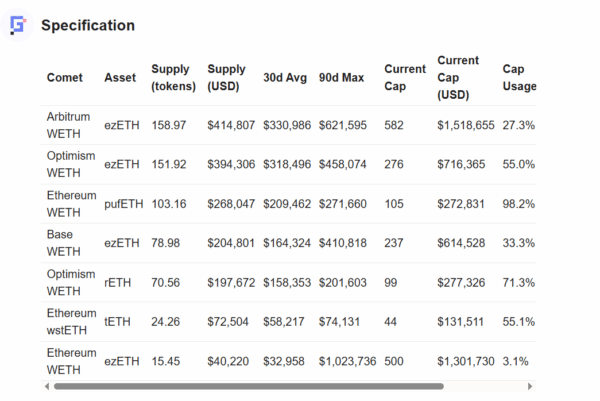
Gauntlet’s recommendation applies a uniform rule: any collateral listing with current supply below $500,000 and a positive supply cap receives a recommended cap of zero. The threshold is described as a coarse floor below which a listing is judged not to cover its associated risk and operational costs.
Stated rationale by Gauntlet
Gauntlet cited low borrower demand for these listings and the elevated parameter risk that liquid-staking and liquid-restaking tokens carry relative to the deposits they attract. Exchange-rate and oracle mechanics for these assets depend on withdrawal queues, restaking layers and, in several cases, rates that can move in only one direction until an unbonding period ends. Such feeds are identified as those most likely to stall or misprice under stress.
Secondary-market liquidity for the assets is described as thin relative to their ETH-equivalent size, particularly at moments when a liquidator would require it. Duplication is also noted: ezETH appears in four separate ETH comets, supporting $1,054,134 of collateral against $4,151,278 of combined caps and requiring four distinct oracle configurations, collateral-factor settings and monitoring surfaces. Risk-parameter reviews, liquidity monitoring and incident response scale with the number of listings rather than total value locked.
High utilisation percentages recorded for pufETH (98.2 percent) and rETH (71.3 percent) are attributed to the low absolute size of the existing caps rather than to sustained demand. Those listings have remained near their ceilings at immaterial sizes for several months.
Operational effects
Gauntlet said zeroing the caps reduces the need to support seven low-use price-feed configurations across four chains and eliminates further growth in the duplicated ezETH listings. Liquidation processes remain intact; absorbed collateral can still be purchased through the buyCollateral function. Borrowers who wish to maintain exposure to liquid-staking or liquid-restaking tokens retain access to deeper listings still active in each comet.
Users holding positions in the affected assets cannot add further amounts of the same collateral to the same comet. If the asset price declines, they must repay debt, supply different eligible collateral, or face liquidation under the existing rules. Given the aggregate exposure of $1.59 million, the assessment of user impact is limited.
Governance discussion adds nuance
Not everyone in the governance discussion framed all seven listings the same way. On September 1, DAOplomats said pufETH’s 98.2% cap usage may not reflect sustained user demand, noting that its 90-day maximum matched the current level, suggesting the cap may have simply filled once. At the same time, the delegate argued ezETH may be the more debatable case, with about $1.05 million spread across four comets, and said those listings could still serve a role if Compound V3 is meant to absorb demand ahead of isolated V4 markets.
DAOplomats also backed the idea of a clearer offboarding framework for low-TVL listings, including a rule that could allow zero-cap actions after two quarters below a set floor. However, the delegate said the floor itself should still be approved through governance rather than left to case-by-case administrative judgment.
Recent organisational context
On August 18, Compound announced a new leadership team and a $52 million DAO-approved development program. Aaron Schnarch joined as executive director. Christopher Donovan was appointed chief operating officer, Steven Liu chief product officer, and Leo Eikelman chief technology officer.
The development program is directed at institutional credit infrastructure on-chain and includes a product roadmap covering native real-world asset support, capital-efficiency features, and integration tooling.
The supply-cap adjustment for the seven LST and LRT listings proceeds under the existing governance and risk framework of the protocol.
Also Read: Grayscale Warns AI Could Raise Demand for Crypto Privacy