
Cango Inc. (NYSE: CANG), the NYSE-listed Bitcoin miner headquartered in Dallas, reported its second-quarter 2026 results after the U.S. market close on Monday, August 31, 2026, disclosing a net loss of $81.6 million on revenue of $50.8 million.
The headline figures are unflattering on their own, but the more revealing story sits below them: Cango is one of the few publicly traded miners actively reducing its hashrate on purpose, and its balance sheet has compressed by roughly 74% over six months as the company rewires itself around unit economics rather than scale.
According to the company’s earnings release furnished to the U.S. Securities and Exchange Commission (SEC) on August 31, 2026, total revenue of $50.8 million fell approximately 50% sequentially from the first quarter, with $47.4 million attributable to Bitcoin mining and $3.4 million to other revenues.
The reported net loss of $81.6 million narrowed sharply from the $261.1 million loss recorded in the first quarter of 2026, with the improvement driven mainly by lower non-cash impairment charges and a much smaller fair-value swing on crypto assets. Adjusted EBITDA was a loss of $10.7 million, compared with a loss of $154.1 million in the first quarter of 2026.
The details behind the loss remain unclear. Within total operating costs and expenses of $131.4 million, the two dominant non-cash items were an impairment loss from mining machines of $42.9 million and a loss on disposal of mining machines of $8.5 million, both tied to the phase-out of older S19-class hardware.
The loss from changes in fair value of crypto assets narrowed to $4.1 million from $151.8 million in the first quarter of 2026, which the company attributed to the stabilisation of spot Bitcoin during the quarter and the initial impact of a newly launched hedging programme.
A miner shrinking on purpose
Total operating hashrate stood at 27.58 EH/s as of June 30, 2026, comprising 19.84 EH/s of self-mining capacity and 7.74 EH/s of leased hashrate capacity. The company mined 656 Bitcoins during the quarter at an average cash cost of $73,313 per coin, a sequential decline of approximately 5%.
For peer context, the CoinShares Q1 2026 mining report pegged the weighted average cash cost to produce one bitcoin among publicly listed miners at approximately $79,995 in Q4 2025, meaning Cango’s Q2 unit cost sits below the last-reported peer group average, though it remained within Bitcoin’s June-quarter spot range.
The company’s own language explains the top-line compression. Cango describes the drop as reflecting “the Company’s proactive reduction of operating hashrate as it phased out older, less efficient S19 series mining machines and transitioned some capacity to a hosted leasing model”. That places Cango in a distinct minority relative to the wider publicly listed mining cohort pivoting into AI, most of which have either continued expanding hashrate or leaned on secured AI/HPC contracts to justify their equity multiples.
Balance sheet compression is the real story
The most striking data point does not appear on the income statement. Total assets fell from $1,132,985,333 as of December 31, 2025 to $294,385,232 as of June 30, 2026, a contraction of roughly 74%.
Over the same period, long-term debts (related party) dropped from $557,567,671 to $31,227,904, and mining machines, net, were marked down from $248,745,505 to $58,699,566. Cash and cash equivalents came in at $10.1 million, compared with $7.2 million as of March 31, 2026, and the company held 1,056 BTC in treasury.
Chief Financial Officer Simon Tang confirmed in the company’s press release, issued at 17:00 Eastern Time on August 31, 2026, that during the quarter the company “launched a Bitcoin hedging program designed to manage our exposure to Bitcoin price volatility and enhance the predictability of operating cash flows”, adding that it will be used “strictly as a risk management tool, not for speculative purposes”.
The related short-term positions show up on the balance sheet as short-term debts of $8,032,711 and cryptocurrencies of $12,892,900, both new relative to year-end 2025.
On the diversification front, CEO Paul Yu said the company’s “Georgia site completed conversion in early July, and the infrastructure is now capable of supporting up to 3 megawatts, with scope for future expansion”, with revenue from its AI compute onboarding “expected to be recognized in the third quarter”.
In absolute terms, 3 MW is a very small AI footprint against the multi-hundred-megawatt HPC campuses several peer miners have contracted, which is why the more informative comparison for CANG at present is not with the AI-heavy names but with pure-play miners still working through legacy fleet write-downs, a pattern also visible in other recent quarterly reports across the mining cohort.
Market reaction: rally into the print, sell-off after
Cango Inc. (CANG) shares closed the regular session at $2.39, up 7.17% on the day, at 4:04:26 PM EDT on Monday, August 31, 2026, per intraday data from Yahoo Finance. The earnings release crossed the wire at 5:00 PM Eastern Time, after the closing bell.
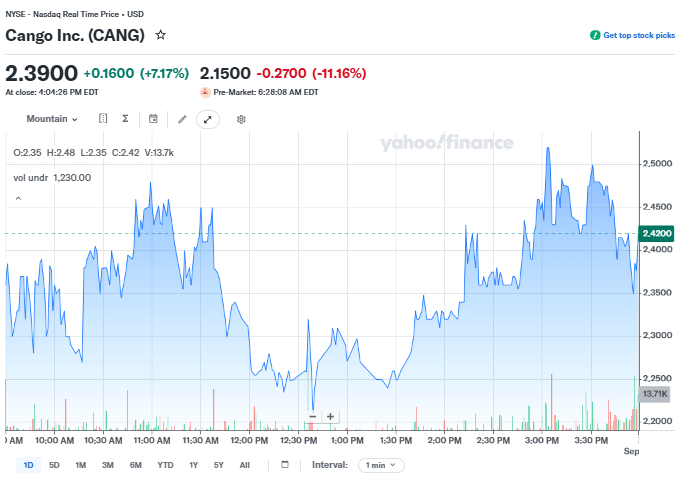
By 6:28:08 AM EDT on Tuesday, September 1, 2026, CANG was quoted at $2.15 in pre-market trading, a decline of 11.16%, at the time of writing, from the prior close, reversing the entire regular-session gain and then some.
The analyst read
Cango’s Q2 print does two things at once. It confirms that the impairment cycle in the Bitcoin mining sector is still working through balance sheets several quarters after the initial write-down wave, and it places Cango in an unusual strategic position: a mid-tier miner (approximately 2.7% of an approximately 1,020 EH/s network per the most recent CoinShares data) that has chosen to prioritise cash cost per Bitcoin and a lighter capital structure over the AI/HPC growth premium other listed miners are chasing.
Whether that discipline is rewarded by the market will depend less on the pace of the Georgia buildout and more on where Bitcoin spot and hash price settle over the second half of 2026.
Also Read: NVIDIA Posts $96.2B Q2 Revenue, Guides $108B Q3 as Bitcoin Miners Pivot to AI