
Polygon’s native token is trading sharply lower on Thursday, giving back part of the gains from a summer rally that had lifted the asset by roughly three quarters off its June low.
The move runs against a mostly flat Bitcoin tape and coincides with a wider cooling in altcoin momentum, pointing to positioning and rotation rather than a coin-specific catalyst as the immediate driver.
At 06:30 AM UTC August 27, POL changes hands near $0.1053, down about 13.26% over the past 24 hours.
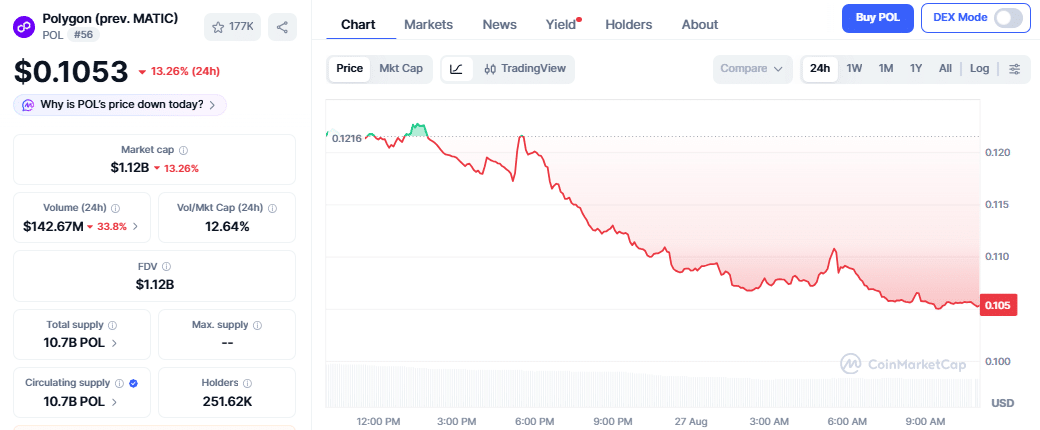
Market capitalization stands at $1.12 billion, with 24-hour spot volume declining 33.8% to $142.67 million and a volume-to-market-cap ratio of 12.64%. Circulating and total supply are both listed at 10.7 billion POL, and the holder count sits at 251,620 addresses.
Altcoin rotation is doing most of the work
The most visible driver of the pullback is a broader rotation out of altcoins. The CMC Altcoin Season Index has drifted lower over the past month to a reading in the high thirties, well inside “Bitcoin Season” territory, which corresponds to fewer than half of the top 100 altcoins outperforming Bitcoin over the trailing 90 days.
Bitcoin dominance itself sits near 59.7%, and Bitcoin is holding a tight band around the $79,000 area at the time of publishing after briefly probing above $80,000 earlier in the week. When BTC consolidates after a leg higher, high beta names that have already run tend to see the first outflows, and POL fits that profile after climbing roughly 75% from its June basing zone.
Broader risk appetite has not collapsed. The Crypto Fear and Greed reading of 79 remains firmly in “extreme greed” territory, which is consistent with a market that is still constructive at the index level but selective within the altcoin complex.
POL fails to hold $0.125 as intraday volume drops 34%
On the daily chart, POL had been probing the $0.125 area for several sessions before this week’s retrace. That level has repeatedly acted as supply during earlier attempts to reclaim higher ground, and the failure to close through it left the token exposed to a mean reversion move once the underlying flow softened.
The intraday tape (see chart above) shows the token peaking near $0.122 during the U.S. morning on Wednesday before rolling over through the New York afternoon, with the sharpest leg lower unfolding between 4 PM and 8 PM UTC. Price stabilized in the $0.104 to $0.106 zone during the Asian session on Thursday.
The 34% drop in 24-hour turnover alongside the decline is worth flagging. Falling volume on a down move is more consistent with buyers stepping away than with aggressive distribution, which supports the profit-taking interpretation over a fundamental break.
Near term, the technical map is straightforward. The $0.10 handle is the first line of defense. A clean break below would open the door toward the $0.095 shelf that acted as support during the June bottoming pattern. On the upside, reclaiming the $0.115 level would be the first sign that dip buyers are absorbing supply, with $0.125 still capping the range above.
Fee redirection proposal keeps a floor under the fundamentals story
Off the tape, Polygon has been in the news for a different reason. On August 23, Polygon co-founder Sandeep Nailwal outlined a proposal that would direct transaction priority fees on Polygon PoS to POL stakers, a change he has said could roughly double staking yields relative to the current inflation-funded rate.
The design is intended to introduce native, L1-style staking on the PoS chain and would pull the additional yield from actual network fees rather than fresh token emissions.
The proposal builds on the framework established by PIP-85 earlier this year and follows the April rollout of sPOL, Polygon’s native liquid staking token, which was designed to unlock roughly $330 million in idle staked capital for use across DeFi. Nailwal has also said that Polygon’s network revenue has grown roughly tenfold this year, with block times cut by around 25% and throughput near 5,000 transactions per second.
The tokenomics push also arrives against a difficult backdrop for POL earlier in the summer. Community members openly questioned the Polygon Foundation’s accountability to token holders in July, citing a widening gap between the network’s usage growth and the token’s market performance, while Polygon Labs announced a round of layoffs ahead of its Coinme integration in mid-July. The August staking proposal has since been read by parts of the market as an attempt to reconnect network revenue with token value.
Whether these changes translate into sustained token demand will depend on execution and on how much of the incremental yield is captured by stakers versus validators. The structural direction, however, is toward a more usage-linked value accrual model for POL, and any meaningful pickup in staked supply would tighten circulating float over time.
Key POL price levels to watch next
Three variables dominate the near-term setup. Whether POL defends the $0.10 support through the daily close, whether Bitcoin holds above the $78,000 area, and whether the Altcoin Season Index begins to base or continues its slide.
A defended $0.10 level combined with a stable BTC tape would keep an eventual retest of $0.125 on the table. A loss of $0.10 in tandem with weakness in Bitcoin would shift focus to $0.095, and beyond that to the June range lows.
For now, the balance of evidence points to a technical shakeout inside a larger recovery structure rather than a fundamental deterioration, though positioning has been stretched enough that a deeper flush cannot be ruled out.
Also Read: Bitcoin and Crypto Stocks Slide After Hot PCE Data