
Key Highlights
- Bitcoin has rallied roughly 22% from its mid-August levels and moved close to the $80,000 resistance after reclaiming $64,000 last week.
- Coin-denominated open interest fell about 11% during the rally, while options traders increasingly paid a premium for upside exposure.
- Ryan Lee, Chief Analyst at Bitget Research, expects a sustained breakout above $80,000 to open the 82,000–87,000 range, while 75,000–76,000 remains the main pullback zone.
Bitcoin (BTC) is approaching the $80,000 mark after one of its strongest rallies this summer, with the price rising roughly 22% from around $63,500 during the August 12–18 period to nearly $78,000 by the weekend.
The rebound gathered momentum after Bitcoin swept lows near $62,700, reclaimed $64,000 and rapidly moved through the $70,000 level. BTC later approached $80,000 before pulling back slightly, leaving traders focused on whether the August rally has enough spot demand to break the resistance.
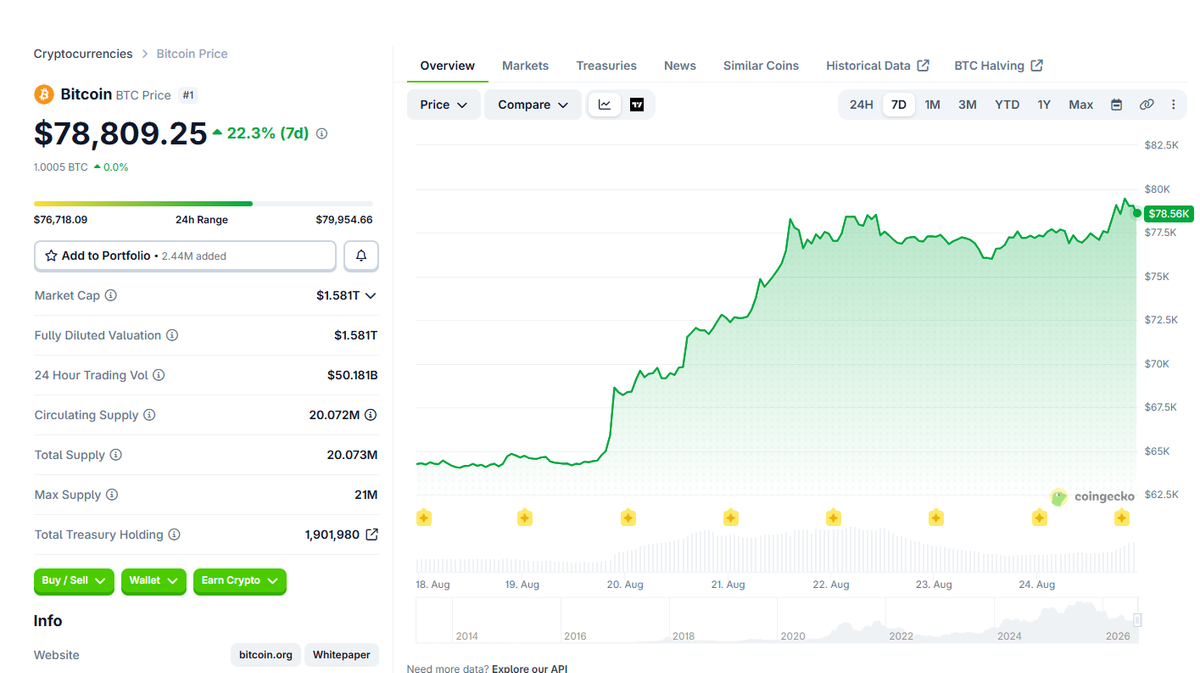
Several market indicators support another attempt. Bitcoin has climbed while coin-denominated futures leverage declined, U.S. spot Bitcoin ETF demand returned, and options traders increasingly positioned for further upside.
However, the rally also received support from short liquidations. Bitcoin now needs fresh buying to replace that forced demand if it is to establish itself above $80,000.
Bitcoin Rallied 22%, But Leverage Fell
Bitcoin’s latest rally differs from moves driven primarily by traders aggressively increasing leveraged positions.
Santiment data show that BTC averaged about $63,500 between August 12 and August 18 before climbing to approximately $77,700 on August 23.
Over the same period, coin-denominated open interest fell from about 353,500 BTC to 312,600 BTC, a decline of roughly 11% and the lowest level in at least a month.
Dollar-denominated open interest increased about 8%, but that increase largely reflected Bitcoin’s rising price rather than an expansion in the number of BTC contracts.
The divergence indicates that Bitcoin gained roughly 22% while the amount of outstanding leverage measured in BTC declined.
That reduces the risk that the entire rally depends on increasingly crowded futures positions. Short positions were liquidated as BTC moved higher, but traders did not replace them with an equally large buildup of new leveraged exposure.
A rally supported by price appreciation while coin-denominated leverage declines generally leaves fewer leveraged positions vulnerable to a sudden liquidation cascade if volatility increases.
Bitcoin Options Traders Position for More Upside
Options markets are also showing stronger expectations for another move higher as Glassnode data show that 25-delta call volatility is now outpacing put volatility across every tracked maturity following the breakout.
Bitcoin’s options skew has fallen to its lowest level of the year across the curve, while the front-end skew has turned negative.
The shift means traders are paying a higher premium for calls relative to comparable puts, indicating stronger demand for upside exposure.
The change is most aggressive in short-dated contracts. One-week positioning shows a particularly large decline in the premium previously attached to downside protection, while longer-dated maturities have also moved toward calls.
The options market is therefore pricing a greater probability of additional upside even as Bitcoin trades near a major resistance area.
This positioning does not guarantee a breakout, but it shows that derivatives traders are no longer primarily paying to protect against another decline. Demand has increasingly shifted toward exposure to a continuation of the rally.
ETF Demand Could Decide the $80,000 Breakout
The more important test now comes from the spot market.
Ryan Lee, Chief Analyst at Bitget Research, said to The Crypto Times that, Bitcoin’s roughly 23% weekly rebound followed months of subdued trading activity and accelerated as returning spot demand combined with forced short covering.
U.S. spot Bitcoin ETFs recorded $517 million in net inflows on August 19, according to Lee, marking their strongest daily inflow since early May.
That institutional demand becomes increasingly important as the effects of the short squeeze fade.
“The test now is whether spot demand can take over from the short squeeze,” Lee said.
Bitcoin can move rapidly when short sellers are forced to buy back positions, but those liquidations provide temporary demand. Once the most vulnerable positions have been cleared, continued price appreciation requires buyers willing to purchase BTC near progressively higher prices.
ETF flows will therefore provide one of the clearest signals of whether institutional demand remains strong as Bitcoin approaches $80,000.
If inflows remain positive while BTC holds above the breakout area, the rally would have a stronger spot-market foundation than one sustained primarily through derivatives liquidations.
$80,000 Becomes Bitcoin’s Major August Test
Bitcoin has already moved into the 78,500–80,000 resistance zone identified by Lee, making the next move increasingly important for the August trend.
Lee expects Bitcoin to trade broadly between $74,000 and $81,000 in the near term, reflecting the possibility of consolidation after the rapid repricing.
A sustained break above $80,000, supported by continued ETF inflows, could indicate that market positioning has shifted beyond short covering and open the 82,000–87,000 range.
Bitcoin would first need to establish acceptance above $80,000 rather than briefly trading through the psychological level before reversing.
Continued spot ETF inflows, stable or declining coin-denominated leverage and sustained demand for upside options would strengthen the breakout case.
The structure would weaken if Bitcoin repeatedly fails near $80,000 while ETF demand slows and price begins returning toward last week’s breakout levels.
What Happens if Bitcoin Fails at $80K?
A pullback would not immediately invalidate the August rally after Bitcoin gained more than 20% in a matter of days.
Lee sees 75,000–76,000 as a reasonable profit-taking area following the rapid advance.
That range could become the first major test of whether buyers who missed the initial rally are willing to enter on weakness.
Holding the 75,000–76,000 region would allow BTC to consolidate while preserving much of its recent breakout. A recovery from that area could produce another attempt at $80,000.
A sustained decline below $74,000 would create a weaker setup because Bitcoin would fall outside the lower end of Lee’s expected near-term range. It would also suggest that demand weakened considerably once forced short covering subsided.
The distinction between a controlled pullback and a deeper reversal will depend heavily on whether spot buyers remain active during any decline.
Can Bitcoin Price Break $80,000 in August?
Bitcoin currently has a stronger setup for testing $80,000 than it did earlier in August because the rally is being accompanied by several constructive market signals.
Coin-denominated futures open interest has declined despite the sharp price increase, reducing evidence of excessive leverage. Options traders are paying more for upside exposure, while returning ETF inflows provide a potential source of sustained spot demand.
The biggest uncertainty is how much of the initial move resulted from short covering.
If ETF inflows continue after forced liquidations fade, a sustained move above $80,000 could shift attention toward Ryan Lee’s 82,000–87,000 upside range.
If institutional buying slows near resistance, Bitcoin could instead consolidate toward 75,000–76,000 before attempting another breakout.
The $80,000 level will therefore test more than Bitcoin’s ability to extend its August gains. It will show whether the rally can transition from a rapid repricing driven partly by liquidations into a move supported by continuing spot demand.