Key Highlights
- Virtuals Protocol has launched its AI-agent tokenization system on Solana.
- Agents can be linked to tradable tokens and wallets that support payments and onchain transactions.
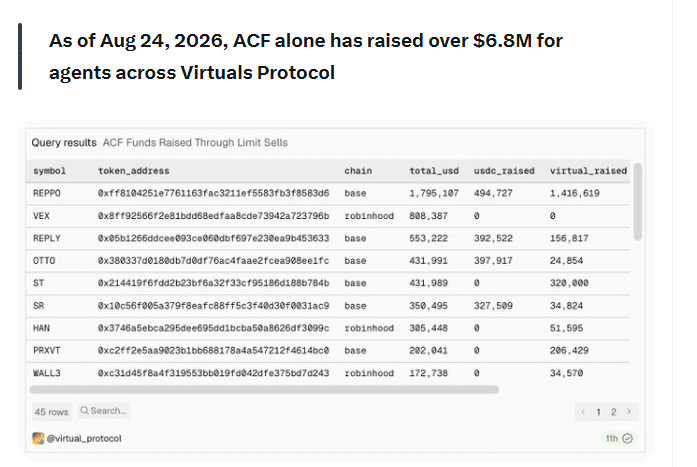
- Virtuals says its Automated Capital Formation system has raised more than $6.8 million for agents.
Virtuals Protocol has expanded its AI-agent tokenization system to Solana, combining AI software with tradable tokens and blockchain-based wallets that can enable agents to participate directly in onchain transactions.
The system, announced on August 24, allows users to create tokens associated with AI agents and connect those agents to wallets and other onchain services.
Depending on how an agent is configured, it can potentially receive payments, pay for services, interact with other applications, and conduct transactions through its wallet.
The model also introduces questions beyond the underlying technology, including what token holders actually own, who controls an agent’s funds, and whether the agents can generate sustainable revenue beyond trading activity surrounding their tokens.
AI agents get a financial layer
Virtuals’ Economy OS provides infrastructure that can connect AI agents to operational and financial tools. An agent can potentially earn money by providing services, paying other agents, purchasing services, or interacting with blockchain applications. Its associated token provides a market for exposure to the agent’s ecosystem.
That differs from a conventional AI application, where software generally acts on behalf of a user without holding its own assets.
An agent token should not, however, automatically be treated as equivalent to ownership in a conventional company. The rights attached to each token depend on how the individual project structures its token economics. Holding a token may provide economic exposure without giving holders direct control over the agent, its wallet, intellectual property, or underlying business.
Agent tokens start with bonding-curve markets
On Solana, Virtuals is using Meteora’s Dynamic Bonding Curve (DBC) infrastructure for initial agent-token markets. Tokens begin trading through the bonding-curve system before moving to a public liquidity pool after reaching the required graduation threshold.
Virtuals also uses an Automated Capital Formation (ACF) mechanism designed to convert portions of an agent’s token allocation into stablecoins as its valuation rises.
The protocol said ACF had raised more than $6.8 million for agents as of August 24. That figure represents capital raised through the mechanism, rather than revenue generated by the AI agents themselves.
Control and security remain open questions
Giving an AI agent access to a wallet creates additional operational and security risks.
Developers determine what permissions an agent receives and what actions it can perform. Depending on the configuration, an autonomous system could potentially move funds or interact with contracts without a person approving every individual transaction.
This creates questions around security, liability, and accountability.
If an agent makes an erroneous transaction, suffers a security breach, or is manipulated through its underlying AI system, responsibility could be difficult to determine.
There is also a distinction between economic ownership and operational control. Token holders may have exposure to an agent’s market value while developers or other entities retain control over its wallet and software.
For now, the technology remains an early experiment rather than an established model for autonomous businesses.
Solana’s infrastructure adds to the experiment
The Virtuals rollout comes as Solana continues developing its infrastructure for financial and autonomous applications. The network is also testing changes to its governance and economic framework through proposals covering areas such as its constitution, token supply and fee structure.
Those proposals are separate from Virtuals’ agent-tokenization system, but Solana’s transaction costs, network economics and governance decisions can affect applications that depend on frequent onchain activity.
Virtuals’ Solana rollout is an early attempt to combine AI agents, programmable ownership and blockchain-based financial infrastructure. Whether the model develops into a category will depend less on launching agent tokens and more on whether these agents can build sustainable economic activity, attract users, and operate securely over time.
Also Read: Coinbase Launches Tokenized Shares on Base for Non-U.S. Users