Coinbase CEO Brian Armstrong said the United States is falling behind other major economies on cryptocurrency regulation, urging the Senate to pass the CLARITY Act when lawmakers return to the issue in September.
In a post on X on Saturday, Armstrong said most Group of 20 economies already have regulatory frameworks governing crypto trading, while the U.S. remains an outlier despite being the world’s largest financial market. “It’s time to pass Clarity in the Senate on Sep 15th!” he wrote.
His comments come as the market-structure bill faces a key legislative test and U.S. regulators prepare to advance their own approaches to digital-asset oversight if Congress does not act.
Armstrong points to G20 regulatory gap
Armstrong said the regulatory disparity has become more pronounced as other jurisdictions establish crypto-specific rules. He cited the United Kingdom’s recently introduced framework as an example, arguing that the U.S. should not remain without a comprehensive federal framework governing digital-asset markets.
The CLARITY Act, formally introduced as H.R. 3633, seeks to establish a framework for digital-asset markets and clarify the respective roles of the Securities and Exchange Commission (SEC) and Commodity Futures Trading Commission (CFTC).
The House passed its version of the legislation in July, but the bill still needs to clear the Senate and receive further consideration before it can become law.
CFTC prepares alternative regulatory route
Armstrong’s comments follow CFTC Chairman Michael Selig’s remarks at the agency’s inaugural Innovation Advisory Committee meeting on August 20. Selig said legislation remains his preferred route for establishing a federal crypto market structure. He also said the CFTC would consider using its existing authority if Congress does not pass legislation.
Selig said he had directed agency staff to explore a framework under which crypto exchanges could operate as a form of CFTC-regulated market and to examine ways for onchain finance developers to operate within a legal framework. The chairman said the agency would give Congress time to act on CLARITY while preparing regulatory measures that could be advanced under existing authority.
That approach would not replace legislation and could face legal and jurisdictional questions, particularly where the CFTC’s authority overlaps with that of the SEC.
Trump has made CLARITY a priority
The debate has also gained support from President Donald Trump, who called on Congress to pass the CLARITY Act during a White House meeting with crypto executives, financial-market leaders and regulators on August 19. “Now we need Congress to take the next step by passing the Clarity Act, a fair version of the Clarity Act,” Trump said at the meeting.
The gathering included executives from Coinbase, Ripple, Kraken, Gemini, Chainlink and other financial and crypto companies, along with SEC Chairman Paul Atkins and CFTC Chairman Selig. Trump has made establishing a U.S. digital-asset market structure a central part of his administration’s crypto policy, alongside measures including a strategic Bitcoin reserve and efforts to develop rules for stablecoins and tokenized financial markets.
Senate vote remains the key test
Armstrong’s comments come as attention turns to the Senate’s consideration of the legislation. He said in an earlier post that regulatory clarity could arrive through either congressional action or new rules from the SEC and CFTC, pointing to the September 15 legislative timetable and regulatory work expected around September 16.
The distinction matters because agency rules could be changed by future regulators, while legislation would establish statutory requirements for the agencies. Armstrong’s argument is therefore less about whether U.S. crypto regulation will change and more about which institution establishes the framework and how durable it will be.
Prediction market odds remain below 30%
A Polymarket contract tracking whether the CLARITY Act will become law by the end of 2026 was pricing the probability at about 29%, according to the market data provided (on August 22 at 1 AM IST). The implied probability had risen from roughly 18%-20% earlier in the week.
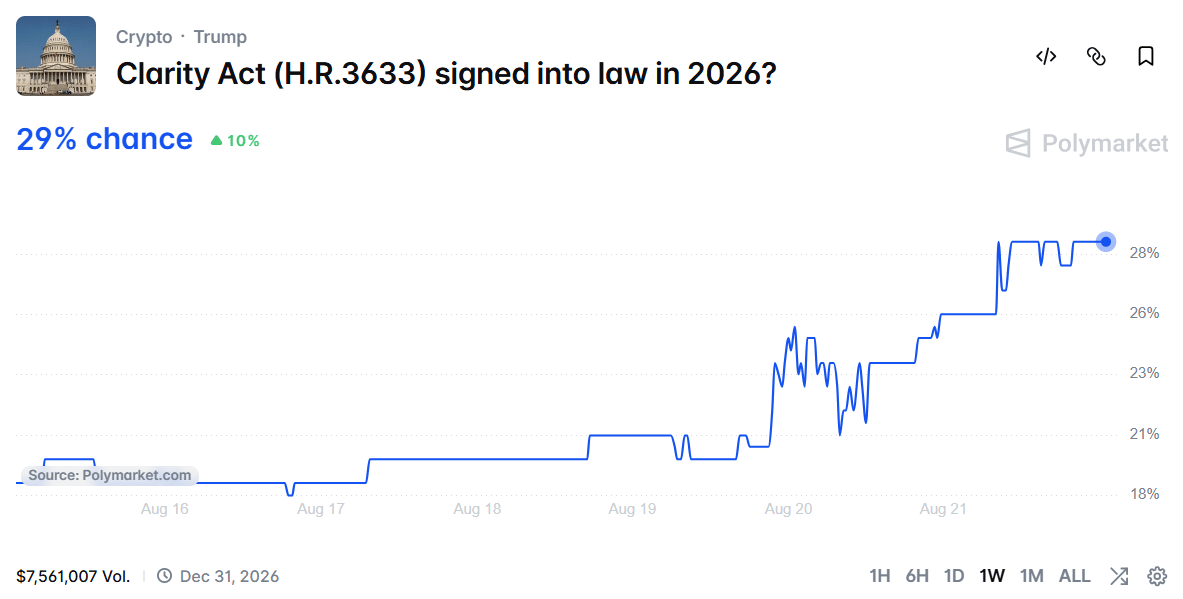
The contract had recorded about $7.56 million in trading volume.
Prediction-market odds do not establish the likelihood that legislation will pass and can shift with trading activity and new information. The increase nevertheless reflects heightened market attention to the bill following Trump’s White House remarks and the CFTC’s discussion of a regulatory alternative.
For now, the Senate remains the critical hurdle for the legislation, while the SEC and CFTC are positioning themselves to shape crypto-market rules through their existing authorities if Congress does not deliver a statutory framework.
Also Read: Galaxy Sees SEC Crypto Proposal as Potential ‘ICO 2.0’ Catalyst