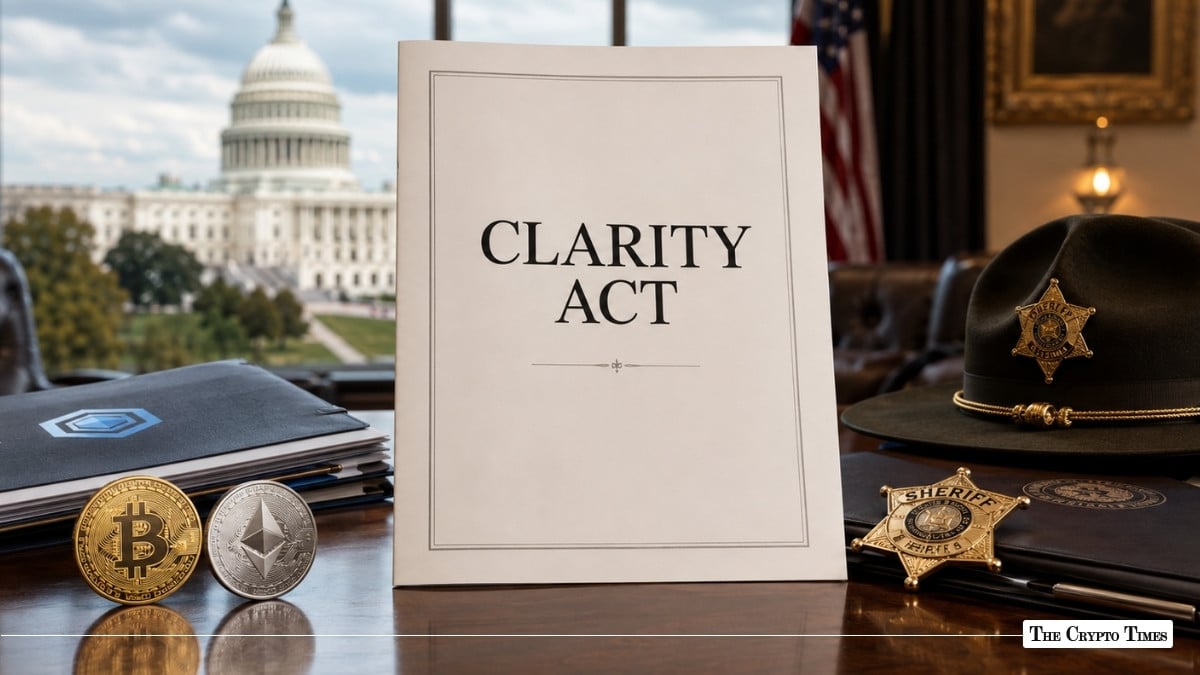
The crypto industry’s main trade group has pushed back against a law-enforcement warning over the CLARITY Act, telling Senate leaders the bill does not exempt decentralized finance from anti-money-laundering rules — a rebuttal that lands as the Senate shelves the bill until after its August recess.
What the Sheriffs Argued
On July 31, the National Sheriffs’ Association (NSA), which says it represents more than 3,000 sheriffs and 10,000 public-safety officials, wrote to Senate Majority Leader John Thune and Minority Leader Chuck Schumer urging them to reject or narrow a key part of the bill.
The group argued that the Digital Asset Market Clarity Act’s developer-protection provision, Section 10604 in the July 22 Senate draft, drawn from the Blockchain Regulatory Certainty Act (BRCA), would create broad carve-outs for DeFi protocols, crypto mixers, and cross-chain bridges from anti-money-laundering, sanctions, and know-your-customer requirements.
That, the sheriffs warned, could make it harder to trace illicit funds and pursue money-laundering cases. The NSA wants lawmakers to delete Section 10604 and characterize a separate provision, Section 10301, as “a big exemption” for decentralized finance. Its position is that all participants in the crypto market should face obligations and that “no one should get a blanket exemption.” The objection is the latest in a months-long campaign by several law-enforcement bodies over the same provisions.
The Blockchain Association’s Rebuttal
On August 3, the Blockchain Association responded with an eight-page letter to the same two Senate leaders, signed by CEO Summer Mersinger, a former CFTC commissioner, arguing the sheriffs had misconstrued the legislation.
The letter’s central charge is that the NSA starts from a premise found nowhere in federal law: that “everyone who receives revenue” from the crypto market should be regulated as a financial institution — a “revenue test” the association says appears in neither the Bank Secrecy Act, FinCEN guidance, nor the Financial Action Task Force’s standard for virtual-asset service providers.
Instead, the association argued, the bill regulates intermediaries based on the control they exercise over funds. Under Section 10201, registered digital-commodity brokers, dealers, and exchanges fall fully within the Bank Secrecy Act framework — AML programs, suspicious-activity reporting, customer identification, and OFAC sanctions compliance. The group said the Act “makes clear that developing neutral software or providing infrastructure does not, by itself, turn someone into a regulated actor,” and urged the Senate to preserve the distinction between financial intermediaries and neutral technology.
On the specific provisions the sheriffs flagged, the letter pushed back point by point. It argued Section 10301 is “an affirmative directive to regulate” protocols that are “decentralized in name only” — not an exemption — directing the Securities and Exchange Commission (SEC) and Treasury to write rules for those who control such systems. And it said Section 10604 shields only a “non-controlling developer” who lacks the ability to control user assets, while expressly preserving criminal money-transmitting liability under 18 U.S.C. § 1960 and leaving the money-laundering, wire-fraud, conspiracy, sanctions, and terrorism-financing statutes untouched. A developer who launders proceeds or conspires with criminals, the letter said, “remains subject to prosecution.”
The letter also pointed to funding the bill directs to law enforcement. Under Title IX, Section 10902 authorizes $600 million a year from fiscal 2027 through 2031, $3 billion in total, for state and local digital-asset investigations, alongside a new Digital Asset Cyber Innovation Center and an additional $30 million a year for FinCEN over five years.
A Divided Law-Enforcement Field
The dueling letters underscore that law enforcement is not speaking with one voice on the bill. Several groups now back the current version: the Fraternal Order of Police, the National Organization of Black Law Enforcement Executives, and the Major Cities Chiefs Association, and the Federal Law Enforcement Officers Association have endorsed it, and the Major County Sheriffs of America dropped its opposition to a neutral stance after revisions.
Ranged against it are the NSA and a cluster of prosecutor and police groups — including the National District Attorneys Association, the National Association of Assistant U.S. Attorneys, and the International Association of Chiefs of Police — that told the administration in June their concerns “remain unresolved.” New York Attorney General Letitia James has warned the Senate the bill would preempt state enforcement, and state securities regulators and anti-trafficking groups have raised similar objections.
The industry’s claim of broad law-enforcement support has also drawn scrutiny: watchdogs including the Revolving Door Project, citing reporting by Punchbowl News, have noted that some of the former officials backing an earlier pro-CLARITY letter are now employed by crypto firms that stand to benefit from the bill — a conflict the letters did not disclose.
A Vote Slips to the Fall
The timing blunts the letters’ immediate impact. Majority Leader Thune has confirmed the Senate will not vote on the CLARITY Act before its August 7 recess, having left the bill off the final-week agenda in favor of judicial nominations and a Russia sanctions measure. That pushes any action toward the fall, when lawmakers turn toward the November elections, and prediction market Kalshi now puts the odds of the bill becoming law in 2026 at roughly 36%.
Treasury Secretary Scott Bessent has pressed for a floor vote, and the White House has spent weeks courting law-enforcement groups, even as a parallel fight over ethics provisions covering federal officials continues to complicate the math. With the near-term window closed, the dueling letters read less as last-minute vote-whipping than as positioning for the fight to come.