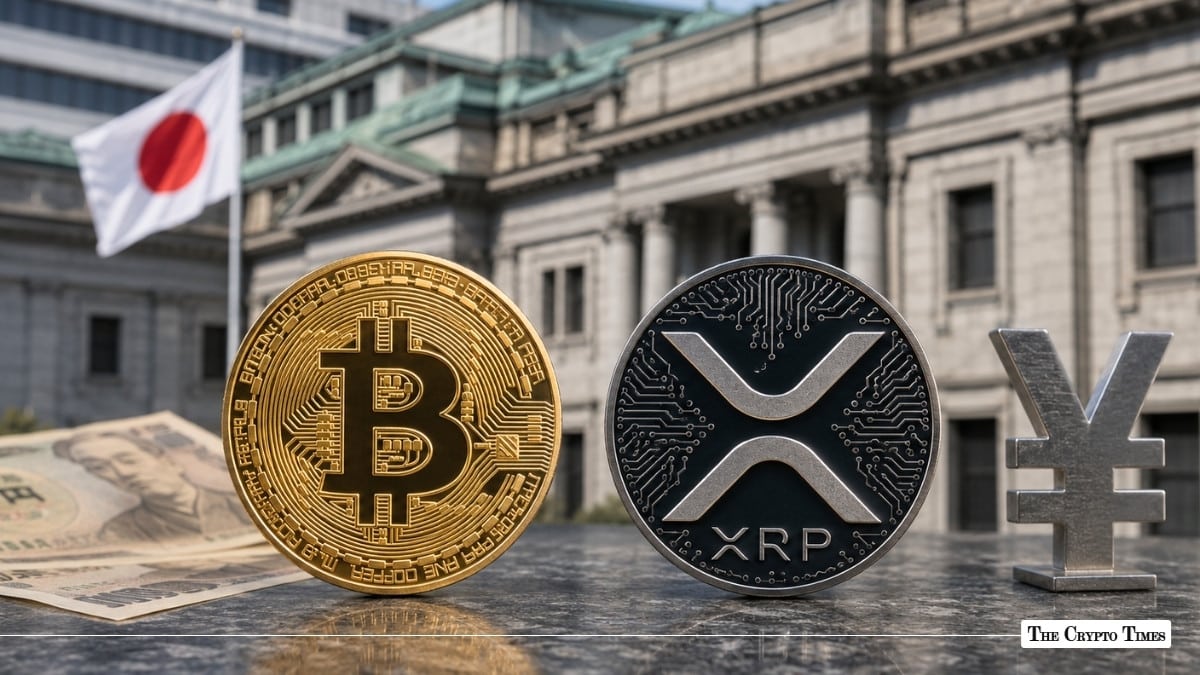
Japan is running two crypto stories at once this week: corporate treasuries are moving into Bitcoin to escape a collapsing yen, and the political footing under the country’s crypto-friendly agenda is loosening just as the Bank of Japan prepares to move.
Corporate Treasuries Turn to Bitcoin and XRP
SBI VC Trade, the crypto arm of SBI Holdings, says corporate demand for Bitcoin and XRP is rising as a weak yen pushes companies to diversify out of cash. In a July filing, the exchange said its registered accounts passed 2 million as of July 6, roughly double its 2025 total, and that its corporate service SBIVC for Prime has gained traction among firms holding crypto as a reserve asset.
The driver is currency erosion. The yen slid to four-decade lows near ¥162 to the dollar earlier this month, and every month a treasurer holds reserves in cash, that cash buys less. Some Japanese firms are now folding Bitcoin and XRP into shareholder incentive programs as well, a dual use as both treasury hedge and investor relations tool.
The flagship case remains Metaplanet, the Tokyo-listed firm that turned its balance sheet into a Bitcoin vehicle and now holds around 43,000 BTC, ranking among the largest corporate holders in the world. Its founder frames the strategy explicitly as a hedge against yen debasement rather than a bet on price.
The BOJ Meeting Is the Near-Term Catalyst
The immediate catalyst is not the politics but the central bank. The Bank of Japan concludes a two-day policy meeting on July 30–31, having already raised its benchmark to around 1% in June, the highest since the 1990s, as it grinds through a slow normalization.
That decision matters to crypto in two directions. A weak yen and low rates have long funded the carry trade, in which cheap Japanese borrowing flows into higher-yielding risk assets abroad, crypto among them. A hawkish surprise or a firmer tightening path risks a carry-trade unwind of the kind that hit Bitcoin alongside equities in August 2024, while a dovish hold reinforces the debasement thesis now driving corporate buyers.
A Weakened Reform Champion
The political backdrop is where the slower-burn risk sits. Takaichi’s cabinet approval fell to 57% in a Yomiuri poll conducted July 24–26, down from 69% a month earlier and the first time below 60% since she took office, with 71% of respondents unhappy over rising living costs. Kyodo has reported she may reshuffle her cabinet as soon as August.
This is the part that touches crypto structurally. Takaichi has been a vocal Web3 advocate, and Japan’s crypto overhaul is part of her economic revitalization agenda. Japan’s Diet passed a landmark amendment on July 15 reclassifying Bitcoin, XRP, and roughly 105 other tokens as financial instruments, opening a spot-ETF pathway targeted for 2027 and a separate flat 20% tax slated for 2028.
The headline law is passed and enjoys cross-party support, so it is not at risk of reversal. What remains is execution: the ETF rails and the tax cut depend on FSA secondary rulemaking that stretches across 2027–2028, and a government preoccupied with inflation and a possible reshuffle is a government with less bandwidth to keep that timetable moving. The reform’s direction is secure; its pace is the open question.
Crypto Traders Have a Way to Price the Politics
The political risk is now tradable on-chain. A Polymarket market on whether Takaichi leaves office before the end of 2026 is pricing roughly a 14% chance, giving crypto-native traders a way to express a view on Japanese political risk without touching the yen directly. The market is thin, with under $20,000 in volume, so it reads better as a sentiment gauge than a firm probability.
The infrastructure to convert this backdrop into flows is being built regardless. SBI has outlined plans for a dual Bitcoin-and-XRP ETF pending regulatory approval, one of several products lining up behind the FIEA reclassification. Against roughly ¥2,000 trillion in Japanese household financial assets, even a small allocation shift into eventual crypto ETFs would be substantial.
What to Watch
The near-term signal is the BOJ on July 31 and Governor’s tone on the rate path; the medium-term signal is whether a reshuffle slows the reform calendar or leaves it intact. For now, the approval slide is a backdrop, not a catalyst—the yen and the central bank are what Japanese crypto actually trades on.
Also Read: Brazilian Police Bust $197M Crypto-Linked Drug Trafficking Network