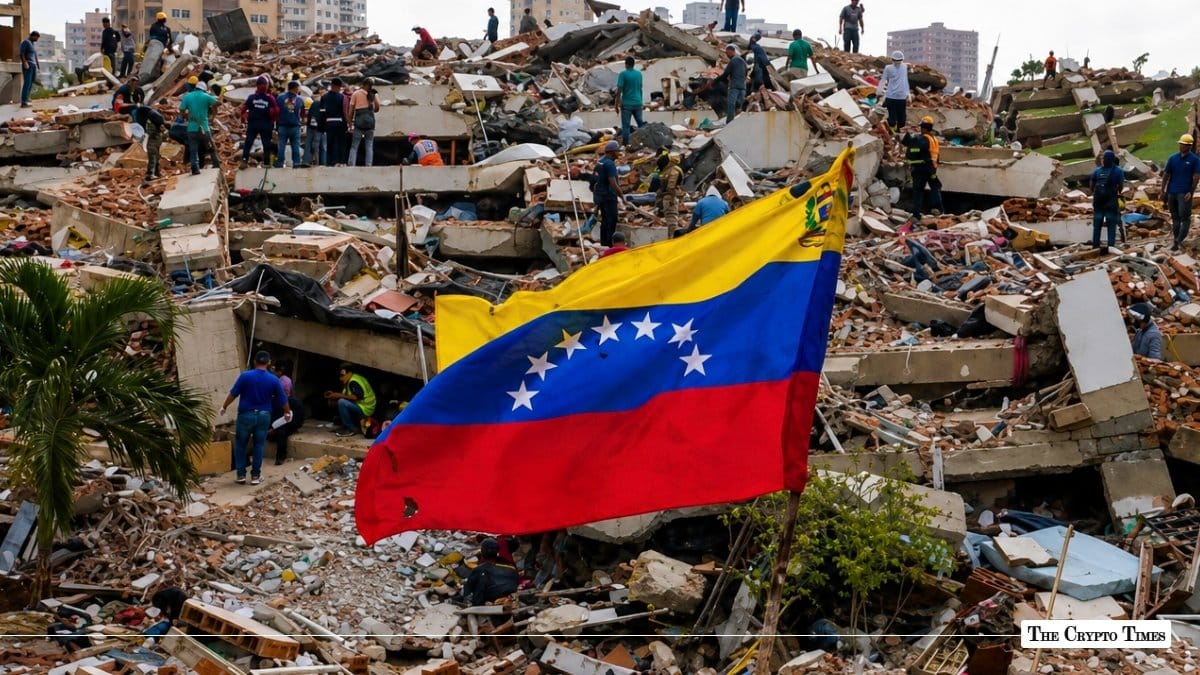
When twin earthquakes measuring 7.2 and 7.5 magnitude struck northern Venezuela on June 24, the immediate crisis was not just about rescuing people from the rubble. It was about getting money to survivors fast enough to buy food, water, and medicine while the country’s banking system buckled under the weight of damaged infrastructure, hyperinflation, and years of sanctions pressure.
What happened next was not a crypto industry publicity stunt. It was a quiet vindication of something that had been building for years: a stablecoin economy embedded so deeply into Venezuelan daily life that it functioned as ready-made emergency infrastructure when traditional systems failed.
Bloomberg first reported this week that the earthquakes, which have now killed at least 3,685 people and displaced tens of thousands, offered a rare real-world stress test for the argument stablecoin advocates have made for years. The value of blockchain-based dollars is not just lower transaction costs. It is a payments network that stays available when everything else slows down or shuts off.
One Woman, $1,000 in USDT, and 500 Meals
Among the most striking details in the report is the story of Lennys Romero, a 27-year-old Caracas resident who posted a message on X the day after the earthquakes, asking her 12,000 followers to help her raise enough money to deliver 500 meals to El Junquito, a mountainous community on the western edge of the capital. She included her Binance wallet address and went to sleep.
By morning, dozens of USDT transfers had arrived. Romero collected roughly $1,000 in Tether’s USDT stablecoin on the first day alone. She spent it on bottled water, canned food, toilet paper, and hygiene products, posting receipts for every purchase on social media to keep donors informed.
Here is where the story gets sharper. Romero also accepted donations through Zelle, the U.S. bank-backed payments service. But that account was blocked after the sudden surge of activity was flagged as suspicious. Crypto kept working. The traditional system did not.
That single anecdote captures the core thesis Bloomberg laid out: stablecoins did not arrive in Venezuela as a disaster response tool. They were already there, functioning as savings instruments, remittance channels, and daily payment rails long before the ground shook.
The Data Behind the Story
TRM Labs tracked a 61% increase in stablecoin inflows to Kontigo, one of Venezuela’s largest crypto platforms, in the days following the June earthquakes. Average daily inflows rose to approximately $638,000 from roughly $397,000 during the preceding 10 days, while the number of transactions remained relatively unchanged.
That last detail matters. The number of transactions stayed flat, but the value per transaction jumped. This was not a wave of new users discovering crypto for the first time. It was an existing user base sending larger amounts through channels they already knew how to use.
“The data suggests that, during periods of significant disruption, digital assets can become an important cross-border financial rail,” said Ari Redbord, Global Head of Policy at TRM Labs.
This finding aligns with TRM Labs’ broader research on Venezuela. In its Q1 2026 Global Crypto Adoption Index released in April, the firm highlighted that Venezuela’s crypto adoption is fundamentally different from other markets. While most countries see crypto usage rise and fall with market cycles, Venezuela’s adoption is “driven by domestic economic and political conditions, with stablecoins serving as the primary transactional and savings tool.”
The country ranked 11th globally for crypto adoption in 2025, and ninth when adjusted for population size.
Binance P2P data shows that 90.2% of listings in Venezuela feature USDT-VES (bolivar) pairs. Just weeks before the earthquake, USDT had crossed 800 bolivars in local P2P trading as the bolivar continued weakening, with the central bank’s money supply expanding by more than 131% since the start of 2026.
Community-Led Fundraising Outpaced Formal Channels
Ana Ojeda, a Venezuelan lawyer and crypto advocate known online as Criptolawyer, coordinated fundraising campaigns that directed stablecoin donations to volunteers working alongside rescue crews in Caracas and the neighboring coastal state of La Guaira, the earthquake’s epicenter.
According to Ojeda’s estimates reported by Bloomberg, the Venezuelan crypto community has raised between $1.2 million and $1.3 million in digital asset donations since the earthquake. The figure is based on fundraising campaigns coordinated across the country’s crypto community, though she acknowledged there is no centralized accounting.
“Without stablecoins, we wouldn’t have been able to raise enough money to meet those needs,” Ojeda said. “Crypto is immediate, it’s global, it’s open and it’s available to everyone.”
Rather than wiring money through banks, organizers sent stablecoins in real time to volunteers on the ground, who converted the funds into bolivars and immediately purchased water, medicine, and other emergency supplies.
The pattern repeated across multiple channels. UCAB, the Venezuelan Catholic university, launched an Emergency Earthquake Fund built on blockchain, accepting BTC, USDT, and Binance Pay to maintain on-chain transparency. Decaf Pay, a community-focused platform, channeled USDC donations to relief efforts.
And blockchain investigator ZachXBT donated approximately $41,000 through The Giving Block to Direct Relief and GiveDirectly for Venezuela earthquake relief after selling unauthorized meme coins that had used his name and likeness.
Why Venezuela is Different From Previous Crypto Aid Campaigns
Crypto fundraising during disasters is not new. Ukraine’s war in 2022 produced some of the largest on-chain donation campaigns in history. But as Bloomberg noted, Venezuela is fundamentally different because stablecoins were already embedded in everyday commerce before disaster struck.
In most previous cases, crypto aid required donors to learn new tools and adopt new behaviors under pressure. In Venezuela, the infrastructure was already in place. Wallets were set up. P2P conversion to bolivars was routine. Merchants in some areas already accepted stablecoins for everyday purchases. The earthquake did not create a crypto economy. It simply revealed one that had been quietly operating for years.
This distinction matters because it shifts the conversation from “can crypto be used for aid?” to “what happens when stablecoin adoption reaches the density where it functions as a parallel financial system?” Venezuela, shaped by years of economic collapse, capital controls, and sanctions pressure, became an involuntary proving ground for that question. The earthquake provided the answer.
The Bigger Picture: A $310 Billion Market Finds a Use Case That Sticks
The stablecoin market has grown past $310 billion in total capitalization, with Morningstar projecting it could reach $1.45 trillion by 2035. In the United States, the GENIUS Act, signed into law in July 2025, created the first comprehensive federal regulatory framework for payment stablecoins, requiring 1:1 reserve backing and regular disclosures. Final implementation rules from the OCC and the FDIC are expected by July 18, 2026, with the law taking full effect in late 2026 or early 2027.
Globally, banks are accelerating their stablecoin infrastructure buildout. More than 37 European banks are backing a euro-denominated stablecoin initiative. HSBC plans a Hong Kong dollar-backed stablecoin. And Open Standard’s OUSD, backed by over 140 companies including Visa, Mastercard, Stripe, and BlackRock, launched on June 30 with the explicit goal of making stablecoins the default settlement layer for global payments.
But for all the institutional momentum, the most compelling case study for stablecoins in 2026 did not come from a corporate boardroom or a regulatory filing. It came from a 27-year-old woman in Caracas who posted her wallet address before going to bed and woke up with enough money to feed a neighborhood.
The sums are modest compared to the broader relief effort. The United States alone has committed over $386 million in humanitarian assistance. The United Nations estimates an additional $300 million is needed to reach 1.3 million affected people. Amazon has established a humanitarian air bridge with seven cargo flights per week to transport emergency supplies.
The stablecoin donations arrived swiftly, directly to people already coordinating aid, offering a glimpse of how crypto networks can complement traditional disaster response rather than compete with it.
Venezuela’s earthquake did not prove that stablecoins can replace the banking system. It proved something more interesting: that in places where the banking system was already failing, stablecoins had already replaced it. The earthquake just made it visible.
Also Read: BNB Chain Unveils H2 Roadmap With AI, Stablecoins, and 100K TPS