Key Highlights
- Russia’s Energy Ministry proposed banning crypto mining in Moscow and nearby regions.
- The restrictions would begin on July 1, 2026, and last until December 31, 2032.
- Several districts in the Kursk Region are also included in the proposed ban.
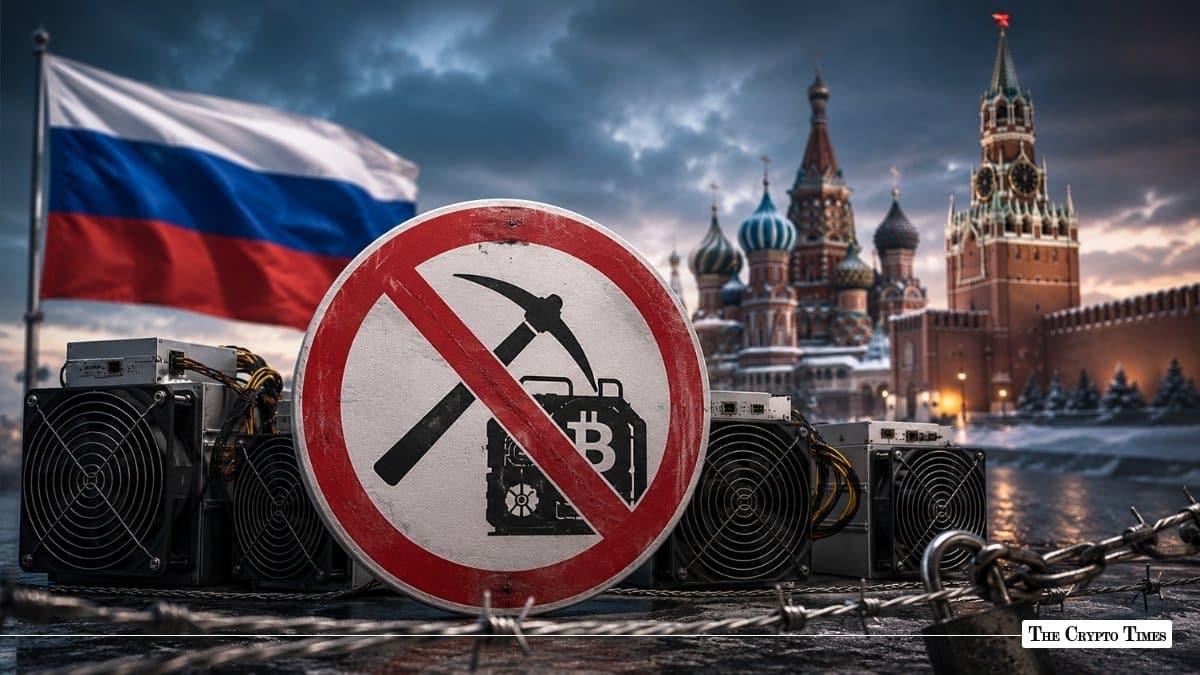
Russia’s Energy Ministry has drafted a government resolution that would impose a comprehensive ban on digital currency mining across Moscow, the Moscow Region, and select districts in the Kursk Region.
According to TASS, a state-owned media outlet, the ban is proposed to take effect on July 1, 2026, and remain in force until December 31, 2032.
The draft, published on the official portal of regulatory legal acts, targets high-density urban and strategically sensitive areas where mining operations have proliferated. In the Kursk Region, the prohibition will cover the Belovsky, Bolshesoldatsky, Glushkovsky, Korenevsky, Lgovsky, Rylsky, Sudzhansky, and Khomutovsky municipal districts, along with the city of Lgov.
This move follows recommendations from the government commission on electric power development, as highlighted by Deputy Energy Minister Yevgeny Grabchak in May.
Regional officials have voiced strong support. Moscow Region Energy Minister Sergey Voropanov emphasized the necessity of the ban, citing data that 65 data centers with a combined capacity of 734 MW are already operational in Moscow and the surrounding region. Of these, 19 facilities in the Moscow Region alone account for 233 MW.
History of geographically targeted bans
This latest restriction builds on a pattern of geographically targeted bans. Earlier this year, the government imposed a year-round prohibition on mining in the Republic of Buryatia and the Trans-Baikal Territory from April 1, 2026, through March 15, 2031.
A broader list of restricted regions, including Dagestan, Ingushetia, Kabardino-Balkaria, and several others in the North Caucasus and newly integrated territories, has been in effect since January 1, 2025. Additional seasonal and localized curbs, such as those in parts of the Irkutsk Region and southern Buryatia, reflect a strategic effort to manage peak consumption periods.
A Calculated Pivot Toward “Regulated Innovation”
While the bans appear punitive at first glance, they reveal a more nuanced strategy: Russia is not rejecting cryptocurrency outright but attempting to channel its development into controlled, energy-efficient frameworks.
By clearing high-demand metropolitan zones of energy-intensive mining, Moscow may be creating space for legitimate blockchain applications in finance, supply chain, and even state-backed digital ruble initiatives.
This approach aligns with Russia’s broader geopolitical positioning, maintaining technological sovereignty while mitigating risks associated with volatile, decentralized energy consumption. The policy could accelerate a migration of mining operations to more remote, energy-abundant regions like Siberia, where hydroelectric and other surplus capacities exist.
However, this shift carries challenges. Relocating sophisticated equipment involves substantial costs, and the ban’s duration through 2032 signals long-term commitment, potentially deterring new investments in affected areas. Smaller operators may exit the market entirely, consolidating power among larger, more compliant players capable of navigating regulatory hurdles.
What to expect in the coming months
As the draft moves through approval processes, the coming months will test the government’s ability to balance enforcement with economic opportunity. For now, the message from Moscow is clear: cryptocurrency has a place in Russia’s future, but not at the expense of the grid’s stability. The six-and-a-half-year horizon provides a defined window for the sector to adapt, potentially emerging more resilient and integrated with state priorities.
This regulatory evolution positions Russia uniquely among global powers, neither fully embracing nor rejecting crypto but sculpting its role to fit national strategic objectives. Whether this fosters sustainable growth or hampers competitiveness remains to be seen, but the July 1 deadline looms as a pivotal moment for miners and policymakers alike.
Also Read: Elon Musk’s X Money Launch Spark Speculation on XRP Integration