Key Highlights
- Bittensor is still not fully decentralized, with core decisions guided by a small leadership group led by co-founder Jacob Steeves.
- The project is intentionally centralized for now to move faster and develop quickly in the fast-changing AI space, with a plan to decentralize later.
- TAO price has dropped recently to around $229, falling 2.77% in 24 hours, after earlier rising to $314.
Bittensor, a peer-to-peer blockchain network, is currently in a transition phase and is not yet fully decentralized, according to co-founder Jacob Steeves.
In a detailed post on X on Sunday, Jacob Steeves explained that the network is not yet decentralized in the same way as Bitcoin but is designed to move toward that state over time.
According to Steeves, the project intentionally maintains a controlled leadership structure so it can move quickly and keep pace with the rapid development of artificial intelligence.
Why the network is still centralized
In the post, Jacob said the network is currently guided by a small core group, including himself and a few trusted engineers and builders. This group helps decide key updates, fixes, and direction for the protocol. He explained that this setup helps the project act quickly, test new ideas, and improve the system without long delays. In his view, slowing down too early for full decentralization could hold back progress in a fast-changing AI space.
He also pointed out that the economic layer of Bittensor is still centralized in some ways, even though the ownership is spread across many people. Miners, validators, subnet teams, and token holders all take part in the system, but final direction still comes from the core leadership group.
Comparing Bittensor with Bitcoin
To explain the idea better, Steeves compared Bittensor with Bitcoin. He said Bitcoin had to be fully decentralized from the beginning because it was created in a strict financial world where control was a major risk.
Bitcoin needed to be resistant from day one. But AI, according to him, is still in its early stages and has not yet faced the same level of pressure or regulation. Because of this, Bittensor can grow first and decentralize later when the system is stronger and more stable.
He said the network is already partially decentralized in important ways. Ownership is not controlled by one person; there was no pre-mine, and the ecosystem has grown through real participation over more than five years. There are now many subnet teams, validators, and builders working across the network. He also stressed that no one needs permission to build or use the system, which he sees as a strong sign of openness.
At the same time, Steeves explained that the project receives different types of feedback. Some token holders want clearer communication, some technical builders support the updates and focus on improvements, while others try to use decentralization arguments to block changes. He said the team will improve communication and release clearer explanations for future updates so more people can understand what is happening.
Roadmap toward full decentralization
Looking ahead, Steeves outlined several initiatives intended to move the network closer to full decentralization, including:
- Making validators more active in competition.
- Improving market systems like borrowing and liquidity balance
- Introducing stronger incentive systems.
He also mentioned improving emission rules and giving more power to committed participants in the ecosystem. In some cases, teams that do not add value may be removed to protect the network’s health.
He said all these upgrades are meant to make the system stronger, more efficient, and better prepared for full decentralization. According to his roadmap, the goal of complete decentralization could be reached within about a year and a half. He described the final vision as a fully trustless network where no central group controls it anymore, and the system runs on its own through aligned incentives and community participation.
TAO price drops after previous rally
Steeves’ comments come as the network token (TAO) has pulled back after performing well since early this year. At the time of this writing, the token was trading for $229, down 2.77% within the last 24 hours.
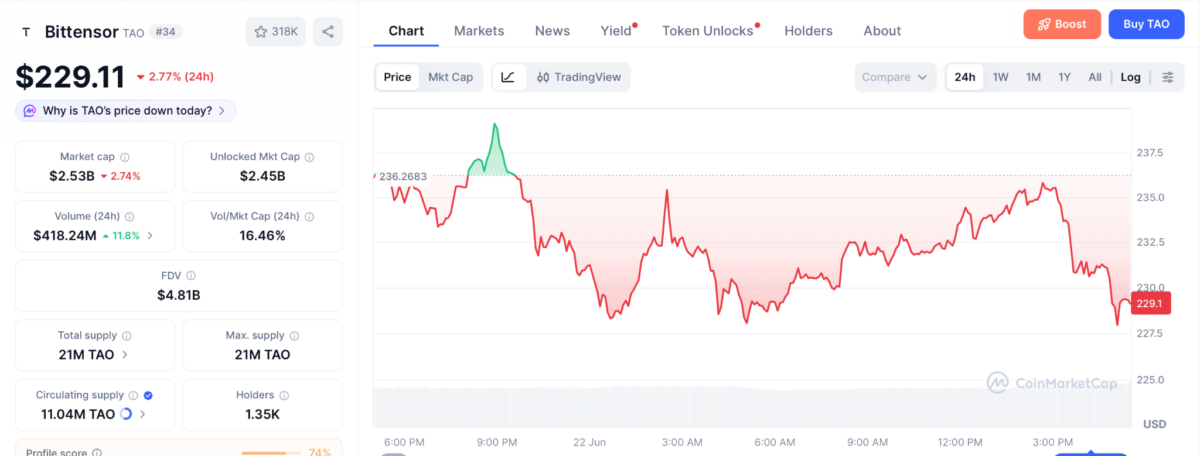
In May, TAO at one point surged to $314, representing a 10% gain on that day. Aside from that, the market cap was at that period pushed above $3 billion with an average volume of $420 million. However, that rally is over, as the market cap has dropped to $2.53 billion.
Also Read: Coinbase Brings OpenAI, Anthropic Pre-IPO Futures to Traders