Key Highlights
- DeFi protocols have generated about $25 billion in fees since 2023, showing real user activity and steady revenue growth.
- Grayscale says investors are now valuing tokens more like stocks, focusing on earnings, revenue, and fundamentals instead of hype and price movements.
- Token value depends heavily on how profits are allocated to projects like Aave, indicating strong valuation potential across different scenarios.
Decentralized finance (DeFi) is entering a new phase where protocol revenues and token economics are becoming more important than market narratives, according to Grayscale.
In a report published on Wednesday, the asset manager said DeFi has generated nearly $25 billion in cumulative protocol fees since 2023, highlighting the sector’s transition from speculative experimentation to a revenue-producing segment of the crypto industry.
The report notes that these revenues are generated through activities such as decentralized trading, crypto lending, borrowing, and derivatives markets, demonstrating continued demand for on-chain financial services.
Investors now focus on real revenue and earnings
Grayscale said the way people value DeFi projects is changing fast. Instead of only looking at popularity or price movement, investors are now looking at real numbers like revenue and earnings. According to the firm, price multiples in the lending sector have compressed significantly. In simple terms, tokens are now being judged more like company stocks.
The asset manager pointed to several major projects in this space, including Aave (AAVE), Sky (SKY), Syrup (SYRUP), Morpho (MORPHO), Uniswap (UNI), Hyperliquid (HYPE), and Maple (MAPLE), saying each one has a different way of making money and sharing value with token holders.
Aave valuation outlook and earnings projection
Grayscale estimated that Aave could generate around $60 million in earnings in 2026, despite ongoing market pressure. Based on traditional fintech valuation ranges of roughly 20x to 25x earnings, it is estimated that Aave’s fair value could be between $1.2 billion and $1.5 billion in total market value, or a token price around $80 to $100, compared to a market price of about $75 at the time.
The firm also presented a base-case scenario where regulatory clarity could accelerate the adoption of tokenized assets, potentially pushing Aave’s token value to around $175 within a year under stronger demand conditions.
Token value now depends on how profits are shared
In the report, Grayscale also emphasized that making money is not enough on its own. It said protocol revenue alone does not decide token value. What matters more is how that money is used. Some projects burn tokens, some buy them back, some reward users through staking, and some give rebates.
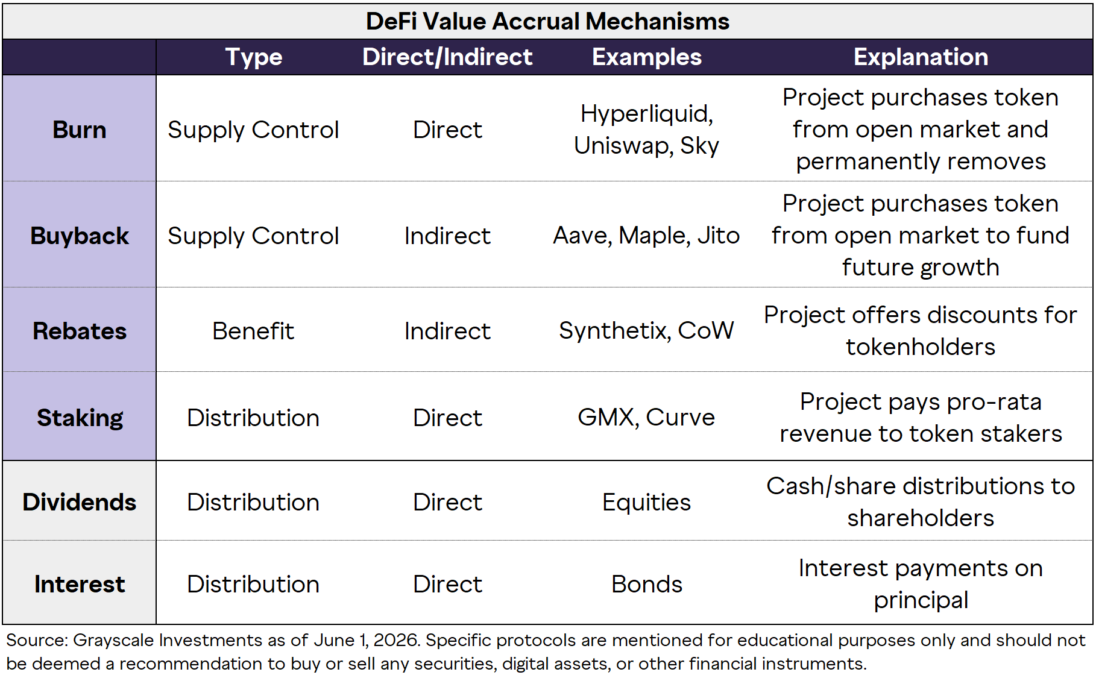
According to the firm, these methods decide how much value actually reaches token holders. In simple terms, two projects can earn the same amount of money but deliver very different results for investors, depending on how they share profits.
It also noted that projects like Uniswap and Hyperliquid allocate nearly all earnings back to token holders, making their models more directly aligned with investor returns. Bitwise recently confirmed this about Hyperliquid after allocating 10% of its management generated by its Hyperliquid ETF (BHYP).
At the same time, it also explained that decentralized autonomous organizations (DAOs) still face unclear rules from regulators, but they can help improve fairness because token holders can vote on decisions and shape how the project runs.
Market shift from hype to fundamentals
Grayscale said the whole crypto market is now moving away from stories and excitement toward real performance. It described this change as a shift “from narrative to fundamentals.”
In other words, people now care more about real income, strong management, and clear token design instead of hype. It said projects with real users, strong earnings, and clear systems are starting to do better than others.
The analysis concluded that DeFi is becoming more like a real financial industry. It is now powered by users, revenue, and structured systems instead of pure speculation. Investors are starting to treat these tokens more like real financial assets, where value comes from real activity and not just price movements.
Also Read: Grayscale Pushes Canton Coin ETF in New Filing With SEC