Crypto Stocks Split as MSTR, COIN, BMNR and IREN Fall
Crypto-linked stocks traded mixed after the Fed’s hawkish rate hold, with Bitcoin and mining-linked names under pressure while Robinhood and Circle outperformed.
Strategy, trading under MSTR, fell 4.30% to $117.53, making it the weakest name among the tracked Bitcoin-proxy stocks. MARA Holdings declined 2.05% to $14.13, while BitMine Immersion Technologies, trading under BMNR, dropped 2.71% to $15.77.
IREN also moved lower, falling 2.29% to $57.83, as mining and infrastructure-linked crypto equities weakened alongside broader post-FOMC volatility.
Coinbase slipped 1.94% to $165.98, tracking the cautious tone across crypto markets after the Fed decision and liquidation spike.
Circle moved against the broader weakness, with CRCL rising 2.12% to $81.41. Robinhood was the strongest performer in the group, jumping 9.15% to $105.56.
The split shows investors are not selling all crypto stocks equally. Bitcoin-heavy and mining-linked names came under pressure, while platform and fintech-linked stocks showed stronger demand despite the broader post-FOMC volatility.
Warsh Ends First Fed Press Conference
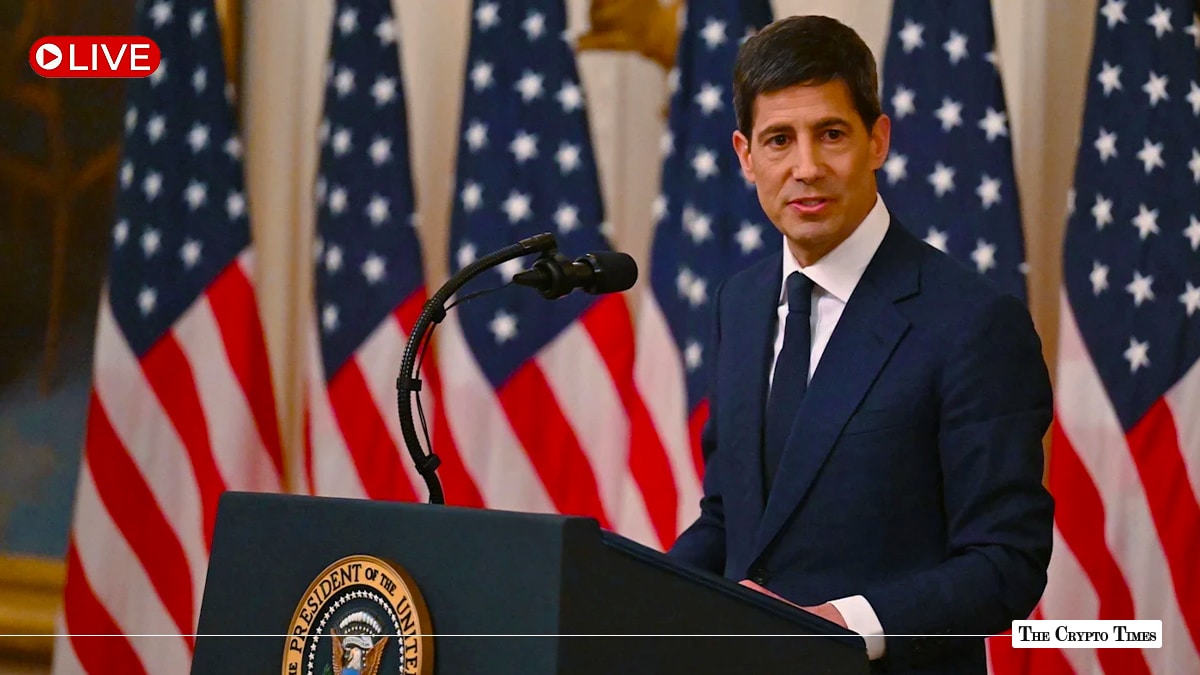
Kevin Warsh has concluded his first post-FOMC press conference since taking over the central bank.
The press conference followed the Fed’s decision to hold interest rates unchanged at 3.5% to 3.75%, while updated projections showed a more hawkish rate path than markets had expected.
Warsh used the briefing to emphasize the Fed’s commitment to bringing inflation back to its 2% goal, confirm that he did not submit a dot plot forecast, and announce five task forces to review key areas of the central bank’s policy framework.
Markets reacted cautiously during the event, with stocks, precious metals and Bitcoin trading under pressure as investors reassessed the outlook for rates, inflation and liquidity.
Traders Now See October Rate Hike
Traders are now pricing in an earlier Fed rate hike after Kevin Warsh’s first policy meeting as Chair.
The CME Group’s FedWatch tool showed a 60.7% chance of a rate hike in October, following Warsh’s press conference and the Fed’s latest summary of economic projections.
Before this week’s Fed meeting, traders did not expect a rate increase until December, making the October pricing shift a clear hawkish repricing.
For crypto markets, the shift matters because earlier rate-hike expectations can tighten financial conditions faster than traders had expected. That could keep pressure on Bitcoin and other risk assets after the initial post-FOMC selloff.
Warsh Declines to Say if He Spoke With Trump
Kevin Warsh declined to say whether he has spoken with President Donald Trump since being sworn in as Fed Chair in May.
Warsh said he has met U.S. Treasury Secretary Scott Bessent three times so far, noting that meetings between the Fed Chair and Treasury Secretary are a long-running practice.
“The long tradition at the central Bank is that the Fed chairman and the Treasury secretary meet weekly. I think we’ve pulled off three of those so far … I think they’re very useful discussions,” Warsh said.
He added that “monetary policy is independent in the conduct of what we do. But that doesn’t mean we’re not interested in what’s happening with the fiscal authorities.”
Asked whether he had spoken to Trump since his swearing-in, Warsh declined to answer.
“On the president, I don’t have anything for you.”
Fed Selloff a Sentiment-Driven Pullback
Santiment Intelligence described the post-FOMC selloff as a classic “buy the rumor, sell the news” reaction after the Fed left rates unchanged as expected.
The analytics platform said traders had spent days positioning for Kevin Warsh’s first FOMC meeting, with prediction markets assigning roughly a 99% probability to no rate change. Once the decision became official, crypto, equities, gold and silver still came under immediate selling pressure.

Santiment said the reaction reflected a shift in focus from the expected rate hold to what comes next. With no surprise rate cut and little fresh bullish catalyst after the recent relief rally, traders moved to take profits across risk assets.
The firm said the pullback appears more sentiment-driven than a fundamental shift, as markets reacted not to the rate hold itself but to the lack of a positive surprise.
Peter Schiff Criticizes Warsh’s Fed Task Forces
Economist and Bitcoin critic Peter Schiff criticized Kevin Warsh’s plan to create multiple Fed task forces, arguing that the central bank already knows the problem it needs to address.
Schiff wrote that the Fed does not need to spend time and money establishing task forces to examine monetary policy. He said the problem is “obvious,” pointing to inflation and loose monetary policy.
“The Fed must stop enabling reckless fiscal policy,” Schiff wrote.
His criticism followed Warsh’s announcement that the Fed would launch five task forces covering communications, the balance sheet, data use, productivity and jobs, and the inflation framework.
Schiff also argued that Warsh’s approach risks studying problems instead of solving them, writing that “Warsh has a task force for everything and a solution for nothing!”
Fed has struggled to communicate its commitment to lower inflation
Kevin Warsh said the central bank has struggled to communicate its commitment to bringing inflation back to its 2% target.
Warsh reiterated that the Fed remains committed to lowering inflation, which he said has not been at target for half a decade.
“The commitment to deliver is strong, unanimous, and unambiguous, and that’s I think an important message we’ve missed for five years, and we’re going to fix that.”
His remarks came as he discussed changes to how the Fed communicates policy. Warsh has already said he is launching a task force to review the central bank’s communications, including press conferences, dots, meetings, transcripts and minutes.
For markets, the comment reinforced the hawkish tone of his first FOMC press conference. It suggested the Fed wants investors, households and businesses to take its inflation target more seriously after years of above-target price growth.
Kevin Warsh Confirms He Didn’t Give a Projection For ‘dot plot’
Kevin Warsh confirmed that he did not submit an interest-rate-path projection for the Fed’s quarterly forecasts.
Asked about the projections, Warsh said he did not submit a dot for the so-called dot plot.
“I did not submit a dot. For me, it’s not helpful in the conduct of policy,” he said.
Warsh also said the Fed’s communication tools could come under review later this year.
“I suspect by year end, as I mentioned in my opening statements, there’ll be a review about communications. Broadly, press conferences, dots, meetings and the like. Transcripts, minutes. This will be part of that,” he said.
Asked about the future of Fed press conferences, Warsh said they can be a “very useful way” to communicate with households and businesses.
“When you have one, you want to make sure you have something important to say. Today, I think we had something important to say about our commitment to deliver on price stability, our commitment to rethink practices,” he said.
He added that he expects “more changes to come. And, some of those might well be worthy of a press conference.”
For markets, Warsh’s decision not to submit a dot adds uncertainty around how investors should read the Fed’s rate projections under his leadership.
Warsh Launches Five Fed Policy Task Forces
Federal Reserve Chair Kevin Warsh said he is launching five task forces to review how the central bank conducts its business in critical policy areas.
The task forces will cover the Fed’s communications, balance sheet, use and reliance on existing data sources, productivity and jobs in an era of transformation, and the Fed’s inflation framework.
“For each of these independent task forces, I’m enlisting some of the very best minds, both inside and outside the economics profession,” Warsh said.
He said the task forces would be supported by Fed staff.
Asked about the likely timing of the reviews, Warsh said: “My expectation is the task forces will begin work in the next couple of weeks, and we’ll start to get some more information from them, some more framing of how they see things, starting in the fall. And hopefully most, if not all of them, concluding by year end.”
For markets, the announcement signals that Warsh may reshape how the Fed communicates policy, uses economic data, and frames inflation risks during his first year as Chair.
Nearly $2T Wiped From Markets After Fed Announcement
Stocks, precious metals and Bitcoin saw a sharp selloff within minutes of the Fed’s no-change rate decision, with the listed market-value losses adding up to about $2.02 trillion across major risk and safe-haven assets.
The S&P 500 fell 0.96%, wiping out about $610 billion in market value, while the Nasdaq dropped 1.28%, erasing nearly $490 billion. The Russell 2000 also declined 1.47%, losing about $50 billion in market capitalization.
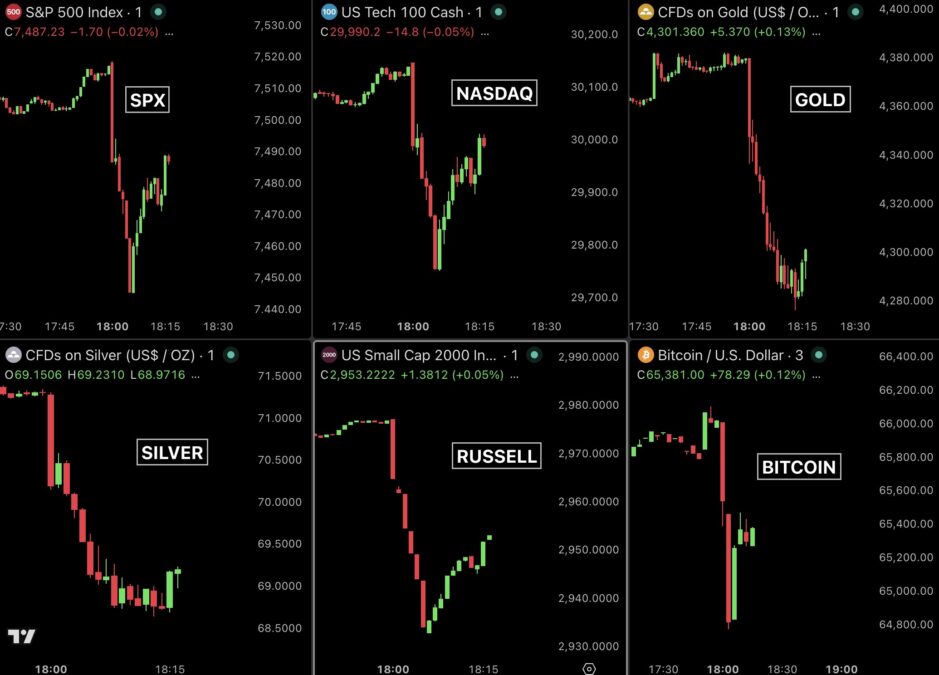
The selloff extended beyond equities. Gold dropped 2.33%, wiping about $700 billion from its market value, while silver fell 3.82%, erasing nearly $140 billion.
Bitcoin also joined the post-Fed decline, falling 2.02% and wiping about $27 billion from its market capitalization.
The move showed that traders treated the Fed’s decision as more hawkish than a simple rate hold. The rate range stayed unchanged, but the updated projections and removal of the Fed’s earlier cutting bias triggered a fast cross-asset repricing across stocks, metals and crypto.
Crypto Stays Lower After Hawkish Fed Signal
Crypto prices remained under pressure after the Fed’s decision landed more hawkish than markets expected.
Bitcoin traded around $65,363, down 0.78%, after moving between an intraday high of $66,316 and low of $64,523. Ethereum fell 1.63% to $1,766.18, while XRP declined 1.64% to $1.20. BNB also slipped 0.56% to $604.28.
The muted reaction shows crypto traders are still waiting for Kevin Warsh’s press conference before taking a clearer direction. The main risk for Bitcoin is whether Warsh reinforces the Fed’s hawkish shift, especially after nine officials projected a rate hike in 2026.
A stronger dollar and higher yields would likely keep pressure on Bitcoin and other risk assets, while a more balanced tone could help BTC stabilize above the $65,000 level.
Stocks Slide as Fed Decision Lands More Hawkish
U.S. stocks fell after the Fed’s decision, as markets reacted to a policy signal that appeared more hawkish than expected.
The S&P 500 dropped about 0.5%, or 36 points, while the Nasdaq fell nearly 1%, or 241 points. The Dow Jones Industrial Average saw a smaller decline of about 66 points, while the VIX Volatility Index moved slightly higher.
The reaction suggests investors are reassessing the Fed’s inflation outlook after the statement pointed to elevated price pressures. Chair Kevin Warsh’s press conference is now expected to give more clarity on how strongly policymakers are leaning against inflation.
Royal Bank of Canada Chief Economist Frances Donald told CNBC that the Fed appears to be recognizing that energy is one inflation issue, but not the only one.
Fed Hold Keeps Consumer Borrowing Costs Elevated
The Fed’s decision to leave interest rates unchanged does little to ease affordability pressure for U.S. households.
The federal funds rate sets what banks charge each other for overnight lending, but it also affects many consumer borrowing and savings rates. Short-term borrowing costs, including credit card APRs, are likely to remain high because they are closely tied to the Fed’s benchmark rate.
Longer-term borrowing costs, including mortgage rates, are influenced more by Treasury yields and the broader economy. Those rates may remain volatile as uncertainty linked to tensions in the Middle East continues to affect markets.
For crypto markets, the consumer takeaway is indirect: the Fed hold does not immediately ease financial conditions. That keeps the broader risk-asset backdrop cautious as traders wait for Warsh’s press conference.
Nine Fed Officials See Rate Hike in 2026
Nine of the 18 Fed officials who submitted forecasts now see interest rates rising in 2026, signaling a more hawkish policy path under Chair Kevin Warsh.
The updated projections mark an important shift for markets because the Fed also removed its earlier cutting bias from the rate decision statement. That makes the June meeting less about a simple rate hold and more about whether policymakers are preparing investors for tighter policy ahead.
For crypto traders, the signal is clear: the Fed is no longer leaning toward easier conditions. If rate-hike expectations build, Bitcoin and other risk assets may face renewed pressure from a stronger dollar, higher yields, and tighter liquidity.
Fed Statement Flags Energy-Led Inflation Pressure
The Federal Reserve’s full policy statement showed a unanimous 12-0 vote to keep the federal funds rate unchanged at 3.5% to 3.75%.
The Committee said economic activity is expanding at a solid pace, even as uncertainty remains elevated partly because of the conflict in the Middle East. It also noted strong productivity growth and capital investment.
The Fed said job gains have kept pace with the workforce and the unemployment rate has changed little. However, it warned that inflation remains above its 2% goal, partly due to supply shocks that have pushed up prices in sectors including energy.
That keeps the focus on price stability rather than near-term easing, a message that could matter for Bitcoin and other risk assets as traders wait for Chair Kevin Warsh’s press conference.
Fed Holds Rates at 3.5%-3.75% in Warsh’s First Decision
The U.S. Federal Reserve left interest rates unchanged on Wednesday, holding the federal funds rate at 3.5% to 3.75% in Kevin Warsh’s first policy decision as Fed Chair.
The decision extends the Fed’s pause as policymakers weigh persistent inflation pressures against a still-resilient labor market and broader global uncertainty. The FOMC said economic activity continues to expand, while inflation remains a key risk for policymakers.
Markets are now focused on the Fed’s updated economic projections and dot plot, which could show whether officials still expect rate cuts this year or are preparing for a longer hold. Warsh’s first post-meeting press conference will also be closely watched for signals on inflation, employment, and the central bank’s policy direction.
For Bitcoin and the broader crypto market, the rate hold itself was largely expected. The next move will likely depend on whether Warsh sounds hawkish enough to push rate-cut expectations further out, or balanced enough to ease pressure on risk assets.
Warsh Faces First Fed Decision
The Federal Reserve is widely expected to leave interest rates unchanged at the conclusion of its policy meeting on Wednesday, making the focus less about the decision itself and more about what’s next.
The Federal Open Market Committee (FOMC) is expected to keep its benchmark interest rate in the 3.5%–3.75% range. The policy statement is due at 2:00 p.m. ET, followed by Federal Reserve Chair Kevin Warsh’s first post-meeting press conference at 2:30 p.m. ET.
Markets will closely watch Warsh’s remarks for clues on the Fed’s policy direction. The central bank will also release its updated dot plot, along with fresh projections for inflation, unemployment, and U.S. economic growth.
Crypto Market Dips as Traders Await FOMC Rate Decision
The cryptocurrency market traded lower ahead of the Federal Reserve’s interest rate decision, with investors taking a cautious stance before the conclusion of the two-day FOMC meeting. While the Fed is widely expected to keep rates unchanged, markets remain focused on Chair Kevin Warsh’s first press conference and the central bank’s updated economic projections.
Bitcoin fell 1.48% over the past 24 hours to $65,056.57, while Ethereum declined 2.54% to $1,755.76. XRP also slipped 2.46% to $1.19, and Tether traded just below its dollar peg at $0.9983. BNB bucked the broader trend, rising 1.22% over the past day to $601.38, according to CoinMarketCap.
Market participants are now watching the Fed’s updated dot plot and economic forecasts for clues on the path of interest rates. Any shift in expectations for future rate cuts could trigger heightened volatility across both traditional and crypto markets after the announcement.