Key Highlights
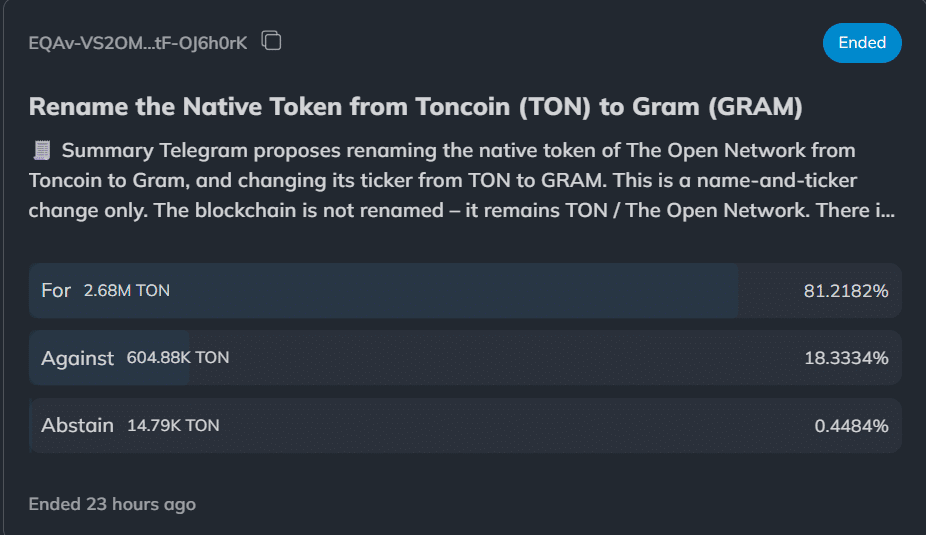
- TON holders approved the Gram rebrand with over 81% support through an on-chain governance vote.
- The ticker will change from TON to GRAM on June 15 without requiring any token swap or migration.
- Wallet balances, staking positions, NFTs, DeFi assets, and smart contracts remain unaffected.
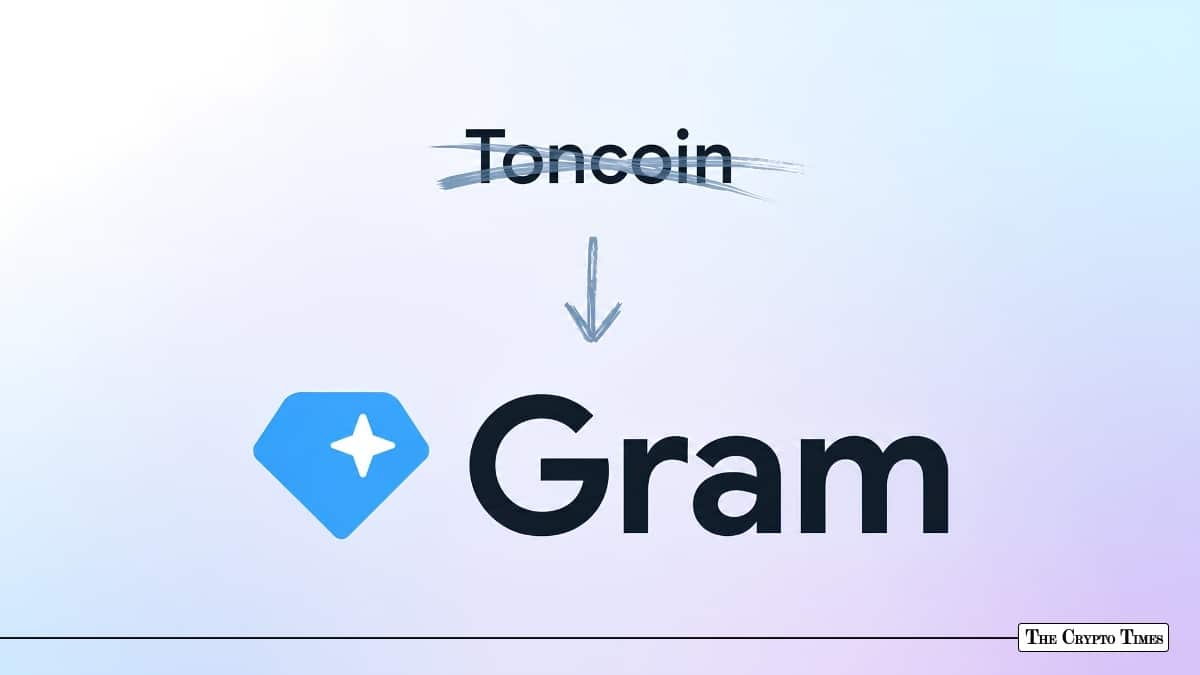
The Open Network (TON) community has approved a proposal to rename its native token from Toncoin (TON) to Gram (GRAM), marking a return to the branding originally envisioned in Telegram’s 2018 blockchain whitepaper.
According to the official announcement, the proposal received 81.22% support in a community governance vote. The change will take effect at 12:00 UTC on June 15, 2026, when the token ticker officially switches from TON to GRAM. Importantly, the blockchain itself will continue to operate as The Open Network (TON). The update only affects the token’s name, ticker symbol, and branding.
No token swap, migration, bridge transfer, or claim process will be required. Existing balances, wallet addresses, staking positions, smart contracts, NFTs, Jettons, and DeFi assets will continue functioning exactly as before. After the transition, one TON will simply be displayed as one GRAM.
Voting mechanics and upcoming changes
Voting took place on the TON Vote platform from June 1 to June 8, 2026. Voting power was determined by participants’ TON balances at a snapshot on May 31, 2026. The proposal was submitted by Telegram as a verified organization. The vote was conducted transparently on-chain using open-source smart contracts.
Exchanges, wallets, and explorers are expected to update trading pairs, asset labels, and user interfaces by June 15, with full consistency targeted by June 22. During a recommended three-month transition period, platforms are advised to display the asset as “Gram (prev. Toncoin)” to reduce user confusion before switching to “Gram” exclusively.
Return to Telegram’s original vision
The announcement follows Telegram founder Pavel Durov’s public statements on the change. The rename revives the original name from Telegram’s 2018 TON whitepaper. The project had shifted to Toncoin after regulatory challenges with the U.S. Securities and Exchange Commission, which led to the termination of Telegram’s initial token sale plans.
Proponents view the return to “Gram” as symbolic of the network’s evolution under renewed Telegram involvement. Telegram has become the largest validator on the network and is driving technical improvements, including reported gains in transaction throughput, faster finality, and lower fees.
Token remains under market pressure
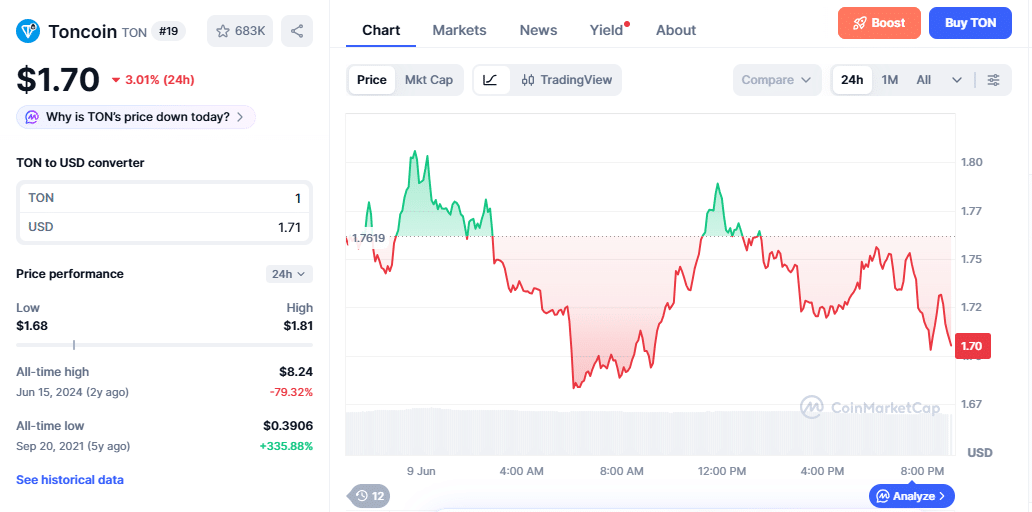
At the time of this writing, Toncoin (TON) was trading around $1.70, down approximately 3% in the last 24 hours and over 11% across the past week, according to CoinMarketCap. The token has declined from roughly $2.10 earlier in the week, reflecting a clear bearish price action following the community vote and official announcement of its impending rename to Gram (GRAM).
The announcement has not generated sustained buying pressure. History suggests rebrands and ticker changes rarely produce lasting rallies on their own. While there may be short-term speculative volatility around the effective date (June 15), the name switch itself does not alter the token’s utility, supply, or network fundamentals.
Any potential “surge” would likely be temporary unless accompanied by stronger catalysts such as major Telegram ecosystem growth, increased adoption, or positive broader market sentiment.
Fundamentals remain same
The move is part of a broader “Make TON Great Again” initiative and coincides with efforts to strengthen the protocol’s technical performance and ecosystem focus. While the name change itself does not alter fundamentals, it reflects the growing influence of Telegram within the TON ecosystem and an attempt to reconnect with the project’s original branding.
Industry observers will watch how smoothly the transition unfolds across major trading platforms and whether the rebrand supports clearer positioning for TON in the competitive Layer-1 blockchain landscape. For everyday users and holders, the primary takeaway is simplicity: no action is needed, and existing holdings remain fully operational under the new name and ticker.
Also Read: Aave’s Next Upgrade Isn’t About Features – It’s About Risk