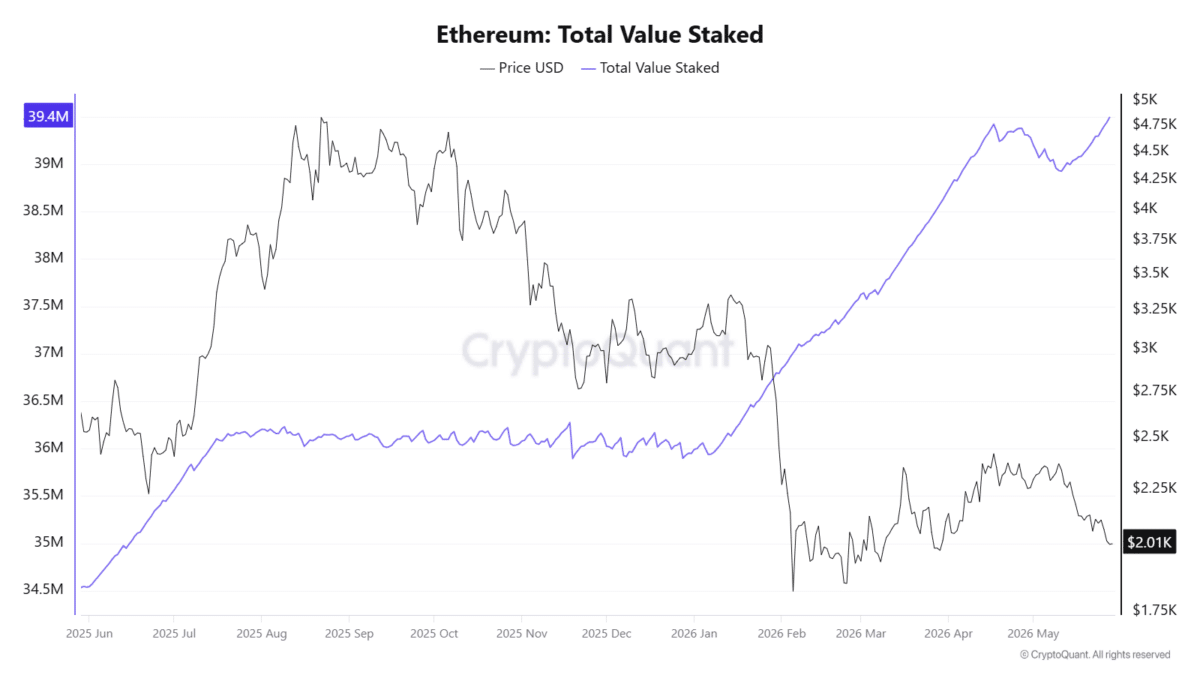
As of late May 2026, Ethereum’s proof-of-stake (PoS) network has reached a significant milestone, with approximately 39.5 million ETH now staked, representing around 32.19% of the cryptocurrency’s total supply.
According to CryptoQuant data, the figure stands precisely at 39,493,919.12 ETH, marking a new all-time high. The number has grown sharply since January, adding over 4 million ETH in 6 months.
This surge in staking underscores strong long-term conviction among holders, including institutions. Major players like Bitmine have added substantial positions, further locking up supply.
At current prices near $2,010, the staked ETH amount equates to roughly $79.4 billion in committed capital.
Ethereum staking queues reflect strong demand and network stability
The Ethereum validator entry queue currently stands at approximately 3.28 million ETH, with an estimated wait time of 56 days and 23 hours at the current churn rate of 256 validators per epoch.
This substantial backlog underscores robust institutional and retail conviction in Ethereum’s long-term prospects, as new stakers continue to outpace the network’s processing capacity.
The high entry demand has contributed directly to the record ETH now staked across 897,754 active validators, further reducing liquid supply in the market.
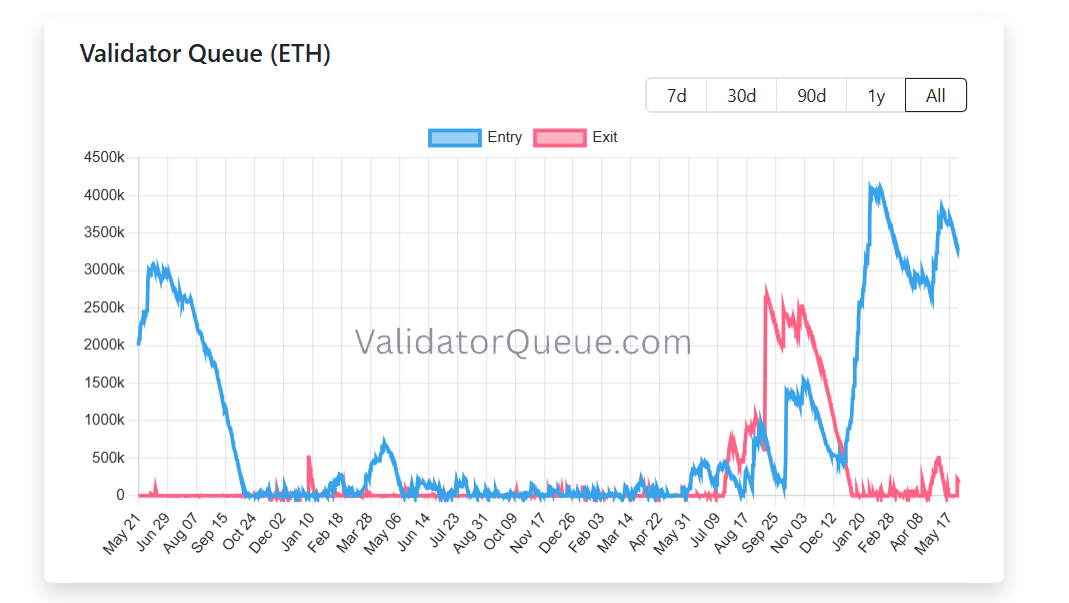
In contrast, the exit queue remains relatively modest at 151,197 ETH, with validators facing a short wait of about 2 days and 15 hours before becoming withdrawable. An additional sweep delay of roughly 7.8 days applies once validators clear the queue, as the network processes withdrawals in cycles.
The imbalance between a massive entry queue and a manageable exit queue highlights limited selling pressure from stakers, reinforcing the narrative of “trapped capital” committed to Ethereum’s security even amid price weakness and subdued staking APR around 2.73%.
Price and ETF pressures mount
While the network shows strong onchain activity, Ethereum’s native currency has struggled to gain momentum, trading around $2,000–$2,100 in late May 2026 after earlier peaks near $5,000 in 2025.
The CryptoQuant chart shows a notable decline in early 2026, with the asset hovering near $2,010 as staking continues its upward trajectory. This divergence highlights a classic crypto dynamic—fundamental strength on one side, market sentiment and macro factors on the other.
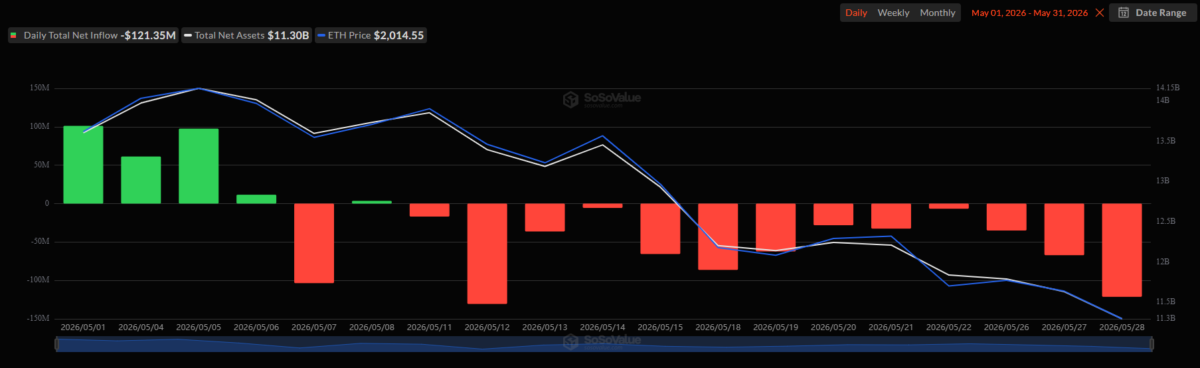
Moreover, spot Ethereum ETFs have faced heavy outflows. Assets under management have dropped to approximately $11.3 billion, with roughly $438 million withdrawn over the past two weeks amid 13 consecutive days of institutional selling. This exodus reflects broader risk-off sentiment in digital assets, even as staking demand signals underlying resilience.
Ethereum’s “Broken economics” debate intensifies
Critics, including on-chain analysts, argue that Ethereum’s economics face structural challenges despite technical successes. The Dencun upgrade and EIP-4844 (Proto-Danksharding) introduced blob transactions, dramatically lowering costs for Layer-2 solutions. Networks like Base now process up to 50x more transactions at roughly 1/100th the cost of mainnet activity.
While this scaling triumph benefits users, it has reduced fee revenue flowing back to the L1. Post-EIP-4844, ETH burn rates from EIP-1559 have collapsed, shifting the supply dynamic toward net issuance in periods of low activity.
Validators still receive new ETH rewards, but diminished burns mean non-stakers experience subtle dilution. High staking yields (currently around 2.7–3%) come partly at the expense of broader token economics, with much of the network’s growth accruing to L2 ecosystems rather than ETH holders directly.
Supporters, on the other hand, argue that Ethereum is ultimately a blockchain that stands at the forefront of the DeFi landscape. “Ethereum is the only smart contract platform that takes the blockchain trilemma seriously, aiming for security, decentralization, and scalability while upholding the cypherpunk ethos of neutrality and self sovereignty,” said an anonymous user, scoopy trooples in a latest X thesis.
Security win and long-term outlook
Proponents counter that 32%+ staking represents Ethereum’s greatest strength—unparalleled economic security. Nearly one million active validators secure the network, making attacks prohibitively expensive.
The long entry queue demonstrates confidence that future upgrades (such as further scaling improvements) will eventually resolve value accrual issues. Ethereum Foundation staking activities further reinforce institutional alignment.
Market observers note that staking growth often decouples from short-term price action in maturing networks. Reduced liquid supply could support prices during recovery, especially if ETF flows reverse or macroeconomic conditions improve.
However, sustained L2 dominance without enhanced L1 incentives remains a key risk for ETH’s “ultrasound money” narrative.
Conclusion
Ethereum finds itself at a crossroads. While staking supply at ATHs and validator participation paint a picture of robust fundamentals and network resilience, its price weakness, ETF outflows, and post-Dencun fee dynamics highlight ongoing challenges in translating technical scaling success into economic gains for ETH holders.
As the ecosystem matures, the coming months will test whether Ethereum can bridge this gap—balancing explosive L2 growth with sustainable value accrual to its base asset. As of now, the 39.5 million ETH locked in staking stands as both a badge of security and a reminder of unresolved tensions in the network’s design.
Also read: Michael Saylor and Strategy’s Bitcoin Bets Face New Scrutiny Over Cash Deployment Choices