
Key Highlights
- Bitcoin ETFs have recorded over $4.01 billion in total outflows since May 7, showing strong and steady money leaving the market.
- The ETFs saw a nine-day straight outflow streak of about $2.8 billion, with one major single-day withdrawal of $733 million, led heavily by BlackRock’s IBIT.
- The trend lines up with weaker Bitcoin price action and softer demand, as investors rotate money into stocks
Bitcoin exchange-traded funds (ETFs) in the United States have recorded more than $4,013,800,000 in total outflows since May 7. This means over $4 billion has been pulled out of Bitcoin ETF products in just a short stretch of time
According to data from Santiment, the withdrawals have not come in one single shock, but in a steady wave across several weeks, showing consistent selling pressure from investors.
Nine-Day selling streak
The ETFs recorded about $2.8 billion exited Bitcoin ETFs over nine consecutive trading days alone, starting from May 15. This was the longest streak of outflows since the products were launched in January 2024.
This includes one of heavy withdrawals of about $733.43 million in a single day on May 27, with BlackRock’s IBIT alone accounting for $527.84 million of that outflow, according to data from Farside Investors.
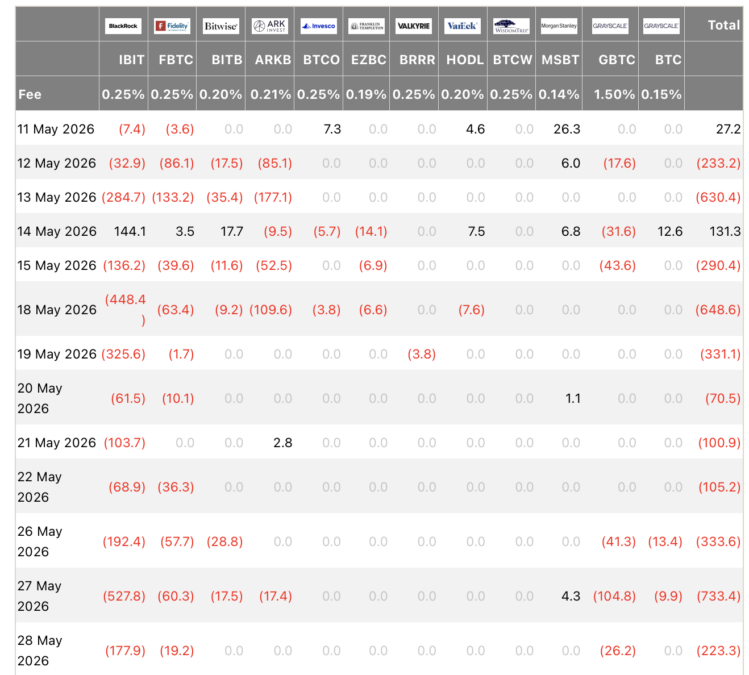
Weekly flow numbers also show the same pattern, starting with roughly $1 billion in mid-May, then increasing to $1.26 billion the following week, and reaching $1.30 billion in the most recent week.
Santiment, in its post on X, explained that the ETF flows are often used to understand how investors feel about Bitcoin. When money flows into ETFs, it usually means people are confident and buying more. When money flows out, it often means fear, caution, or investors reducing risk.
It also pointed out that in the past, big inflows often happened near price highs, while big outflows sometimes appeared near market lows, based on past patterns.
Macro and market pressure
Some reports link the broader pressure to shifting macro conditions. CoinShares, in a recent report, said that geopolitical tensions, including the conflict going on in the Middle East is one of the factors influencing investor behavior.
Meanwhile, stock markets have been performing strongly. The S&P 500 reached a new high of 7,568, and tech and AI-related stocks have been leading the rise. In short, investors seem to be pulling money away from crypto and into stocks instead.
Bitcoin price trades sideways around $70k
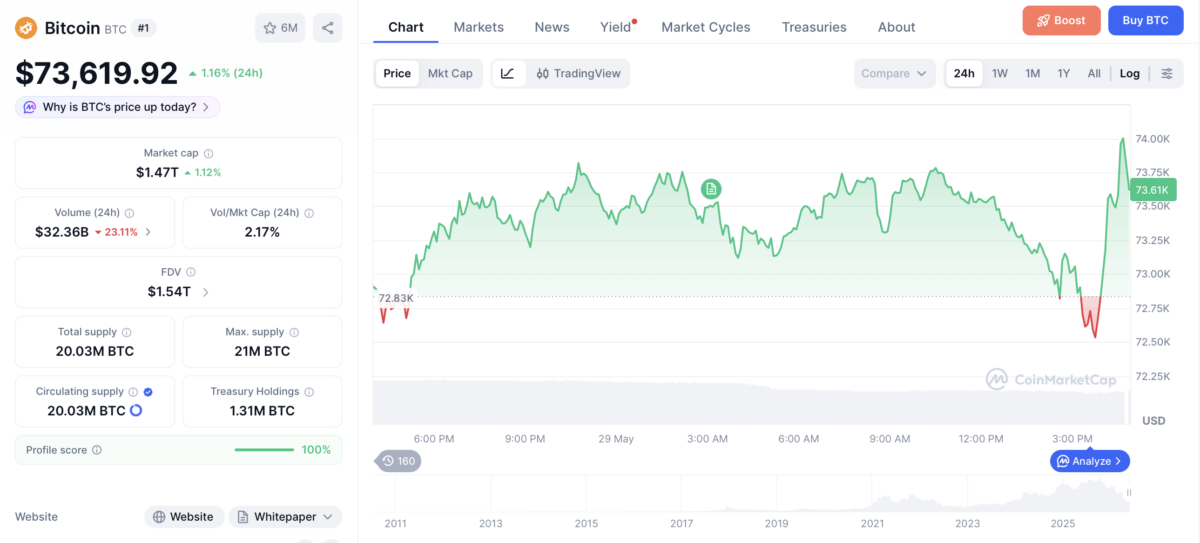
Meanwhile, Bitcoin’s price itself has also been weak during this time. It has fallen about 3.91% over the past week, and about 2.9% in a month.
It recently dropped below $74,000 after failing to sustain momentum near $82,000. At the time of writing, Bitcoin is trading for $73,618, up 1.12% within the last 24 hours.
On-chain indicators also show reduced buying strength. According to Cryptoquant, large holders of Bitcoin, called whales, holding between 1,000 and 10,000 BTC, have been shrinking year-over-year at notable levels, while mid-tier holders have slowed accumulation.
Long-term holder supply has reached a record 15.8 million BTC, but analysts say this reflects weaker new demand rather than fresh accumulation. Short-term holder supply has also declined significantly over recent months.
Overall, the data shows a clear pattern of steady money leaving Bitcoin ETFs, weaker buying activity, and changing investor behavior across both crypto and traditional markets.
Also Read: 40% of Bitcoin Holders Are in Red: Could a 2022 Bear Be Returning?