
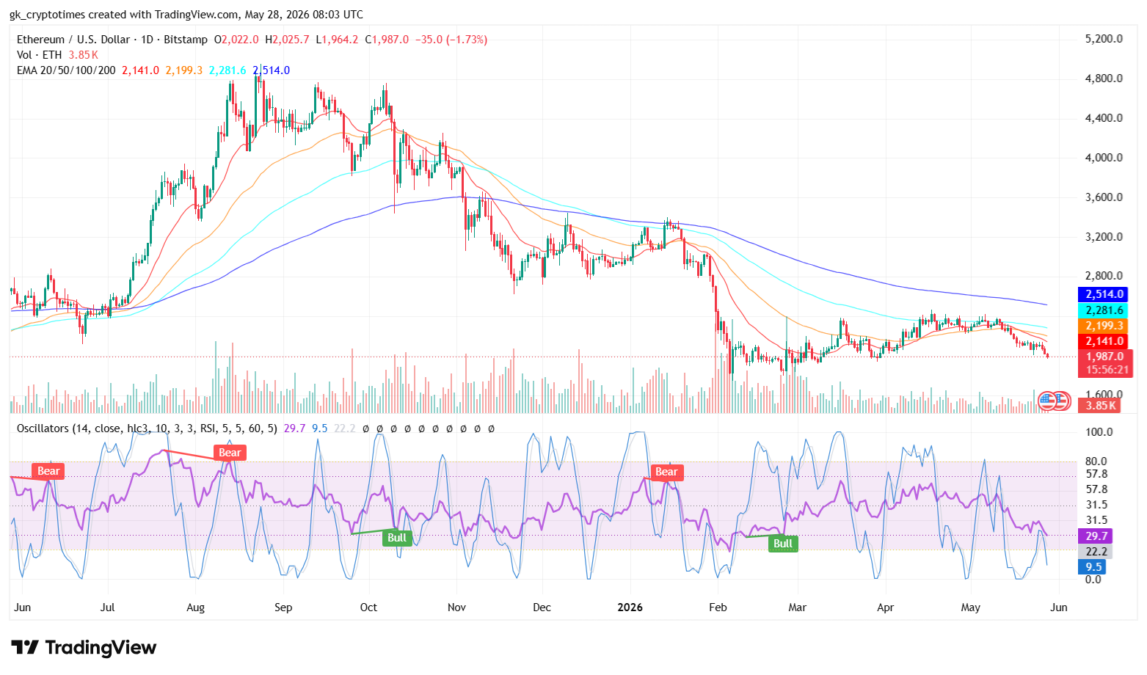
Ethereum (ETH) has broken below the critical $2,000 psychological barrier, dropping more than 4% to as low as $1,971 as the broader crypto market witnesses sharp sell-off on May 28, 2026.
This marks the first sustained breach of that level since late March and represents a reversal from early May highs near $2,400. The decline comes amid broader crypto market volatility, persistent spot ETF outflows, whale selling, and ETH’s continued underperformance relative to Bitcoin.
The drop reflects intensified bearish momentum. The second largest cryptocurrency’s market capitalization has slipped to $240 billion, while 24-hour trading volume remains elevated around $18 billion—as per CoinMarketCap data.
Year-to-date, Ethereum remains deeply in the red, down over 30% from 2026 opening levels and more than 58% from its August 2025 all-time high near $4,953.
Psychological Support at $2,000
The $2,000 level has long served as a major psychological and technical benchmark for Ethereum. It acted as strong support in prior cycles and a launchpad for rallies in 2024–2025. Breaching it now signals potential further downside, with analysts eyeing $1,900–$1,970 as the next support zone, followed by deeper Fibonacci retracements near $1,750–$1,800.
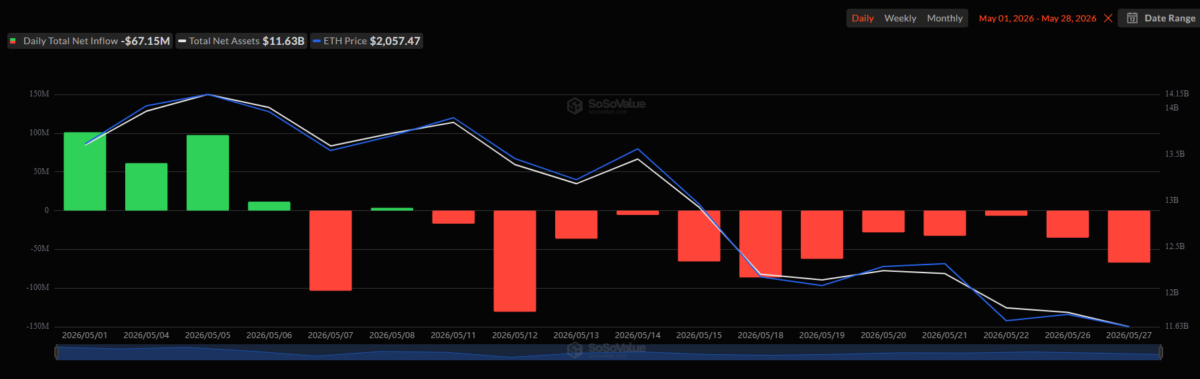
On-chain data shows rising exchange inflows and declining reserves on some platforms, suggesting distribution by large holders. This retail optimism contrasts sharply with professional selling. ETF outflows have totaled hundreds of millions in May alone, exacerbating liquidity pressure.
Technical indicators paint a mixed but cautious picture. Oversold readings on RSI and Stochastic oscillators hint at a possible short-term bounce, but failure to reclaim $2,050–$2,100 resistance quickly could accelerate moves toward lower supports.
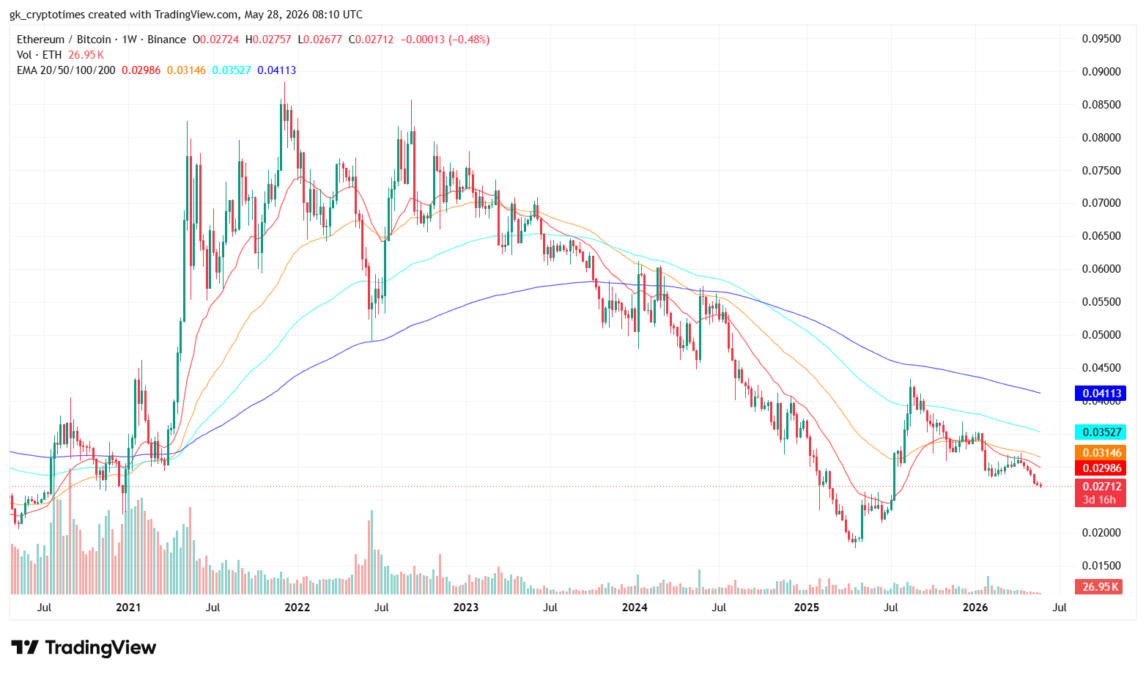
The ETH/BTC ratio sits near multi-year lows around 0.027, underscoring Ethereum’s relative weakness as capital rotates toward Bitcoin’s perceived safety.
Broader Criticism on ETH’s Lack of Momentum
Ethereum faces mounting criticism for its failure to deliver significant upside in the current cycle, despite its foundational role in decentralized finance (DeFi) and smart contracts. Detractors point to chronic underperformance versus Bitcoin, with the ETH/BTC pair hovering around five-year lows.
While BTC has held relatively holds near $72,000–$74,000 ranges, ETH has lagged, fueling narratives of “flawed value proposition” and “overpromised scaling.”
Ethereum’s current key grievances include competition from faster, cheaper alternatives like Solana. Some analysts argue Ethereum’s modular roadmap has diluted its narrative, turning it into a “settlement layer” rather than a high-growth asset.
Vitalik Buterin’s occasional (and Ethereum Foundation’s repeated) ETH sales and internal development debates have also drawn scrutiny, amplifying perceptions of leadership fatigue.Institutional rotation exacerbates this.
Spot ETH ETFs have also seen prolonged outflows, with the current month seeing $401.62 million in outflows—stretching the daily outflow streak to 12 days now.
Critics sarcastically label ETH “overvalued at $200B market cap” relative to its utility growth, especially as meme coins and newer L1s capture retail hype. This sentiment echoes past cycles where Ethereum endured long consolidation before breakout rallies, but the prolonged drawdown tests holder patience.
Recent Developments and Institutional Moves on Ethereum
Despite the current price pressure, Ethereum’s ecosystem continues to attract significant institutional interest and deliver technical progress in 2026. The most prominent corporate buyer remains BitMine Immersion Technologies (NYSE: BMNR), chaired by Tom Lee.
In the week ending May 25, 2026, BitMine executed its largest single-week Ethereum purchase of the year—acquiring 111,942 ETH worth approximately $237 million. This brought the company’s total holdings to 5.39 million ETH, valued at around $12 billion and representing over 4.47% of Ethereum’s circulating supply.
BitMine has now staked more than 87% of its stack via its MAVAN platform, generating substantial annualized yield. The firm remains firmly on track for its “Alchemy of 5%” goal sometime in 2026.
Implemented in 2025, Pectra upgrade effects continue to materialize. This upgrade raised the maximum effective validator balance from 32 ETH to 2,048 ETH, enabling large institutions and custodians to consolidate staking operations dramatically. Ultimately, it lowered operational overhead and improved capital efficiency for corporate treasuries and ETF providers.
The current staking participation remains robust on Ethereum, with over 30% of supply locked, supporting network security and deflationary mechanics through fee burning.
Outlook
Ethereum’s near-term outlook hinges on reclaiming $2,100 and stemming ETF bleeding. A failure to hold $1,970 could test $1,800, but oversold conditions and upcoming catalysts offer rebound potential.
Analysts like those at Standard Chartered eye ambitious $7,500+ targets by end-2026, citing RWA growth, staking yields, and network upgrades. More conservative forecasts cluster around $3,000–$5,000 if macro headwinds (inflation, rates, geopolitics) ease.
Longer term, Ethereum’s moat in smart contracts, security, and developer activity remains formidable. Success of Pectra and future scaling will determine whether it regains narrative dominance or continues ceding ground to competitors.
Also read: Coinbase, Binance.US, Kraken Join Blockworks Transparency Alliance