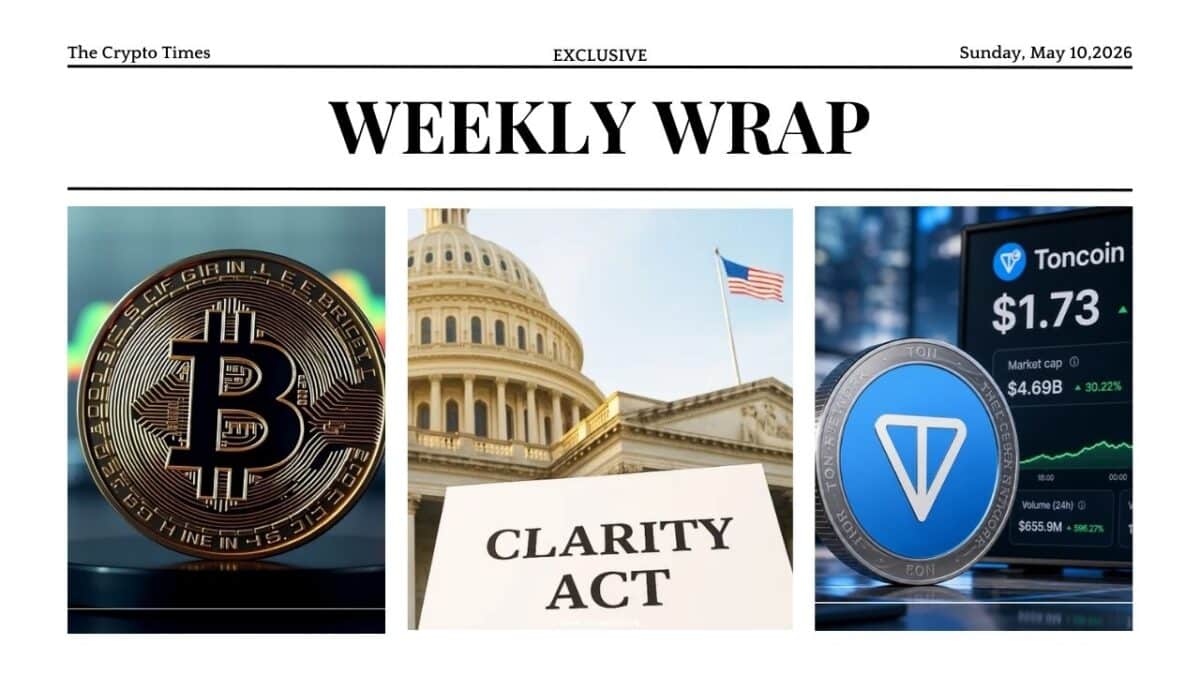
Welcome to this week’s cryptocurrency market update. If last week was about the CLARITY Act breaking its deadlock and the steady drip of DeFi exploits, this week the conversation shifted to Bitcoin reclaiming $80,000 on the back of Trump’s “Project Freedom,” a CLARITY Act sprint toward a July 4 signing deadline, and Toncoin’s explosive 120% rally as Telegram tightened its grip on TON.
Justin Sun and World Liberty Financial took their feud to court, Vitalik got sandwiched, and Western Union’s USDPT finally went live on Solana. Let’s get into it.
Top headlines for this week
Below are the major headlines, giving an overview of what happened in the crypto market this week.
Bitcoin surges past $80,000 on Trump’s “Project Freedom”
The biggest market story of the week was Bitcoin’s breakout above $80,000 as President Trump’s newly announced “Project Freedom” initiative sent risk assets ripping across the board. The rally was reinforced by $630 million in fresh institutional flows into BlackRock, Fidelity, and Ark spot Bitcoin ETFs, signaling that the institutional bid is back in full force.
Strive kept its weekly accumulation streak alive, adding another 444 BTC as Bitcoin touched the $80K mark. All eyes, however, are on Strategy. With Saylor’s company sitting on 818,000 BTC and a Q1 earnings call on deck, speculation grew over whether Saylor might finally trim his Bitcoin stack after a reported $12.5 billion paper loss, a possibility that would mark a stunning U-turn from the firm’s “never sell” mantra.
CLARITY Act heads for a July 4 finish line
Regulatory momentum on the CLARITY Act accelerated dramatically this week. Senator Bernie Moreno predicted Trump would sign the bill before July 4, setting a hard public deadline. Senator Lummis declared the Act “the priority” amid a fresh banking divide, while she and Senator Tillis publicly defended the stablecoin compromise against mounting banking lobby pushback.
The bill is in an awkward sweet spot. Banks and crypto firms both hate it, yet the White House is calling it a deal. Senator Gillibrand drew her own red line, refusing to back the Act without a strong ethics provision, and Democrats more broadly threatened to block the bill without tougher ethics rules attached.
Crypto stocks rallied hard on the compromise. Circle closed up 19.9%, and Coinbase rose 6.1% on the news, with the broader basket of crypto-linked equities surging in tandem. Consensys lawyer Bill Hughes argued the Act could bring crypto trading back onshore, while Arthur Hayes was less convinced, bluntly stating the CLARITY Act won’t help crypto at all.
Toncoin rockets 120% on Telegram takeover
Toncoin had a week to remember. The token jumped 26% in a single session after Telegram slashed network fees by 6x and formally took control of the TON blockchain, ending years of arms-length distance between the messaging giant and the chain it spawned.
By week’s end, the rally extended to a 120% weekly gain as TON hit a record 0.6-second finality, the fastest in its history. The combination of slashed fees, blistering finality, and direct Telegram stewardship has repositioned TON as one of the most aggressive ecosystem plays of 2026.
Western Union’s USDPT goes live on Solana
After signaling its move into stablecoins last week, Western Union officially launched its USDPT stablecoin on Solana, promising faster payments across more than 200 nations. The launch is one of the largest TradFi-to-crypto crossovers of the year, putting a 173-year-old remittance giant directly on chain just as the CLARITY Act inches toward a stablecoin framework.
WLFI takes Justin Sun to court
The simmering feud between World Liberty Financial and Tron founder Justin Sun finally boiled over into the courtroom. WLFI filed a lawsuit against Sun over a token dispute and defamation claims, escalating a feud that has played out publicly for months.
Sun fired back almost immediately, calling the suit a “PR stunt” and vowing to fight every claim. WLFI later denied crisis rumors swirling around the legal battle, but the optics of the Trump-linked DeFi project tangled up in litigation with one of crypto’s most polarizing figures will not fade quickly.
DeFi exploits keep stacking up
The DeFi exploit cycle continued without pause. Wasabi Protocol triggered an emergency lockdown and probe after an EVM breach, halting activity while the team investigated. Days later, Trusted Volumes was drained for $5.9 million through the 1inch liquidity system, the latest reminder that DEX aggregator infrastructure remains a high-value target.
The Drift Protocol fallout from its $295 million hack also moved into recovery mode, with the team rolling out a user recovery plan for affected depositors. On the Kelp DAO front, the post-mortem turned ugly. KelpDAO pinned the blame on LayerZero and announced a shift to Chainlink’s CCIP after the $292 million hack, while a parallel court clash erupted between Aave and law firm Gerstein Harrow over the $71 million in stolen ETH tied to the same incident.
Polygon launches private stablecoin payments
Polygon made a significant privacy push, launching private stablecoin payments for USDC and USDT transfers using zero-knowledge technology. The feature lets users transact with the two largest stablecoins without exposing amounts or counterparties on chain, an aggressive move at a time when regulators are sharpening their focus on stablecoin transparency.
Vitalik gets sandwiched on Ethereum
In one of the more bruising headlines of the week, Vitalik Buterin was hit by an MEV sandwich attack on his own network. An MEV bot front-ran and back-ran one of his Ethereum swaps, costing him real money and reigniting the long-running debate over MEV mitigation on Ethereum. If Ethereum’s co-founder cannot avoid getting sandwiched, the average user does not stand a chance.
Bitmine adds 101K ETH but holdings slip to $13B
Ethereum treasury accumulation continued, with Bitmine adding another 101,000 ETH to its stack. The price action, however, took a bite out of the books. The firm’s holdings slid to roughly $13 billion on the ETH price dip, a reminder that even the most aggressive treasury buyers are exposed to mark-to-market swings.
Terra Luna Classic surges 150% on Binance burn
LUNC bulls finally got something to cheer about. Terra Luna Classic surged 150% in a month after Binance executed a burn of 923 million LUNC tokens. The burn slashed circulating supply at a moment when retail attention was rotating into long-tail recovery plays, sending the once-left-for-dead token vertical.
News you might have missed
- Litecoin patches MWEB again: Litecoin released its 5th core patch in 2 months after the ongoing MWEB crisis, the latest in a steady drumbeat of fixes for its MimbleWimble privacy feature.
- Eric Trump-backed miner posts heavy loss: The Eric Trump-backed Bitcoin miner reported an $81.8 million loss amid growing political and regulatory scrutiny over the venture.
- SIREN meme coin awakens: The SIREN meme coin rallied roughly 50% in 24 hours after weeks of silence, with traders piling back in on a fresh wave of social momentum.
Buzz of the Week
The buzz this week belonged to the CLARITY Act, but for a different reason than last week. Last week, the question was whether the bill could survive committee. This week, it is whether Trump signs it before July 4.
Senator Moreno’s deadline put a hard date on the calendar. Lummis and Tillis stepped out to defend the stablecoin compromise. Crypto equities ripped on the news, with Circle alone closing up nearly 20%. And yet, in a strange bipartisan symmetry, both the banking lobby and a vocal slice of the crypto industry are now openly hostile to the final shape of the bill.
Banks dislike the carve-outs around stablecoin issuance and yield. Crypto natives like Arthur Hayes argue the bill does nothing meaningful for the industry it claims to regulate. Gillibrand and a bloc of Senate Democrats want ethics provisions added before they will support it.
The White House calling it “a deal” while both sides of the aisle complain may be the clearest sign that something is actually going to pass. Compromises that satisfy nobody often clear the floor; perfect bills die in committee.
Bitcoin’s surge to $80,000 on “Project Freedom” added fuel to the political narrative. With BTC ETFs absorbing $630 million in a single push and Strive, Strategy, and Bitmine all pressing ahead with treasury buys, the institutional bid has clearly returned. The pressure point now is Saylor.
After a $12.5 billion paper loss and the highest-stakes Q1 earnings call of the year, even the smallest hint of a Strategy sell-down would echo through the market for weeks.
Toncoin, meanwhile, ran the loudest under-the-radar trade of the week. A 120% rally, a 6x fee cut, record 0.6-second finality, and Telegram formally taking the wheel is the kind of week that resets a project’s narrative completely. TON walked into the week as a Telegram-adjacent chain and walked out as a Telegram-led chain.
The DeFi exploit pace is the part of the picture nobody can spin. Wasabi, TrustedVolumes, the lingering Drift recovery, and the Kelp DAO blame game all landed in the same seven-day window. The Aave vs Gerstein Harrow court fight in particular signals that the legal recovery phase of these hacks is now its own multi-million-dollar arena, with law firms, DAOs, and protocols all jockeying over frozen funds.
What to expect for next week?
Next week is shaped by three questions. Does Strategy’s Q1 earnings call confirm or kill the speculation that Saylor is about to sell? Does the CLARITY Act survive the Democratic ethics-provision standoff and clear another procedural hurdle on its way to Trump’s desk? And does the DeFi exploit cycle finally take a breather, or do Wasabi and TrustedVolumes get joined by another major name?
The Strategy call is the single highest-impact event on the calendar. With 818,000 BTC on the balance sheet and a $12.5 billion paper loss in the books, anything Saylor says about treasury policy will move price. A reaffirmed “never sell” stance keeps the bid intact. Even a hint of a strategic trim, and the market will price it in instantly.
On the regulatory side, the next test is whether Senate Democrats hold the line on ethics provisions or fold under the timeline pressure of a July 4 signing. If Gillibrand’s bloc holds, the bill may slip into the second half of the year. If they fold, Trump signs the most consequential piece of crypto legislation in U.S. history before Independence Day.
And keep watching TON. A 120% week ends one of two ways: a hard correction back into the trend, or a continuation that drags more capital out of Solana and Ethereum L2s. Telegram’s deeper involvement is the structural wildcard that did not exist a month ago.
Also Read: LayerZero Says “We Own That” After $292M Kelp DAO Hack, Admits Security Mistake