Key Highlights
- Bitcoin whales (1,000+ BTC wallets) accumulated 270,000 BTC — worth ~$20B — in 30 days, the largest monthly buying spree since 2013. This occurred while retail sentiment stayed weak and the Fear & Greed Index lingered in extreme fear.
- CryptoQuant’s Spot Average Order Size metric shows elevated activity, with Binance’s average Bitcoin spot order size reaching $1.96 million. Green-highlighted “big whale orders” dominate near $70K–$75K, indicating institutions are overpowering retail flows.
- Exchange Bitcoin reserves have plunged to levels last seen in December 2017 (~2.3–2.7M BTC). Combined with rising 1,000+ BTC addresses, this signals coins moving into strong hands — echoing past cycles where whale accumulation during fear preceded major rallies.
Bitcoin whales have accumulated roughly 270,000 BTC over the past 30 days in what on-chain analysts describe as the biggest monthly buying binge since 2013, according to data highlighted by Bitfinex and tracked by CryptoQuant.
The purchases, worth roughly $20 billion at current prices around $74,500–$75,000, come as Bitcoin (BTC) hovers in a tight range after a volatile start to 2026. Large holders—typically wallets with 1,000 BTC or more—have stepped in aggressively while retail sentiment remains subdued, with the Crypto Fear and Greed Index lingering in extreme fear territory for weeks.
This wave of buying stands out for its intensity. Wallets in the 1,000+ BTC cohort net added approximately 270,000 BTC in a single month, equivalent to about 1.3% of Bitcoin’s total circulating supply. Analysts note this marks the strongest monthly accumulation by large holders in over 13 years, surpassing even notable periods from previous cycles.
The move comes amid mixed broader signals. While some early whales from the 2013 era have taken profits by moving coins to exchanges, the net flow for the broader whale category shows clear net buying. This divergence—smart money accumulating while select long-dormant holders distribute—highlights a maturing market where different cohorts operate on varying time horizons.
Market microstructure: Spot Average Order Size tells the story
The massive accumulation by whales has coincided with a notable shift in market microstructure visible on CryptoQuant’s Spot Average Order Size chart. This metric divides total spot trading volume by the number of executed trades across major platforms like Binance, Coinbase, OKX, and others.
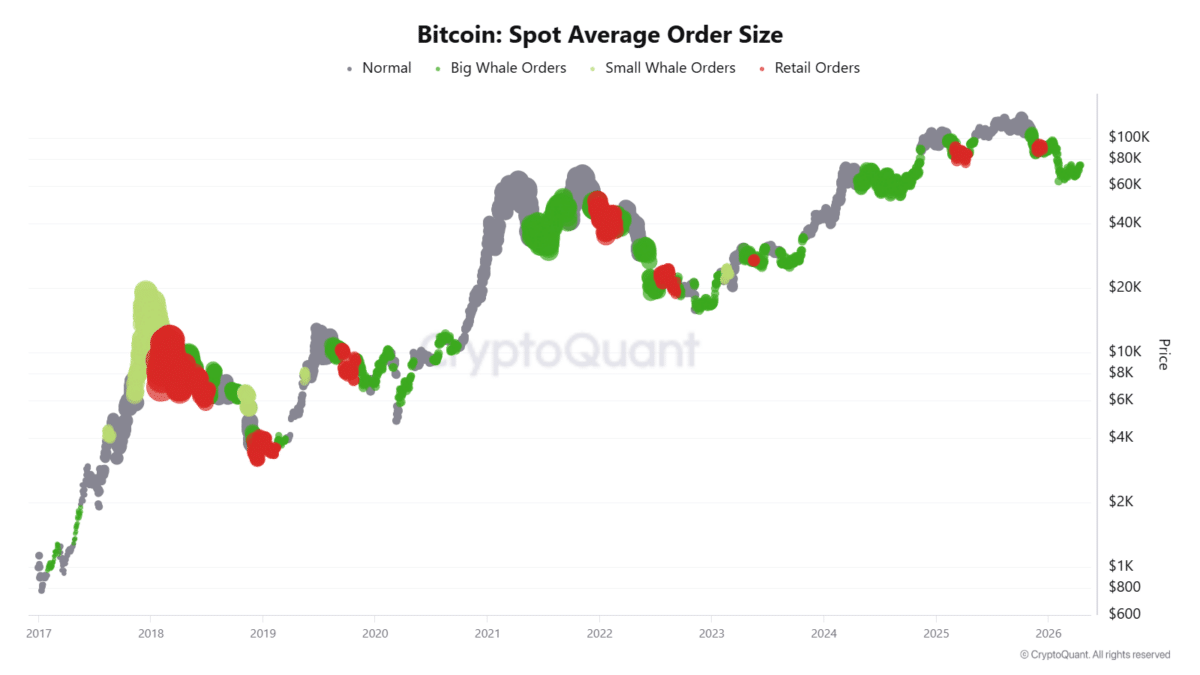
In recent sessions, the indicator has shown elevated readings. On Binance alone, the average Bitcoin spot order size climbed toward $1.96 million, reflecting a heavier presence of large, professional-sized trades amid the broader accumulation phase.
Green-highlighted periods on the chart—indicating dominant “big whale orders”—have become more prominent near the $70,000–$75,000 range. This suggests oversized buys are increasingly overpowering smaller retail flows while Bitcoin consolidates. Larger average order sizes typically signal increased participation from institutions and sophisticated players rather than fragmented retail activity.
This order-size dynamic adds weight to the broader supply-tightening narrative. As whales quietly stack coins—often pulling them into long-term wallets—Bitcoin reserves on centralized exchanges have dropped to levels last seen in December 2017, hovering around 2.3–2.7 million BTC depending on the exact tracking window.
Fewer coins remain on platforms for immediate trading, reducing the liquid supply available to meet new demand. Miner reserves have also declined modestly over longer periods, contributing to the overall sense that Bitcoin is migrating from exchange hot wallets into colder, more permanent storage.
Conviction signals amid fear
The combination paints a picture of conviction-driven demand: large players absorbing supply during a period of elevated fear, with fewer coins left on platforms for immediate trading. In recent months, the number of addresses holding at least 1,000 BTC has ticked higher, reaching around 2,024–2,029 addresses, adding to the conviction signal.
While overall spot demand has shown some contraction in recent CryptoQuant readings, and hourly exchange inflows have occasionally spiked (reaching 11,000 BTC amid recent rallies toward $76,000), the quality of volume—skewed toward bigger orders—hints that smart money is positioning for the long haul, even if short-term price action remains choppy.
Besides, the Fear and Greed Index has frequently dipped into the teens, reflecting widespread caution after early-2026 volatility. This setup echoes classic accumulation phases where fear keeps weaker hands sidelined while disciplined buyers quietly build positions.
Historical parallels and cautious voices
Others caution that past whale buying sprees haven’t always marked immediate bottoms. Macro headwinds, regulatory noise, and occasional large profit-taking from early holders can still weigh on price action.
Some 2013-era whales have resurfaced to realize gains, reminding observers that not all large holders move in lockstep.
Still, the combination of record accumulation and shrinking exchange balances is hard to ignore for long-term bulls. It echoes patterns from previous cycles where supply shocks eventually fueled sharp rallies once demand reignited. In prior bull markets, similar periods of whale loading during fear preceded extended uptrends as liquidity returned and sentiment shifted.
Whether this marks a definitive bottom or simply a deep accumulation phase remains an open question. Bitcoin continues testing ranges around $70,000–$76,000, with near-term selling pressure noted when prices approach higher resistance and inflows rise.
At the time of publishing, BTC was trading near $74,000 with a 24 hour trading volume of $38 billion—as per CoinMarketCap data.
For now, the data shows institutions and large holders voting with their wallets—quietly, and in size. The next leg may depend on whether that conviction spreads beyond the whale cohort, potentially drawing in sidelined capital once fear subsides.
In the meantime, the on-chain picture suggests Bitcoin’s available supply is tightening, setting the stage for potential volatility as the market digests this significant transfer of coins into stronger hands.
Also read: US Sees India at the Center of Global Crypto Framework