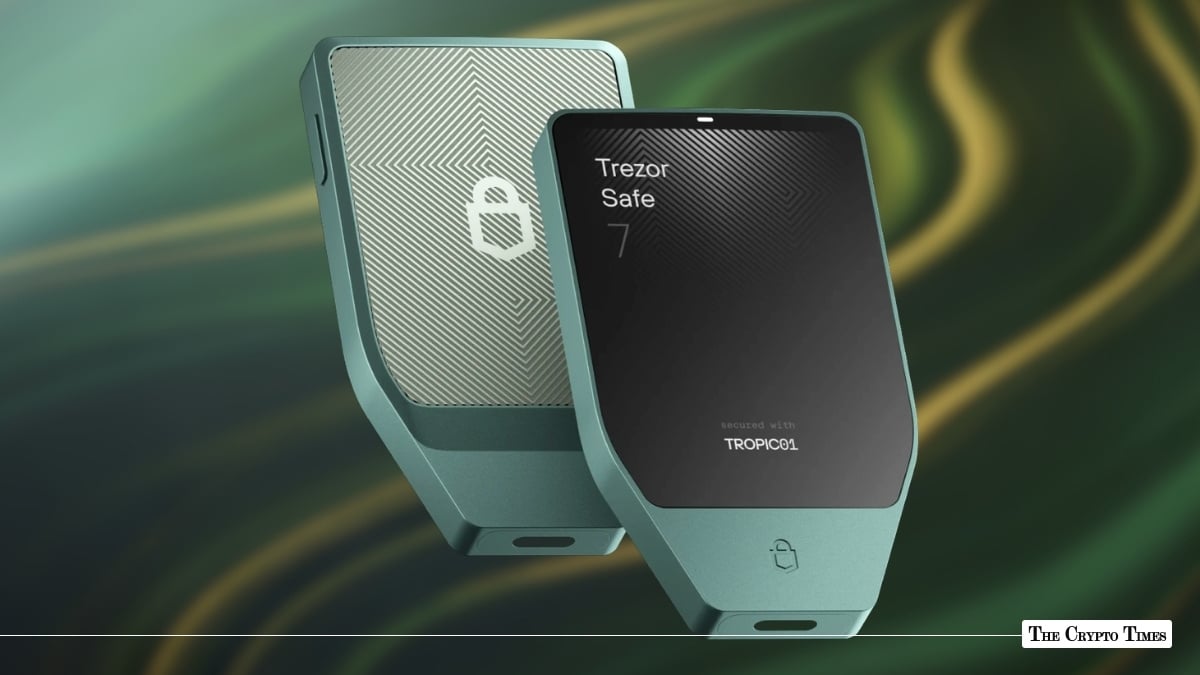
Trezor, a leading crypto hardware wallet brand, has publicly announced a security vulnerability in the TROPIC01 secure element chip used in its Trezor Safe 7 hardware wallet.
The flaw was uncovered during an independent audit by Ledger’s Donjon team and formally disclosed by Tropic Square. Trezor emphasized that user funds, PINs, and backups remain completely secure, requiring no action from owners.
The vulnerability was identified through rigorous security research by Ledger Donjon. Tropic Square’s engineering team then extended the analysis and disclosed an additional finding. This coordinated process exemplifies responsible vulnerability handling in the cryptocurrency hardware industry.
TROPIC01 was developed as the first fully open and auditable secure element, featuring a RISC-V core and custom cryptographic coprocessor. Its complete source code and documentation are publicly available on GitHub, enabling community verification unlike traditional closed-source chips. This transparency was a deliberate design choice by Trezor to address past industry limitations where NDAs prevented timely disclosure of issues in proprietary components.
“Ledger Donjon’s audit identified a vulnerability in TROPIC01 through complex security research,” Trezor CEO Matej Žák said in an exclusive statement shared with The Crypto Times. “Tropic Square’s engineering team then extended the work and disclosed an additional finding. This is what coordinated disclosure should look like. And because the Trezor Safe 7 was built with multiple independent security layers, a vulnerability in TROPIC01 does not put user funds at risk.”
Layered Security Ensures No Risk to Users
The Trezor Safe 7 incorporates multiple independent physical security layers, ensuring no single component becomes a point of failure.
The TROPIC01 chip handles tasks such as device authenticity verification, PIN enforcement, and secure randomness generation, but it works alongside Infineon’s OPTIGA Trust M and the main microcontroller unit (MCU).
The firm notes that private keys (the seed) are encrypted on the MCU and never stored solely in any secure element. Decryption requires combining temporary keys from multiple sources, which exist only briefly in memory.
As a result, compromising user assets would demand simultaneous breaches of all layers—an exceptionally difficult and resource-intensive attack. Tamper-protection sensors for voltage, temperature, and physical intrusion further strengthen the device.
“Trezor Safe 7 was built to include TROPIC01, an open and auditable secure element, so its security could be independently verified,” Žák highlighted the intentional architecture, adding, “The device itself was designed with multiple independent security layers so that no single component is a single point of failure. Both decisions matter today.”
Advancing Open-Source Security Standards
Trezor’s swift and transparent response reinforces its commitment to open-source principles. By choosing an auditable secure element and publicly detailing the issue, the company aims to raise industry standards and foster greater trust in self-custody solutions.
The incident demonstrates the advantages of verifiable hardware. Open designs allow faster identification and patching of vulnerabilities compared to opaque “black box” alternatives. It encourages wider adoption of auditable components across crypto and IoT devices. As regulatory frameworks like the EU Cyber Resilience Act emphasize verifiable trust, collaborative audits and transparent disclosure are likely to become best practices.
The TROPIC01 vulnerability underscores the strength of Trezor’s multi-layered architecture and proactive transparency. For millions of users, the incident highlights how deliberate design choices—open verification and redundancy—build genuine resilience.
The broader message is that true security in cryptocurrency hardware relies on verifiable processes rather than unexamined assumptions.
Also read: Singapore’s Second Joint Operation Prevents $4.2M in Crypto Losses