Key Highlights
- World Liberty Finance (WLFI) has publicly threatened legal action against Justin Sun following his April 12 allegations that the protocol embedded a hidden blacklist function used to freeze his ~$70M token holdings.
- The project’s treasury borrowed roughly $75M in stablecoins against 5 billion WLFI tokens on Dolomite, where it now controls more than half of all supplied assets.
- Sun is demanding public disclosure of the single guardian wallet and 3-of-5 multisig that retain unilateral freeze authority over user tokens.
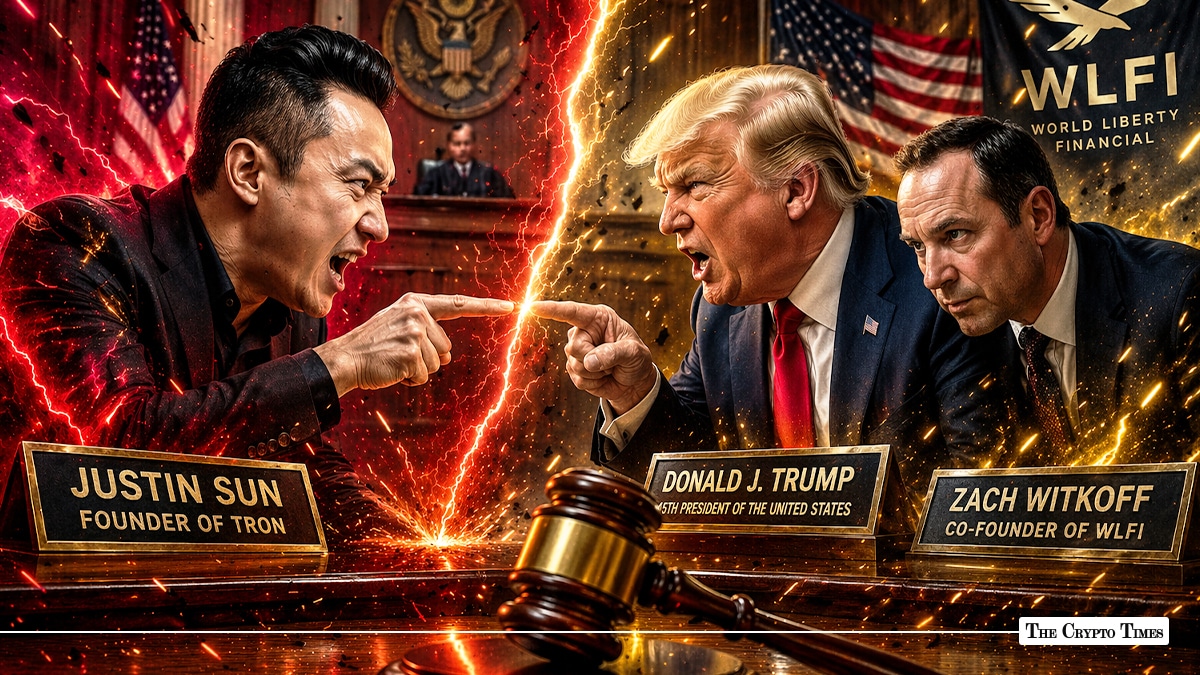
The dispute between Trump-linked World Liberty Financial (WLFI) and Tron Founder Justin Sun has escalated into open legal threats over the weekend, after Sun alleged the protocol secretly inserted a token-freezing function into its smart contracts following his $30 million investment.
WLFI’s official X account responded on April 12 with a four-line statement ending: “See you in court pal.” Within minutes, Sun called on the project to publicly identify the wallet holders who retain unilateral authority to freeze any user’s tokens — a demand he repeated, more forcefully, the next day.
The standoff has pushed WLFI’s token to a fresh all-time low and reignited long-running questions about whether the self-described decentralized protocol was ever decentralized at all.
Sun, who invested ~$30 million and served as advisor, responded within minutes, demanding the anonymous team identify itself and accusing WLFI of treating the community “as a personal ATM.” The next day, he doubled down, calling for full disclosure of the single guardian EOA and 3/5 multisig controllers that can freeze tokens unilaterally.
The timing couldn’t be worse. Just days before, WLFI’s treasury had deposited ~5 billion WLFI tokens as collateral on Dolomite to borrow ~$75 million in stablecoins — a move that helped trigger a 15% price crash to a new all-time low near $0.08. Community panic over liquidation risk, self-dealing, and centralized control has now reached a boiling point across X, Reddit, and WLFI’s governance forum.
This is the most detailed breakdown yet of the WLFI vs. Justin Sun war — on-chain facts, full timeline, tokenomics red flags, and what it means for every PolitiFi investor.
What is World Liberty Financial (WLFI)?
Launched in 2024, World Liberty Financial is a DeFi protocol with deep ties to the U.S. President Donald Trump’s family, which, according to public disclosures, receives up to 75% of profits from certain token sales while holding limited operational roles.
The project operates a lending market, the USD1 stablecoin, and a staking system, and has signaled plans to enter forex.
As of April 14, WLFI trades near $0.08120, down roughly 82% from its September 2025 peak of $0.46. The circulating supply sits at 31.76 billion of a 100 billion total, giving it a market capitalization of about $2.54 billion against a fully diluted valuation of $8.02 billion.
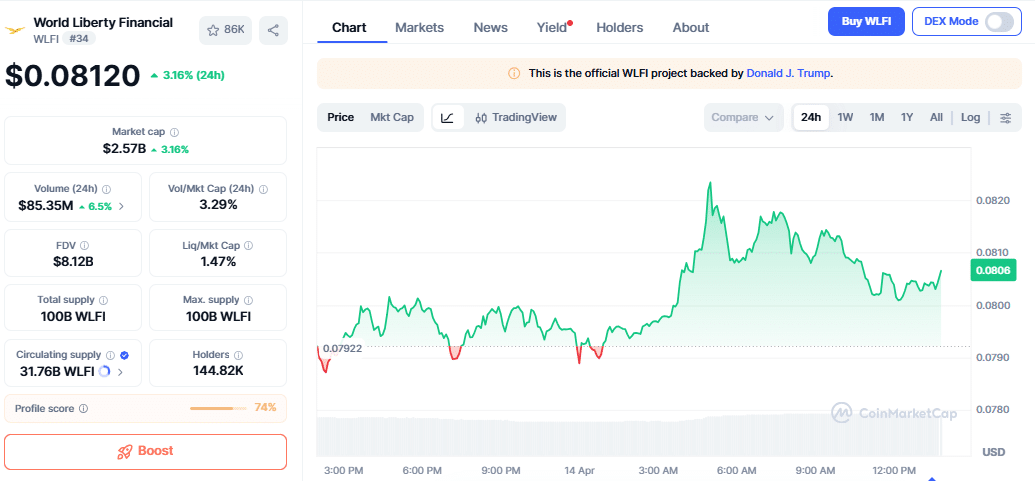
The drama has spiked 24-hour volume to roughly $86 million. The project’s USD1 stablecoin has more than $4.08 billion in circulation.
The project launched Dolomite-powered lending in January 2026 and overhauled staking in February to favor long-term holders. Critics now say anonymous multisig power and treasury moves prove it was never truly decentralized.
The Justin Sun Fallout: From $30M+ Investor to “Trap Door” Victim
Justin Sun became WLFI’s largest outside investor with a ~$30M purchase on November 26, 2024 and joined as advisor. Then in September 2025, WLFI blacklisted his wallet, freezing 545–595 million WLFI tokens (then worth ~$107M). Sun claims the project quietly added blacklist and batch-reallocation functions via upgrades in August and November 2025 — after his investment.
Sun’s relationship with WLFI was, until recently, the project’s strongest external endorsement. His November 2024 investment — among the largest single buys in WLFI’s history — was followed by an advisory role and frequent public support across his social channels. The September 2025 freezing of his wallet, which the project has framed as a security action against alleged misappropriation, marked the formal end of that alliance.
In a thread posted April 12, Sun wrote that the protocol had “embedded a backdoor blacklisting function” giving insiders “unilateral power to freeze… without notice, without cause, and without recourse,” concluding: “This is a trap door marketed as an open door.”
On April 13, he escalated: “I am calling on World Liberty Financial to publicly disclose who controls the single guardian EOA and the 3/5 multisig… one person — one single individual — has the unilateral power to freeze any token holder’s assets.”
WLFI’s response was short and combative: “Justin’s favorite move is playing the victim… See you in court pal.”
The $75M Dolomite Borrow: Self-Dealing or Smart Treasury Move?
Just days before the public blow-up, WLFI’s treasury supplied 5B WLFI ($440–460M at the time) to Dolomite and borrowed ~$75M in stablecoins ($65M+ USD1 and USDC). Over $40M was routed to Coinbase Prime. WLFI now controls >50% of Dolomite’s supplied assets.
Community reaction was immediate: 15% price crash, liquidation fears, and accusations of “collateral looping.” WLFI defended the move, stating it is “nowhere near liquidation” and would simply add more collateral if needed. It also highlighted $6.558M in token buybacks and USD1 revenue.
The structural concern is straightforward: WLFI is a thinly traded governance token, and using 5 billion units of it as collateral to extract $75 million in liquid stablecoins concentrates risk in two directions at once. If the token slides further, automated liquidations on Dolomite could force collateral sales into a market with limited depth, creating a feedback loop.
And because WLFI now accounts for more than half of all assets supplied to Dolomite, retail lenders on the other side of the trade are effectively underwriting the treasury’s position. The team has stated it will “supply more collateral” if the price falls — a defense that depends entirely on the team’s continued willingness and ability to do so.
Full WLFI Drama Timeline (2024–2026)
| Date | Event | Market Impact |
|---|---|---|
| Nov 26, 2024 | Justin Sun invests over $30M and joins as an advisor | Massive hype |
| Aug–Nov 2025 | Smart contract upgrades introduce blacklist and batch-reallocation functions | Sun’s wallet frozen (Sep 2025) |
| Sep 2025 | Sun’s 595M tokens blacklisted (~$107M value at time) | Trust erosion begins |
| Jan 2026 | Dolomite lending markets launch for USD1 | Stablecoin growth |
| Feb 2026 | Staking overhaul + forex platform tease | Mixed governance sentiment |
| Apr 9–10, 2026 | Treasury deposits 5B WLFI, borrows $75M on Dolomite | 15% crash to ATL |
| Apr 12, 2026 | Sun’s “trap door” thread; WLFI “See you in court pal” | Volume explodes |
| Apr 13, 2026 | Sun demands EOA/multisig disclosure | Legal war escalates |
WLFI Controversy vs. Community Sentiment
| Issue | Justin Sun’s Stance | WLFI Team’s Defense | Community / DeFi Analyst View |
|---|---|---|---|
| Token Freeze | Hidden “trap door” used to confiscate tokens illegitimately. | Necessary security measure; Sun’s wallet was flagged for misappropriation. | Skeptical of centralized backdoors in supposed DeFi protocols. |
| Dolomite Loan | Points to it as further proof of team mismanagement. | “Nowhere near liquidation.” Highlights $159.5M annualized USD1 revenue. | Highly dangerous. Illiquid tokens used to extract hard cash by insiders. |
| Governance | Rigged votes orchestrated to benefit the founders. | Community-driven votes to protect the ecosystem. | Governance is an illusion; insiders hold majority control. |
Fact-Checking the Drama
Claim: Dolomite lenders have lost their funds.
False.
Dolomite remains operational and no liquidations have been triggered. That said, the risk profile of the platform has shifted significantly, with WLFI now accounting for more than half of all assets supplied to the protocol. The WLFI team has stated it will add further collateral if the token’s price continues to decline, though that defense rests entirely on the team’s willingness and ability to do so.
Claim: Justin Sun is suing Donald Trump.
False.
Sun has explicitly reaffirmed his support for President Trump and his crypto policy stance in both his April 12 and April 13 X posts. His allegations and legal threats are directed at what he has called “the bad actors at WLFI” — namely the project’s core development and operational team — not the Trump family or the President personally.
Claim: The $75M Dolomite borrow was illegal.
False.
Though the structure has drawn sharp criticism, self-collateralized borrowing is a standard DeFi mechanic and not unlawful on its face. The concern, raised by on-chain analysts and community members, is narrower: WLFI used a thinly traded governance token to extract $75 million in stablecoins on a lending platform whose Co-Founder, Corey Caplan, also serves as a WLFI advisor and CTO. That overlap — combined with the treasury’s dominant share of Dolomite’s supplied assets — is what critics have flagged as a governance and conflict-of-interest concern, not a legal one.
Tokenomics & On-Chain Red Flags
- Supply: 100B total, only ~31.76% circulating. Sun claims his vesting category was uniquely altered.
- Buybacks: $6.558M spent repurchasing 43.5M tokens.
- Performance: –82% from ATH; drama has driven 3–5× volume but crushed holder confidence.
On-chain data shows one guardian EOA (tied to the multisig) can freeze unilaterally, while seizures need 3/5 approval — a structure Sun calls “theater” governance.
What to watch
No formal court filing has been made public by either party, and it remains unclear which jurisdiction WLFI would pursue action in. The more immediate pressure points are on-chain: any further decline in WLFI’s price brings the Dolomite position closer to liquidation thresholds, and any movement from the guardian wallet — particularly additional freezes or treasury transfers — will almost certainly intensify community backlash.
Regulatory attention is the longer tail. PolitiFi tokens with direct ties to sitting political figures already sit in an uncomfortable gray zone, and a public legal fight between the project and one of its largest early backers is precisely the kind of dispute that draws scrutiny.
For now, the dispute remains a war of statements. Both sides claim to hold the contracts and the evidence. Only one of them will be proven right.