Key Highlights
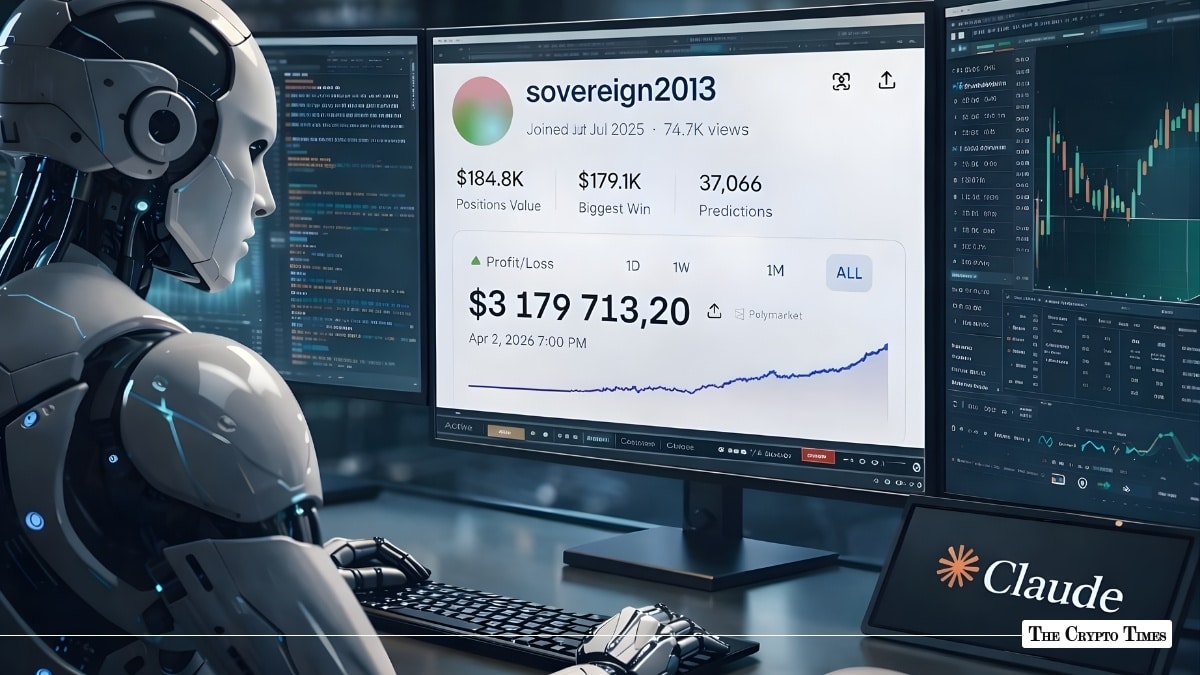
- Mario Nawfal shared a post showing a Claude-powered bot growing $1 into $3.3 million on Polymarket.
- The video in the post appears to track the bot’s activity from August 9, 2025, through April 2, 2026.
- The latest visible closed positions alone show more than $520,000 in profit across five sports-market trades.
Mario Nawfal, the host of the largest show on X, shared a post on Friday, claiming that a Claude-powered bot turned $1 into $3.3 million by arbitraging Polymarket faster than any human could react, adding fresh attention to the growing role of automation in prediction markets.
Based on the video shown in the post, the bot began trading on August 9, 2025, continued through April 2, 2026, and is still active at the time of posting.
The most recent visible trades in the video show realized profits of $179,119.67 on an Arizona Wildcats position, $114,244.37 on a Utah State Aggies spread market, $81,414.96 on Tulane vs. Temple, $73,763.92 on a Broncos spread trade, and $71,918.19 on a New Mexico vs. Minnesota market. Across just those five visible closed positions, the bot appears to have booked about $520,461.11 in profit.
The latest visible positions show repeated six-figure and high five-figure gains across sports markets, reinforcing the view that the strategy was consistently exploiting pricing inefficiencies rather than simply riding isolated winners.
The post adds to a broader shift underway in prediction markets, where speed, automation, and execution are becoming as important as the underlying forecast. If the video accurately reflects the account’s history, it points to a market increasingly shaped by bots that can identify and act on short-lived edges faster than manual traders.
How an AI trading bot would work on Polymarket
A bot like this would likely monitor Polymarket’s live feeds continuously, scan for temporary mispricings in sports or event markets, and then execute faster than a human user clicking through the interface. In fast-moving markets, especially sports, even a small delay can create a tradable gap if the bot is consuming real-time market data and reacting instantly through APIs rather than waiting for manual input. Polymarket’s own documentation shows that this kind of automated workflow is technically feasible on the platform.
That is why the post matters beyond the headline number. If the footage accurately reflects a live strategy, then the story is not simply about one profitable account. It is about prediction markets increasingly rewarding infrastructure, automation, and execution speed, not just directional conviction.
Risks readers should understand
The phrase AI trading bot can sound more precise than it really is. Large language models can help interpret information and generate trading logic, but they are still probabilistic systems. They can misread context, overfit patterns, or make poor decisions unless they are tightly constrained by rule-based code and risk limits. Anthropic’s own documentation makes clear that Claude is an API-accessible reasoning model and tool-using assistant, not a purpose-built market-making engine.
The market risks are equally serious. A bot trading prediction markets can be hurt by sudden repricing, low liquidity, slippage, bad fills, incorrect market assumptions, or event-resolution misunderstandings. The operational risks are just as important: if a system is wired into live APIs with wallet credentials, any bug, bad prompt chain, faulty external signal, or weak security setup can turn automation into a fast way to lose capital. That risk profile is a direct inference from the fact that Polymarket supports real-time data ingestion and authenticated order execution, while Claude can be embedded into tool-using software loops.
Also Read: TSLA, NVDA, PLTR: Polymarket Expands into TradFi with Pyth Integration