Key Highlights
- A group of seven accounts deposited $1.85M USDC, opened highly leveraged long positions to pump the illiquid XPL perpetuals, then simultaneously withdrew $4.63M—securing a swift ~150% return on capital while the trade lasted minutes.
- The aggressive pump triggered a cascade of short liquidations, forcing the platform’s Hyperliquidity Provider (HLP) pool to absorb roughly $600,000 in losses. Arkham also flagged a similar smaller play on the low-liquidity token Aster that netted the group ~$324K.
- This latest XPL maneuver highlights ongoing risks on Hyperliquid, where pre-market or low-float contracts have repeatedly seen large short squeezes.
A group of seven coordinated accounts pulled off a calculated maneuver on Hyperliquid that netted them roughly $2.78 million in profit while leaving the platform’s liquidity providers on the hook for $600,000 in losses.
Arkham Intelligence laid out the playbook in a Friday thread, noting the entity—now publicly labeled “XPL-trade” on Arkham’s explorer with holdings north of $4.9 million—routed about $1.85 million in USDC deposits primarily through Hyperliquid’s Bridge2.
From there, the accounts piled into highly leveraged long positions on XPL perpetuals—the native token of the forthcoming Plasma Layer 1 network, which carries ‘stablecoin narrative’ hype but limited real liquidity in futures markets.
Coordinated pump and precision exit
The mechanics of this coordinated exit were straightforward yet ruthless in an illiquid environment. In such markets like that of XPL on Hyperliquid, even moderate buying pressure in a shallow book can ignite violent moves, and that’s exactly what happened.
The leveraged longs created a sharp upward spike, squeezing shorts who had positioned against the token—whether hedging earlier pre-market exposure or simply betting on mean reversion. Charts shared by Arkham captured the textbook pattern: a near-vertical pump, a flurry of liquidations, and then the rapid unwind.
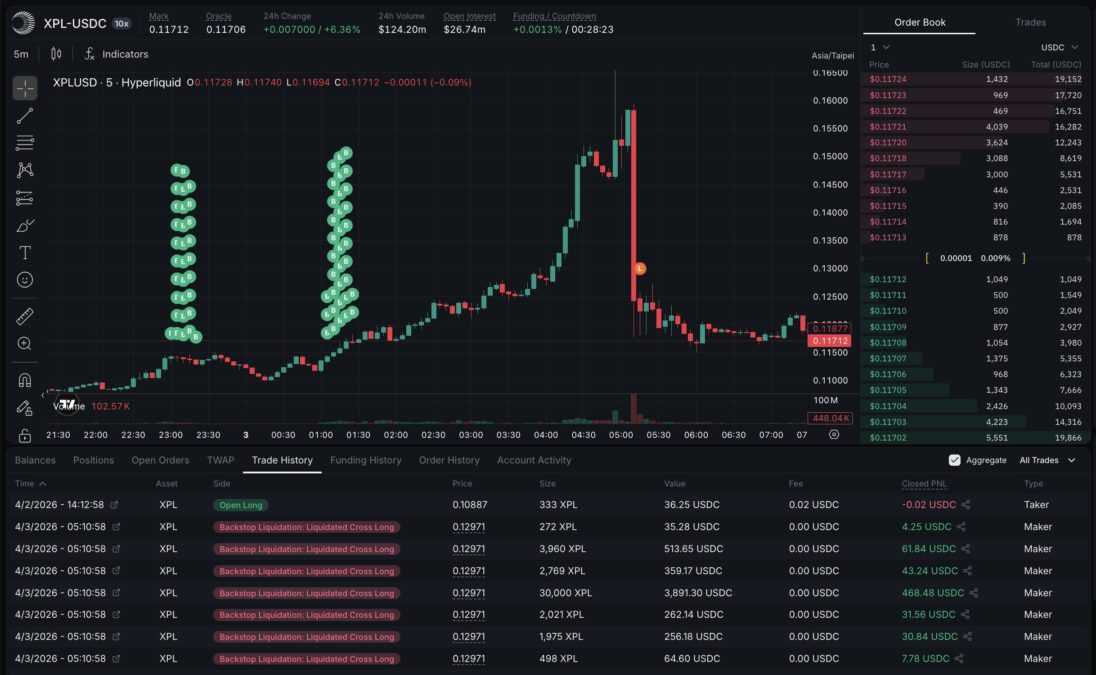
The cleanest part was the exit. At virtually the same instant, the seven accounts withdrew a combined $4.63 million from their collateral balances, locking in the gain.
Arkham noted a similar-looking play on another low-liquidity token, Aster, where the group apparently cleared around $323,000. The synchronized timing of deposits, position building, and mass withdrawals pointed to shared tooling or tight coordination rather than random traders riding the same wave.
Backstop losses and lingering questions for Hyperliquid
The real cost of this ‘push-and-dump scheme’ landed on Hyperliquid’s Hyperliquidity Provider (HLP) pool—the backstop that steps in during disorderly markets to prevent systemic failure.
By allowing their positions to hit backstop liquidation, the operators shifted roughly $600,000 of bad debt onto liquidity providers and the broader user base. It’s a feature of the platform’s design that protects overall stability but effectively socializes certain risks when aggressive plays succeed.
However, this is not an uncharted territory for Hyperliquid, as the perp DEX has witnessed repeated blowups in pre-market or low-float contracts. Earlier XPL episodes involved even larger squeezes that generated tens of millions in whale profits and triggered nine-figure liquidation volumes.
Hyperliquid’s full on-chain transparency helps analyze and reconstruct events after the fact, complete with wallet flows and timing. Yet that openness has not eliminated the incentive for players who view the mechanics as a solvable puzzle.
The platform has tweaked risk parameters in the past and, in some cases, delisted volatile contracts, but policing coordinated activity without introducing heavier central oversight remains a core tension in DeFi.
Plasma’s XPL itself sits at the intersection of genuine utility—gas, staking, and governance on a Bitfinex-linked Layer 1—and the speculative frenzy that surrounds pre-launch tokens. Moreover, futures markets detached from spot fundamentals amplify leverage-driven distortions, turning modest capital into outsized influence.
The episode adds another data point to the debate over market integrity in high-leverage DeFi venues. When thin liquidity meets heavy leverage and coordinated capital, the line between aggressive trading and manipulation can blur in real time.
As perpetual volumes keep climbing on platforms like Hyperliquid, the pressure mounts to harden risk engines against those who treat volatility as an extraction strategy rather than a two-sided risk.
Also read: ALGO Price Jumps 42% in a Week, but Bigger Risks Still Remain