Key Highlights
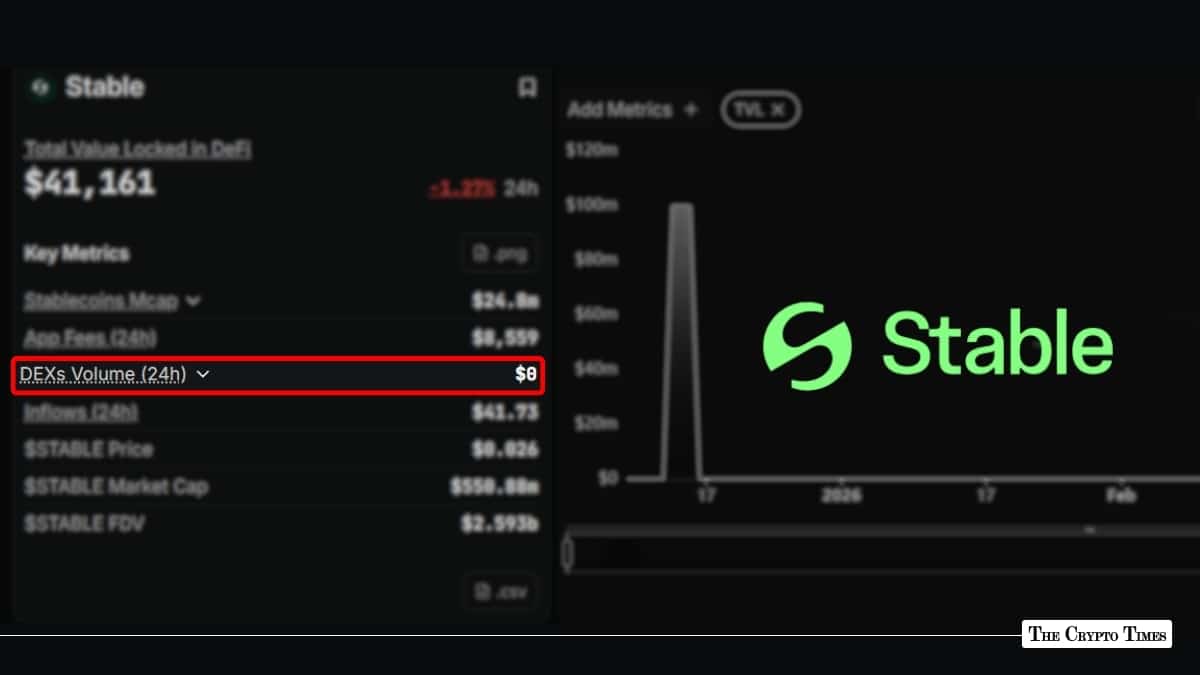
- Stable L1 (Tether-linked, USDT gas token) has a $2.68B FDV for its STABLE token, yet shows almost zero activity: $0 24h DEX volume, ~$41K TVL, and $24.8M stablecoin market cap.
- Plasma L1 (Bitfinex/Tether-backed) delivers real usage with ~$1.54B TVL, millions in daily DEX volume, and >$1.3B stablecoin deposits — yet its XPL token trades at only ~$950M FDV, less than half of Stable’s.
- Analyst The DeFi Investor highlighted how Plasma achieves far higher adoption than Stable despite a much lower FDV, underscoring that early-stage “stablechain” pricing often favors hype and backing over actual on-chain activity.
A stark divide in the crypto market has come into sharp focus after a prominent analyst, The DeFi Investor, highlighted the wildly divergent valuations of two new Layer 1 blockchains both built around stablecoin payments.
On one side sits Stable L1, a Tether-linked network launched late last year with sub-second finality and USDT as its native gas token.
According to data from DeFiLlama, the chain’s native STABLE token commands a fully diluted valuation (FDV) of roughly $2.68 billion. Yet on-chain activity remains virtually nonexistent on the network, as data shows 24-hour decentralized exchange volume stands at exactly $0, not even a single dollar.
Stable’s total value locked (TVL) hovers around just $41,000 while its stablecoin market cap on the network is a modest $24.8 million, almost entirely USDT.
By contrast, Plasma L1 tells a different story. The network—backed by Bitfinex, having strong support from Tether executives and investors including Peter Thiel—is optimized for zero-fee USDT transfers and EVM-compatible execution, has attracted substantial real usage.
Its TVL has climbed to approximately $1.54 billion, with daily DEX volume reaching several million dollars and stablecoin deposits exceeding $1.3 billion. The native XPL token trades with an FDV near $950 million, less than half that of Stable despite far higher metrics.
This comparison has reignited debate over how the market prices early-stage chains. “Crypto valuations don’t make any sense,” The DeFi Investor said, noting Plasma’s FDV is roughly one-third of Stable’s while delivering orders of magnitude more activity.
Both projects entered a crowded 2025 field of “stablechains” aiming to turn USDT and USDC into everyday digital cash rails. Plasma launched with immediate DeFi integrations and quickly pulled in billions in deposits, benefiting from Bitfinex’s distribution muscle and a clear focus on payments in regions with volatile local currencies.
Stable, which positioned itself similarly with USDT-native fees and fast settlement, has struggled to convert hype into usage since its own rollout.
The finding underscores a broader tension in crypto. While stablecoins themselves have matured into a mainstream tool with trillions in annual settlement volume, the infrastructure layers built to host them remain vulnerable to disconnects between token economics and actual adoption.
Also read: Tether Selects KPMG for Historic $185B USDT Audit