Key Highlights
- Over the past two weeks, Hyperliquid recorded a staggering $1.4 billion in 24-hour RWA trading volume.
- Total open interest for HIP-3 (Real World Assets) markets has officially crossed the $1.3 billion milestone, proving sustained trader commitment.
- While Bitcoin and other altcoins are consolidating, HYPE has rallied over 9.3% in 24 hours.
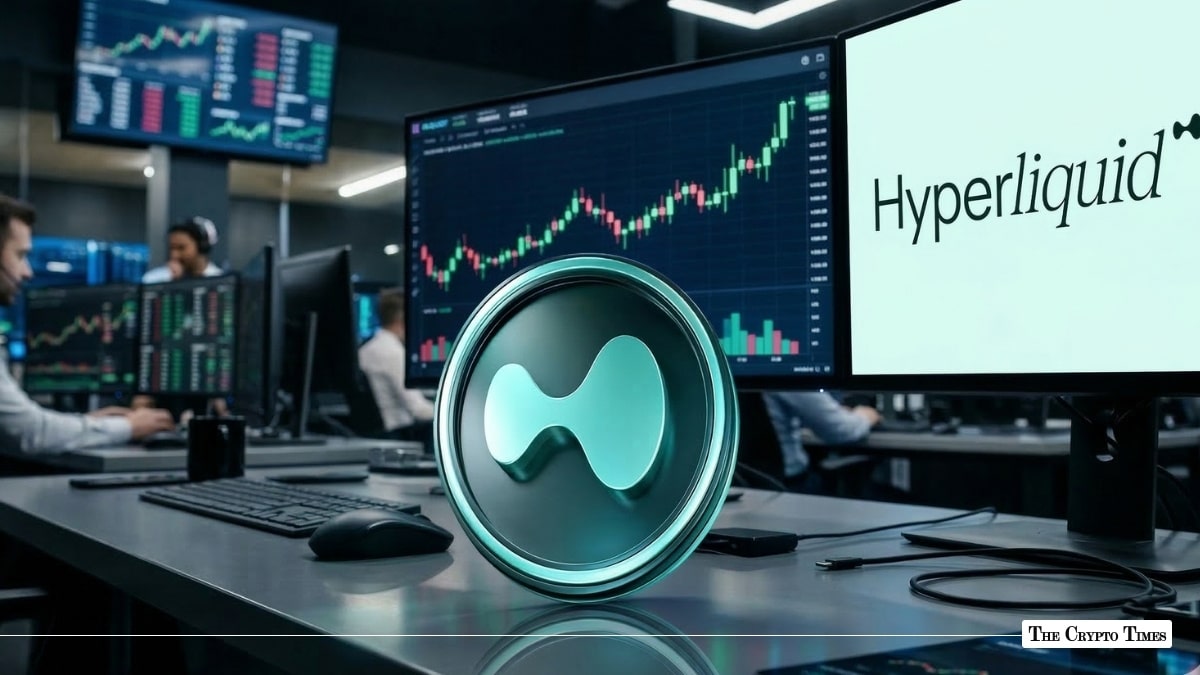
Hyperliquid is currently having its “mainstream moment,” shattering records as it effectively turns into a 24/7 decentralized version of the NASDAQ and the commodities pits.
When U.S.–Israeli airstrikes hit Iran on February 28 and oil prices surged more than 30% to nearly $120 a barrel, traditional commodity exchanges were closed. The NYMEX doesn’t trade on weekends. Neither does the ICE. But Hyperliquid does. Wall Street never sleeps on-chain.
The “RWA” (Real World Assets) surge on the platform is being driven by the HIP-3 upgrade, which allows permissionless listing of traditional assets via its high-performance L1 blockchain.
Traders flooded the platform’s CL-USDC perpetual to hedge, speculate, and price-discover in real time. The oil contract racked up over $1.2 billion in 24-hour volume on March 9, flipping Ethereum to become the platform’s second-most traded market. By March 10, that HIP-3 open interest had hit a record $1.2 billion, with CL-USDC alone generating $1.62 billion in daily volume.
The numbers continued climbing. The oil contract reached $1.39 billion in volume by March 11, while platform data showed peak readings as high as $1.99 billion during the most volatile sessions. Crude oil positions worth $56 million were liquidated in 24 hours—making oil the second-largest liquidated asset on the platform after Bitcoin.
The ‘Closing Bell ‘Problem’—Solved
What Hyperliquid did during the Iran crisis is what its architecture was designed to do: provide continuous, global price discovery when the rest of the world’s financial infrastructure is offline.
Traditional commodity futures operate on fixed schedules. When geopolitical shocks hit outside market hours, investors have no venue to adjust exposure until Monday morning. Hyperliquid fills that gap with a fully on-chain order book running on its custom HyperBFT consensus, processing sub-second execution 24 hours a day, seven days a week.
The structural advantage isn’t theoretical anymore. MakerDAO Co-Founder Rune Christensen deposited $4 million in USDC into a fresh wallet and went long on oil perpetuals—a $5.7 million position that underscored how major DeFi operators are treating Hyperliquid as a primary macro trading venue.
HIP-3: The Engine Behind the Records
The infrastructure enabling this explosion is HIP-3 (Hyperliquid Improvement Proposal 3), the platform’s permissionless market creation protocol launched in late 2025. HIP-3 allows any builder to stake 500,000 HYPE and deploy a perpetual futures market for any asset with a reliable price feed—no listing committee, no approval process.
Silver became a top-traded asset due to industrial demand from AI and EV sectors. But oil took center stage when the Iran crisis gave traders a reason to be in the market around the clock.
The composition of Hyperliquid’s markets now tells its own story. Of the top 30 markets by volume, only seven are crypto pairs. The rest are oil, gold, silver, Brent crude, the S&P 500, and other traditional assets.
HYPE Price Action: The Revenue Flywheel at Work
While the broader crypto market trades in “Extreme Fear” and most altcoins remain down 40–70% from their peaks, HYPE is doing something different. The token is trading at approximately $37.65, up over 25% in the past month and more than 80% from its January lows—making it the best-performing large-cap token in 2026.

The driver is mechanical, not speculative. Approximately 97% of Hyperliquid’s protocol fees are routed to the Assistance Fund, which performs automated HYPE buybacks from the open market. When oil volume spikes over $1 billion in a day, the protocol generates record fees—and those fees translate directly into non-discretionary buying pressure on the token.
BitMEX Co-Founder Arthur Hayes amplified the narrative with a widely shared essay projecting a $150 HYPE price target by August 2026, calling the token his fund’s largest holding.
From a technical standpoint, HYPE recently broke out of a 4-hour descending channel and flipped $33.16 resistance into support. Bulls are targeting $38.50 as the next level; a daily close above that mark could accelerate momentum toward the $50 psychological zone. The critical support sits at $32.50 — as long as HYPE holds above it, the midterm structure remains bullish.
What Comes Next: Portfolio Margin and HIP-4
Hyperliquid is not standing still. The platform announced via its Telegram channel that its portfolio margin system will upgrade from pre-alpha to alpha phase in the next network release. The feature will allow experienced traders to borrow up to 1 million USDC against spot HYPE or BTC holdings to fund perpetual positions.
Beyond margin, HIP-4 prediction markets are live on testnet, which will help Hyperliquid to challenge Polymarket and Kalshi in the event-driven trading market.
Hyperliquid didn’t just benefit from the oil spike. It proved that a decentralized exchange can absorb, price, and settle commodity-scale flows in real time—something no other on-chain venue has demonstrated at this magnitude. Whether that translates into durable institutional adoption or remains a crisis-driven anomaly is the question the next quarter will answer.