Key Highlights
- Pi Mainnet is undergoing protocol upgrades, requiring all nodes to upgrade to version 19.9 by March 1 to stay connected and secure.
- Pi Nodes run on desktops or laptops, and help verify transactions using a trust-based system, not proof-of-work.
- Testnet has three stages, Selection, Revision, and Live Testnet, to test the network and improve the consensus algorithm.
Pi Network reported that its blockchain is undergoing major updates, requiring all Mainnet nodes to update to version 19.9 before March 1 to keep working on the network. Amid this blockchain development, PI coin has regained $1.7 with a 40% gain this week.
According to a blog post, the upgrade is expected to improve the network’s security, decentralization, and performance. Pioneers, the users of the Pi Network, can participate by installing the Pi Node software on their computers for Windows, Mac, or Linux. The core team is managing this upgrade and the ongoing Testnet to ensure everything works well and to gather information for future updates.
All Mainnet nodes are required to complete this step before the deadline to remain connected to the network,” the team said.
What are Pi Nodes
Pi Nodes are programs that run on laptops or desktops. They help check and confirm transactions on the blockchain. Unlike Bitcoin or Ethereum, Pi uses the Stellar Consensus Protocol, which works differently. Nodes only approve transactions that trusted groups of other nodes agree on. Mobile users form security circles, which create a trust network. This network helps decide who can confirm transactions.
According to the blog post, the Pi Node software has three ways to participate:
- The Computer App, which lets users see their Pi balance, chat, and watch content on their computers.
- Nodes check transactions and make sure they are valid.
- SuperNodes do everything Nodes do, plus they help all other nodes stay updated and confirm transactions correctly.
The team shared that participants selected to operate as Nodes or SuperNodes must pass KYC verification to join.
Stages to test the network
The Pi Testnets have been divided into three stages. First is the “Selection Stage” which checks the computers of users who want to be a node. Their hardware, as well as their internet connection, will be tested to confirm if they meet the requirements.
The second stage is the “Revision Stage,” where the team will run a scenario test to check the consensus algorithm under different conditions, like sudden node dropouts or isolated network segments.
The live Testnet will involve real activity from nodes and Supernodes, with transactions recorded on the blockchain to see how the network performs. Pioneers who only use mobile apps can also take part and earn rewards.
The team said that the Pi Node software is designed to be easy to use. “Through this computer application, Pioneers can switch the node software on/off to make their devices available/unavailable for serving as a node,” the team said.
The team also explained that running a node does not use much of the computer unless fully activated. The blockchain part of the software will be open-source in the future, letting the community help improve it. Rewards for running nodes will be decided using Testnet data.
PI Coin surged almost 40% in a week
Meanwhile, Pi Coin, the native token of the network, is up by 5% today. The token surged from a daily low of $0.161, up to $0.172 before settling around $0.171. This adds up to about 39.37% gain in the last 7 days.
Trading activity is also up by a modest 7.94% from the previous day, reaching about $16.7 million in trading volume while its market cap sits at $1.58 billion. However, the token is still down 89% in a year. This is from a high of $0.29, which it reached in October 2025, and is trending
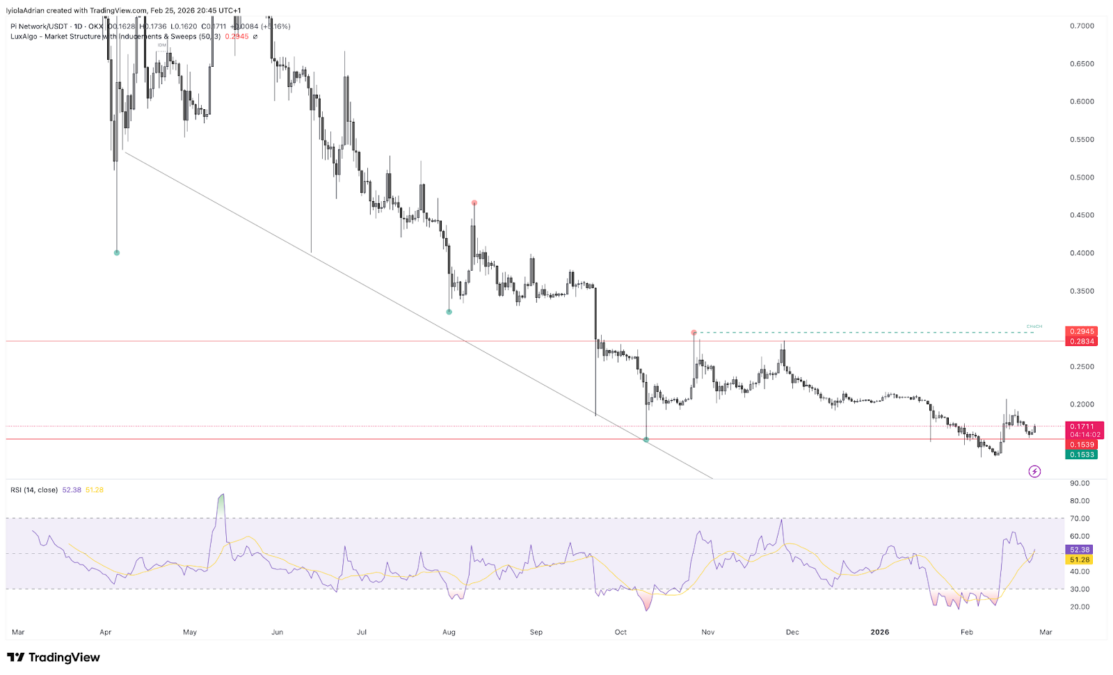
On the daily chart, the price resistance was rejected off the October 2025 low before recovering briefly. Meanwhile, the Relative Strength Index (RSI) is at 52, while the moving average is at 51, suggesting a neutral ground between buyers and sellers.
Also Read: Pi Network Mining Rate Drops To 0.0029 Amid 1st Anniversary