
Key Highlights
- Pi Network base mining rate now stands near 0.0029 π/hour for active users.
- Declining rewards align with Pi’s long-term token emission control strategy.
Pi Network’s mobile mining rewards have continued trending lower, with users reporting a total mining rate of approximately 0.0029 π per hour, according to in-app mining dashboards shared this week.
The latest figures show the base mining rate holding at 0.0029 π/hr, while total rewards depend heavily on optional boosters such as Security Circles and lockup commitments. In several user accounts, booster contributions remain minimal, leaving overall earnings largely tied to the base rate alone.
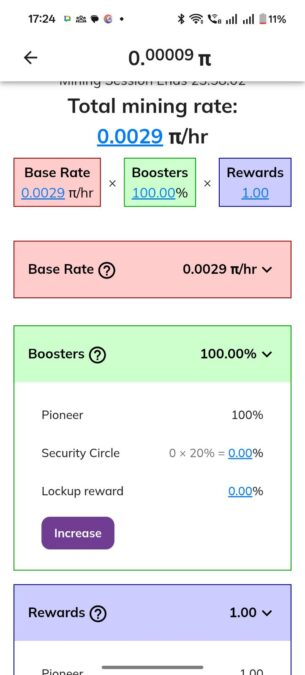
The reduction follows Pi Network’s predefined emission model, where mining rewards gradually decrease as network participation expands and token distribution progresses.
Boosters becoming critical for earnings
Data visible inside the mining interface shows that many users currently rely only on the “Pioneer” participation reward, contributing roughly 100% of the active boost.
Security Circle bonuses, designed to strengthen trust relationships within the network can add up to 20% per verified member. Similarly, lockup rewards also incentivize long-term token holding
As base rewards decline, these boosters are becoming increasingly important for maintaining meaningful mining output.
Supply control strategy behind lower rewards
The falling mining rate reflects Pi Network’s broader tokenomics approach aimed at limiting inflation as user adoption grows. Unlike early phases where higher emissions were used to attract participation, newer reward adjustments prioritize gradual scarcity.
Projects using mobile mining models often reduce issuance over time to transition from growth incentives toward ecosystem utility including payments, applications, and marketplace activity.
What it means for Pi miners
For existing participants, the lower mining rate means daily accumulation is slowing significantly compared to earlier years of the network. Users seeking higher rewards may need to activate additional boosters or participate more deeply in network verification mechanisms.
The adjustment also signals Pi Network’s continued shift away from rapid distribution toward a more controlled economic structure, a phase many community members interpret as preparation for broader ecosystem deployment.
Also Read: Pi Network Posts Major Growth Metrics After Open Network Anniversary