Key Highlights
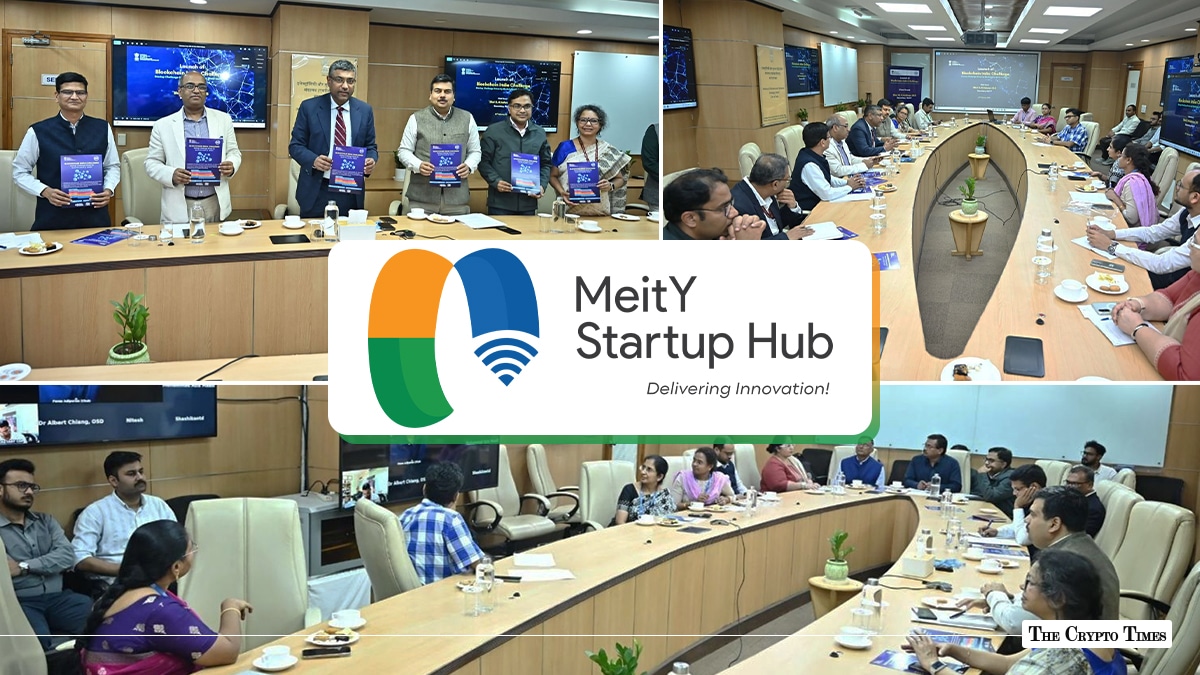
- National Launch in Delhi: On February 23, 2026, MeitY Secretary Shri S. Krishnan launched the Blockchain India Challenge, inviting startups to pilot blockchain solutions for government use.
- Permissioned Framework: Implemented by C-DAC, the initiative uses “Permissioned Blockchain” to ensure regulatory control, auditability, and tamper-proof security across sectors like PDS and healthcare.
- Call for Scalable Pilots: The Secretary urged startups to go beyond identified use cases to build scalable, field-ready solutions, with stage-wise funding for DPIIT-recognized entities.
India took a step forward in using blockchain for governance on February 23, 2026, when the Ministry of Electronics & Information Technology (MeitY) launched the Blockchain India Challenge in New Delhi.
The move shows that blockchain is now being treated as a practical tool to address long-standing problems in governance and public service delivery, rather than just a future idea.
As per an official press release, the challenge was launched by S. Krishnan, IAS, Secretary, MeitY, at the ministry’s headquarters, in the presence of senior officials, including Additional Secretary Abhishek Singh, Joint Secretary Sudeep Srivastava, and senior representatives from MeitY and Centre for Development of Advanced Computing (C-DAC).
Officials from various government departments and Indian startups also attended the event, underlining the collaborative nature of the program.
A structured push for blockchain in government systems
The Blockchain India Challenge is being implemented by C-DAC with support from MeitY as a national-level effort to bring blockchain into real government workflows. The objective is clear: encourage Indian startups to design, test, and deploy permissioned blockchain solutions that meet the operational, legal, and security needs of government departments.
Unlike open public blockchains, this challenge is centered on permissioned blockchain systems designed specifically for government use. The idea is to keep regulatory control intact while ensuring strong audit mechanisms and reliable data integrity. The focus is on building trust through records that can be verified and cannot be altered, addressing gaps where traditional government databases have often fallen short.
The challenge highlights several governance areas where blockchain can be applied in a meaningful way. These include e-procurement, supply chain management, public distribution systems, education, healthcare, agriculture, power, Internet of Things-based services, land records, and environmental sustainability.
Officials clarified that this list is not fixed. Startups are encouraged to suggest other use cases as long as they solve real government problems and are developed in coordination with relevant departments.
MeitY’s message to startups and departments
Speaking at the launch, the Secretary of the Ministry of Electronics & Information Technology (MeitY) said blockchain can strengthen government systems by making data verifiable and creating a single, reliable source of truth across departments.
He noted that government data is often spread across multiple platforms, and blockchain offers a way to bring greater transparency, consistency, and confidence in how that data is recorded and shared.
He noted that blockchain can significantly improve transparency and efficiency in public services and invited startups to think beyond the ten identified use cases. He also asked MeitY and C-DAC teams to actively promote the challenge across India’s startup ecosystem, with a focus on developing solutions that are not only technically sound but ready for deployment in real government settings.
The larger aim, he said, is to ensure that successful pilots can be scaled across states and departments, rather than remaining isolated experiments.
Funding support and real deployment opportunities
As part of the challenge framework, DPIIT-recognized startups working in collaboration with government departments will be eligible for stage-wise funding support. The program is designed to support the development of 10 impactful blockchain-based solutions across ten different governance categories.
Selected startups will be helped to take their ideas forward from the concept stage to pilot projects and, where possible, into actual use within government systems. Officials said the intention is to build solutions that can work with existing public infrastructure and be used on the ground, instead of remaining as one-off demonstrations.
Parliamentary momentum builds around blockchain land records
The launch of the Blockchain India Challenge has coincided with growing discussion around blockchain in the Parliament. Earlier this month, during a Rajya Sabha debate on the Union Budget for 2026–27, Raghav Chadha, a Member of Parliament from Punjab, called for the creation of a national blockchain-based registry for land and property records.
Speaking during the session chaired by Deputy Chairman Harivansh and attended by Finance Minister Nirmala Sitharaman, Chadha argued that India’s land records system is burdened by inefficiency, corruption, and excessive dependence on intermediaries.
During his speech, Raghav Chadha said, “Today, there is utter chaos in our real estate and land property record market. Chaos because people are being pushed around outside the registrar’s office, and middlemen have completely taken over those offices.”
He proposed a phased implementation, starting with ten major metropolitan and tier-two cities before expanding nationwide. According to Chadha, a blockchain-based registry would ensure that property transactions, mutations, and inheritance records are stored digitally in a secure manner.
This, he said, would allow instant verification of land titles and sharply cut down the time taken to complete property transactions. He also connected the proposal to protecting middle-class wealth, noting that clearer and more reliable records would make it easier for people to use property as collateral for loans.
Amravati shows how blockchain works on the ground
India already has clear, real-world examples of blockchain being used in local governance. In October 2025, the Municipal Corporation of Amravati integrated blockchain into its core administrative work, making it among the first municipal bodies in Maharashtra to adopt the technology at this level.
As part of the rollout, services like fire safety certificates, trade licenses, and construction approvals were shifted to a blockchain-based system. Once a record is entered, it cannot be altered, helping deal with long-standing problems such as forged documents, duplicate records, and manual interference.
Municipal Commissioner Saumya Sharma Chandak said the move was intended to build a system that people can trust. She said the move is not only about using a new technology, but about bringing more transparency, accountability, and trust into everyday administration.
India’s broader blockchain roadmap
India’s larger push toward blockchain follows policy direction announced in August 2025, when the government laid out plans to introduce blockchain and artificial intelligence (AI) into public services under the long-term Amrit Kaal vision up to 2047.
Since then, pilot projects using blockchain for land records have begun in Chandigarh and Telangana. These efforts are focused on making property records tamper-proof and improving the safety and reliability of land transactions.
At the same time, blockchain is also being tried in supply chains and digital commerce, including through initiatives such as the Open Network for Digital Commerce.
All of this is happening alongside the continued expansion of India’s digital public infrastructure. Platforms such as Aadhaar, DigiLocker, UMANG, and UPI are already used across the country to deliver government services. These systems are now being used as the base to add newer technologies, including blockchain.
Why blockchain is becoming central to governance
Across government departments, state and local bodies, and discussions in the Parliament, blockchain is increasingly being looked at as a practical fix to long-standing problems. In areas such as land records, procurement, welfare schemes, and municipal services, the focus is on cutting manual work, stopping data tampering, and making official records more reliable.
With the launch of the Blockchain India Challenge, the government has indicated that blockchain use is moving beyond trial projects. The emphasis is now on putting systems into actual use, working with startups, and building solutions that can be rolled out and run within government departments.
Also Read: How India’s ‘PRAHAAR’ Aims to Block Terrorists’ Use of Crypto & Dark Web