Key Highlights
- Long-term Bitcoin holders are selling at a loss, signaling growing market stress and potential short-term volatility.
- Altcoins face record outflows, with $209B sold over 13 months, leaving only downward momentum in the market.
- Bitcoin reacts first to liquidity pressure while stocks lag, highlighting AI-driven job risks and credit stress in the U.S.
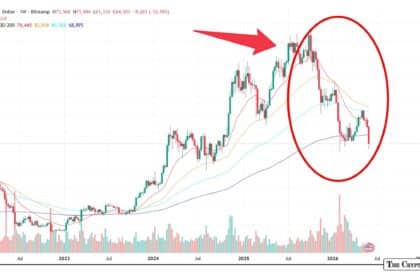
Bitcoin (BTC) is showing signs of deep stress as long-term holders (LTHs) increase inflows to major exchanges, signaling intensifying selling pressure. Despite remaining a key store of value, the leading crypto now trades over 45% below its October 2025 all-time high of $126,080.
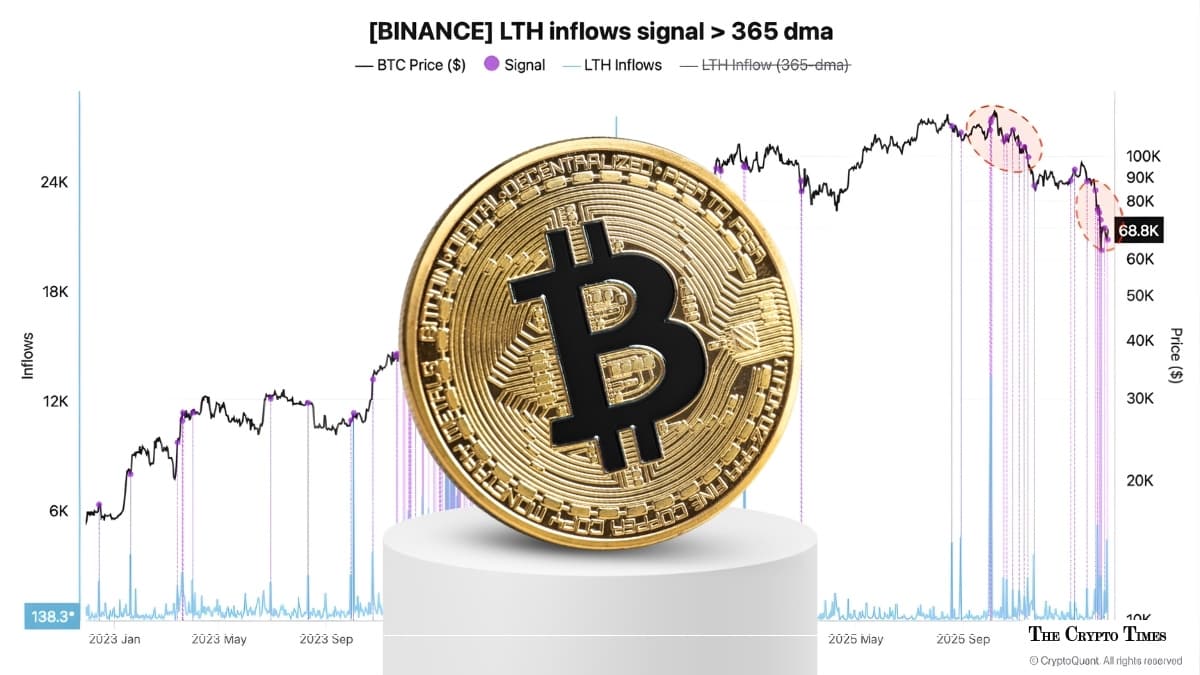
Even investors who usually hold Bitcoin for the long term are starting to feel the pinch, signaling a possible change in market behavior. CryptoQuant analyst Darkfost pointed out that more long-term holders are moving their coins to Binance, showing growing selling pressure.
“In this context, rising LTH inflows can be interpreted as a sign of intensifying selling pressure, even as the broader correction continues to unfold,” he noted. The LTH SOPR, which measures whether long-term holders are selling at a profit or a loss, recently dropped to 0.88—below the key level of 1. This means long-term holders are now selling at a loss for the first time since the 2023 bear market.
Elevated LTH activity on exchanges
As per the analyst, recent data indicate that the daily inflow of funds to Binance has nearly doubled from the average yearly figure. Such peaks indicate that some LTHs are actively rebalancing their portfolios in the face of market uncertainty. There have been several days of consecutive inflows that are significantly above the normal level.
Besides offering high liquidity, Binance’s deep market makes it a go-to platform for those moving large amounts of Bitcoin. Consequently, this behavior could keep adding downward pressure on prices in the short to medium term.
Adding to this, the fact that LTHs are now selling at a loss signals an adjustment phase, where even long-term investors are managing their exposure. The ongoing correction has created financial stress among a group that usually holds through downturns. Hence, the market could see more volatility if these trends continue.
Altcoin market faces extreme pressure
The altcoins are also experiencing huge selling pressure, as CryptoQuant analyst IT Tech pointed out. The cumulative buy/sell differences for the altcoins, excluding BTC and ETH, have been a net outflow of $209 billion in 13 months.
“Retail is out. Smart money rotated. No institutional alt accumulation in sight. This is not a dip. It’s 13 months of continuous net selling on CEX spot,” IT Tech posted. This means that the buyers of altcoins have left the market, and only the downtrend is left.
Broader implications for crypto and markets
Bitcoin’s fall also reflects the overall economic situation. BitMEX Co-Founder Arthur Hayes said that Bitcoin is the first to respond to liquidity problems, while common stocks follow. He attributes the delay to AI-related job displacement, which may affect consumer credit.
Hayes estimates that U.S. banks stand to lose $330 billion in potential consumer credit losses and $227 billion in mortgage losses if 20% of knowledge workers lose their jobs due to AI developments. He also pointed out that the Nasdaq has yet to factor in these changes, which may cause further market misalignments.
As of writing, Bitcoin is currently trading at $67,987.96, up 0.17% in the last 24 hours and 27% in the last month, as per CoinMarketCap.
Also Read: Analyst Willy Woo Says Bitcoin Bear Market Is Gaining Strength