Key Highlights
- Tether halts Uruguay operations after high energy costs and strict tariffs, highlighting challenges crypto firms face in global markets.
- USDT remains dominant, holding over 60% of stablecoin market cap, as stablecoins continue growing in everyday blockchain use.
- Regulatory scrutiny rises as S&P downgrades USDT stability and Bithumb suspends trading, reflecting risks in crypto operations.
Tether Holdings Ltd. has officially ceased operations in Uruguay, dismissing 30 of its 38 local staff. The decision, confirmed by Uruguay’s Ministry of Labor and Social Security (MTSS), follows months of internal review and prior warnings about the high energy costs in the country.
According to a local report, Tether had flagged an uncompetitive tariff framework, which hindered the completion of its large-scale projects. Tether had planned to invest $500 million in Uruguay, building three data centers and a 300 MW wind and solar energy park, but it spent just over $100 million before deciding to leave.
The company also highlighted the economic infeasibility of continuing under existing conditions. Tether repeatedly requested a move to 150 kV power tolls and amendments to its power purchase agreement to lower operational costs.
Since the company’s suggestions weren’t accepted, Tether had no choice but to shut down. This shows how hard it can be for crypto companies to operate in countries with high energy costs and strict rules.
USDT dominance remains strong
Operational setbacks in Uruguay have not deterred Tether’s leading stablecoin, USDT, from dominant positions across the world. According to DeFiLlama data, the total market capitalization of stablecoins has reached roughly $305.36 billion and keeps expanding smoothly in 2025.
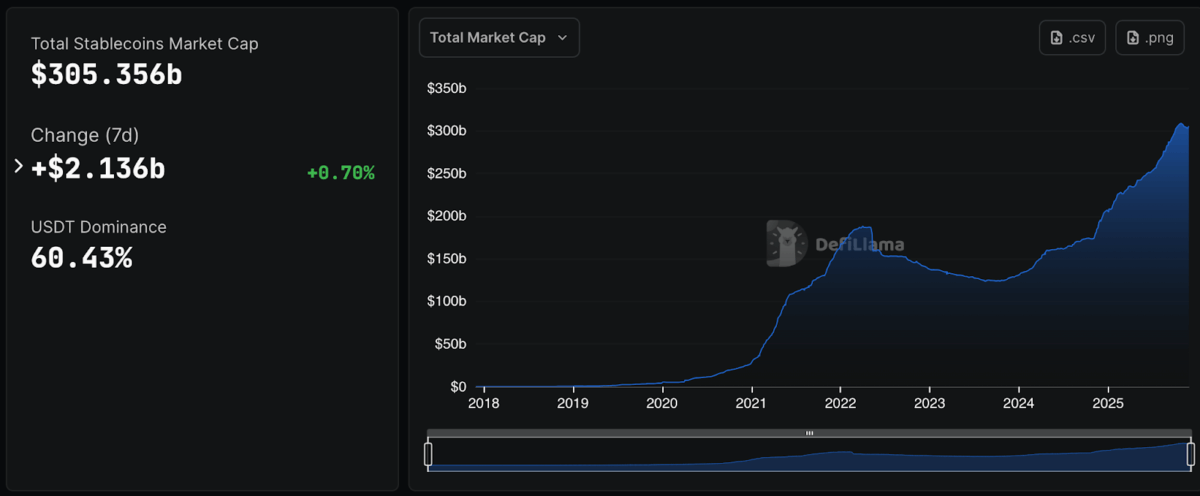
In the past week, the supply went up by 0.70%, which is an addition of $2.13 billion. USDT has about 60.43% of the sector’s market cap, reaffirming its liquidity and widespread adoption across crypto networks. Besides USDT, other stablecoins are growing, but Tether still maintains a significant market presence.
Analyst Crypto Patel pointed out the bigger picture, saying, “Stablecoins just hit $50T in on-chain settlement this year. It’s real global money movement happening on blockchain rails.” BitGo also noted that stablecoins are being used more in everyday transactions, showing that demand for these digital assets keeps growing.
Regulatory and market pressures
Tether has recently come under closer watch from rating agencies. S&P Global Ratings lowered USDT’s stability score from 4 (“constrained”) to 5 (“weak”), pointing to its bigger exposure to riskier assets like Bitcoin, gold, secured loans, and corporate bonds.
Riskier assets now comprise 24% of Tether’s reserves, up from 17% last year. CEO Paolo Ardoino criticized the rating, stating, “The classical rating models built for legacy financial institutions…are broken. Tether instead built the first overcapitalized company in the financial industry, with no toxic reserves.”
Additionally, Tether-related trading services are under pressure. South Korea’s Bithumb will suspend USDT-based trading services from November 28 due to regulatory scrutiny. The exchange cited system maintenance and plans to reorganize its platform for a “more stable and advanced trading environment.”
Also Read: SpaceX Moves $105M in Bitcoin, Now Holds 6,095 BTC Worth $556M