Monad made one of the most anticipated debuts of the year as its mainnet went live and its MON token opened for public trading across centralized and decentralized exchanges.
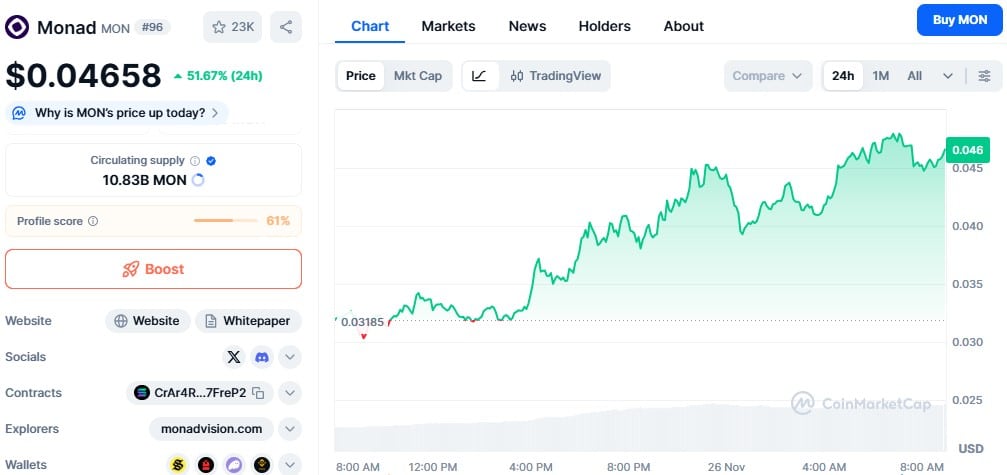
The token immediately jumped more than 51% on its first day, signaling strong early interest in the new Ethereum-compatible Layer-1 blockchain.
The launch follows more than three years of development and is backed by some of the largest venture investors in Web3. With its fast start, Monad now enters a crowded but fast-moving L1 race at a time when traders are seeking new opportunities after months of market volatility.
A strong first day for MON trading
The native MON token began trading at around $0.046, quickly rising more than 51% in early price discovery. The strong debut was supported by an impressive $1.2 billion in trading volume within the first few hours, with 10.8 billion MON entering circulation out of its 100 billion total supply.
MON launched as a multichain asset, with versions available on several networks, including Solana. Despite its broad release, the token still holds nearly 90% of its supply for future unlocks, raising questions about long-term price stability once more tokens hit the market.
But the first trading session showed unique activity. Over 60% of initial MON volume was paired with the Korean won, reflecting the growing dominance of Korean exchanges in early token speculation. MON also traded actively on Coinbase, Upbit, Bybit, and a mix of DEX platforms.
Monad enters the L1 arena with activity and liquidity
As the token began trading, the Monad mainnet showed signs of life. Within hours of launch, more than 100 decentralized applications were already deployed or preparing deployments.
Developers also brought over 18,000 smart contracts, contributing to more than three million transactions recorded in the early hours, according to Nansen data.
Liquidity also arrived quickly. Uniswap became the leading venue for native MON trading, while the ecosystem saw inflows of more than $123 million in stablecoins. The chain launched with $115 million in initial liquidity, helping support early trading.
Monad positions itself as a high-speed, EVM-compatible blockchain known for low-cost transactions, a pitch similar to other recent L1s that experienced waves of hype earlier this year.
Solana version of MON gains traction but faces issues
MON also went live on Solana, becoming one of the most traded new assets on the network. The MON/USDC pair on Solana captured around 60% of the trading volume on the main MON pool on Uniswap.
However, liquidity remained thin, and top whales moving funds on Solana cashed out relatively small amounts, often under $80,000. Some users encountered friction during the airdrop and trading period.
One trader reportedly spent most of their airdrop allocation simply trying to pay for transactions due to network congestion and wallet issues. Even so, many airdrop recipients still hold large unrealized gains due to MON’s strong opening price.
Risk signals appear as whales take short positions
The sentiment of MON is mixed even after the strong launch. According to the data provided by Hyperliquid, there are only 2 long positions of 11 large whale traders in MON.
The rest opened short positions, expecting a potential price correction following the initial hype. The token also carries negative funding rates, a sign of bearish pressure in the derivatives market.
According to analysts, numerous high-profile airdrops experience sharp pullbacks after initial hype, particularly as millions of tokens become unlocked in the next few months.
A high-value launch driven by past Hype cycles
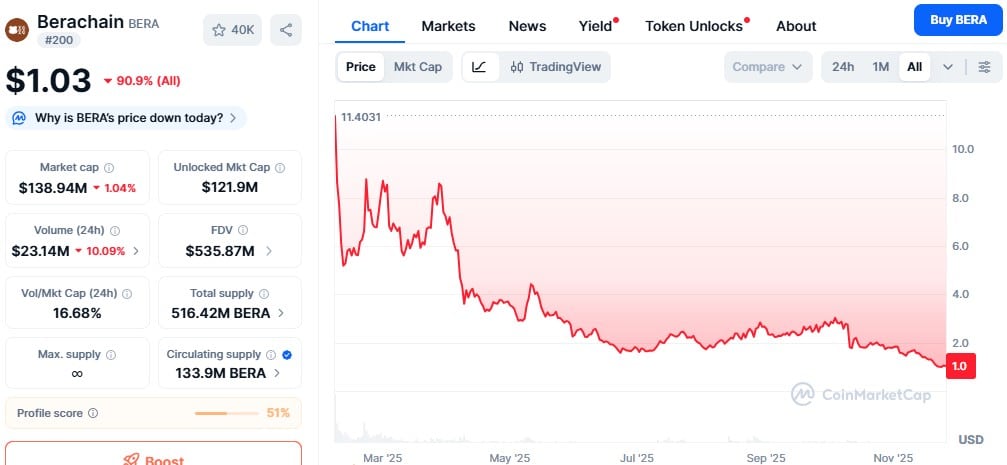
The excitement around Monad comes just months after other highly anticipated blockchains, like Bitfinex’s Plasma and Berachain’s, saw rapid rises followed by dramatic declines.
Plasma’s XPL token fell 75% after a strong debut, while Berachain’s BERA token is down more than 90% from its peak. Investors are closely watching whether Monad can avoid a similar fate.
A key difference may be its token sale conditions. Between November 17 and 22, Monad sold 7.5 billion MON to the public at $0.025, giving early buyers millions in unrealized gains.
While these tokens were immediately liquid, Coinbase warned that selling early could affect allocations in future token sales, creating a mild incentive for holders to resist dumping.
Why Monad’s launch matters
The MON surge comes as crypto markets bounce back from the October 10 leverage wipeout that wiped billions across Bitcoin, Ethereum, and other assets. With Bitcoin recovering around 5% from its recent lows, newer tokens like MON are enjoying renewed bullish momentum.
In the meantime, Monad is a fresh battleground in the L1 space, a new Ethereum-compatible alternative with the support of some of the largest investors, including Paradigm, Dragonfly Capital, and Coinbase Ventures.
Its initial performance in the trading market demonstrates that the community is interested in it, yet the next several weeks will show whether the network will be able to maintain the growth of developers, liquidity, and demand of the ecosystem beyond the hype of its launch.
Also Read: Monad (MON) Airdrop Sparks Chaos, FOMO, and Community Backlash