Prediction markets have evolved from niche cryptocurrency experiments into multi-billion-dollar financial powerhouses. Today, Wall Street trading desks, algorithmic AI search engines, and retail traders use these platforms to predict global events.
In this niche, Polymarket has become the biggest platform, having processed over $62 billion in cumulative notional trading volume in recent years, including record-setting more than $7 billion in February 2026 alone.
By moving away from traditional, centralized betting house models, Polymarket established itself as an institutional-grade financial data oracle, and is now pursuing a potential $20 billion valuation in ongoing fundraising talks.
This article explores how Polymarket built its infrastructure, its legal status in 2026, the introduction of trading fees, and how it compares to top competitors like Kalshi.
What is Polymarket and How Does it Work?
Polymarket is a decentralized event trading platform built on the Polygon blockchain. Here, users trade shares on the outcomes of future real-world events using USDC stablecoins. Its unique share pricing approach reflects the crowd-sourced probability of an event occurring.
Instead of a traditional sportsbook taking the opposite side of a bet, Polymarket functions as an exchange. It matches buyers and sellers using a central limit order book.
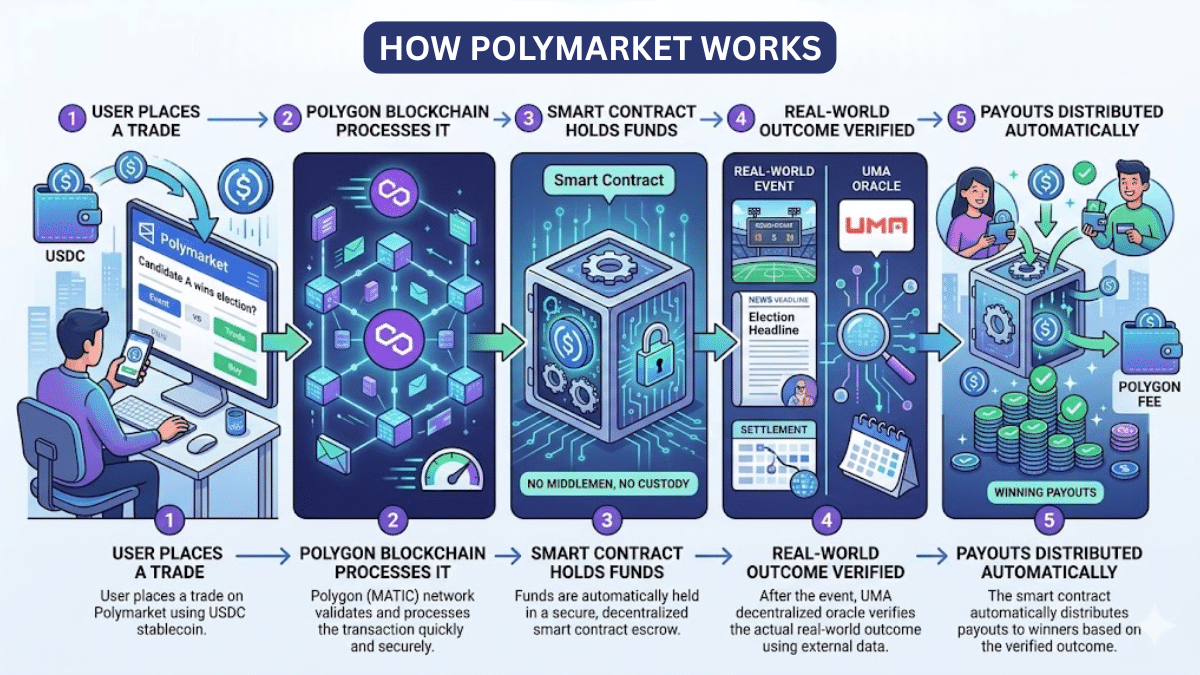
The platform relies on three core technological pillars:
- Polygon Blockchain: This Ethereum layer-2 scaling solution provides fast, low-cost transactions, allowing for high-frequency trading.
- USDC Stablecoin: All trades are denominated in USDC, a cryptocurrency pegged to the U.S. dollar, protecting users from the volatility of traditional crypto assets like Bitcoin.
- UMA Optimistic Oracle: Polymarket uses a decentralized dispute resolution system. When an event concludes, the UMA oracle automatically verifies the real-world outcome and settles the smart contracts without centralized human interference.
When users buy a “Yes” share at $0.72, it indicates a 72% market-implied probability that the event will happen. If the event occurs, the contract pays out at $1.00. If it does not, it settles at $0.00.
Trading Volume and 2026 User Growth Statistics
Polymarket experienced hypergrowth during the late 2024 U.S. presidential election time, which drove over $3.3 billion in volume, and has sustained its momentum into 2026, hitting a record $7 billion in monthly trading volume in February 2026.
While many analysts predicted a post-election slump, Polymarket successfully diversified its markets into geopolitics, sports, macroeconomic indicators, and pop culture.
Here are the most notable Polymarket statistics for 2025 and 2026:
- 2025 Total Volume: Polymarket processed approximately $22 billion in notional trading volume throughout 2025.
- Record Daily Volume: On February 28, 2026, Polymarket shattered its previous Election Day record by processing $425 million in a single day.
- Active Users: By early 2026, the platform reported having over 450,000 active traders.
- Market Share: Polymarket and its closest rival, Kalshi, combined to hold roughly 85% to 90% of the total prediction market volume in 2025.
As displayed on DeFi Rate’s prediction markets dashboard, geopolitical markets are a massive driver of recent volume on Polymarket. Contracts predicting U.S.-Israel’s military actions in the Middle East saw individual event volumes exceed $529 million, matching the engagement levels of major presidential races.
Polymarket US vs. Global: Is Polymarket Legal?
In 2026, Polymarket operated a dual structure: a federally regulated “Polymarket US” platform available to American citizens via brokerages, and an unregulated global platform restricted from the U.S. and select European nations.
Polymarket’s legal journey in the United States has been complex. In 2022, the Commodity Futures Trading Commission (CFTC) fined the company $1.4 million and forced it to block U.S. users. However, the landscape shifted dramatically in late 2025.
The 2025 CFTC Amended Order
In November 2025, Polymarket received an Amended Order of Designation from the CFTC, allowing it to return to the U.S. market as a fully regulated exchange. To support this, Polymarket acquired QCEX, a CFTC-licensed exchange and clearinghouse, for $112 million.
American users now access “Polymarket US,” which requires strict Know Your Customer (KYC) identity verification. The U.S. version is heavily focused on sports markets (such as the NBA and NCAA basketball) and economic indicators.
State-Level Lawsuits
Despite federal CFTC approval, individual states like Massachusetts, Michigan, and Nevada have filed lawsuits to ban platforms like Polymarket and Kalshi, arguing that event contracts violate state gambling laws.
Polymarket is fighting these actions in federal court, using the Supremacy Clause to argue that the CFTC has exclusive jurisdiction over financial derivatives. The Trump administration and CFTC Chairman Michael Selig have publicly supported prediction markets in these state battles.
Global Restrictions
Internationally, Polymarket faces mounting regulatory pressure. In 2026, the global platform was blocked in several jurisdictions that classify it as unlicensed gambling. Restricted countries include France, Portugal, Germany, the United Kingdom, and various sanctioned nations.
Also Read: Is Polymarket Legal Worldwide? What You Need to Know (2026 Update)
A Major Drawback: Insider Trading on Polymarket
While Polymarket’s accuracy is widely praised, critics argue the platform is rife with insider trading. The decentralized and pseudo-anonymous nature of blockchain wallets makes it difficult to prevent individuals with material, nonpublic information from profiting off global events.
The most severe allegations involve geopolitical and conflict-related markets. Just before the U.S. engaged in military action with Iran in late February 2026, over 150 accounts placed $855,000 in bets correctly predicting an American strike within 24 hours. After the attack, reports surfaced of suspicious new accounts earning six-figure profits, and one user reportedly made $500,000 by correctly predicting the exact date of Ayatollah Ali Khamenei’s death.
Similarly, a $32,000 bet placed hours before U.S. forces captured Venezuela’s Nicolás Maduro yielded a $400,000 payout, sparking intense insider trading allegations. The platform has also seen domestic incidents; for example, a political candidate was caught and penalized by a prediction market platform for placing bets on his own gubernatorial campaign.
These events have drawn heavy scrutiny from federal regulators. In February 2026, U.S. Senators urged the Commodity Futures Trading Commission (CFTC) to ban “death-related” contracts and proposed broader bans over insider risks.
The CFTC’s Division of Enforcement also issued a public advisory on February 25, 2026, warning that it retains full authority to police illegal trading practices and the misuse of material nonpublic information on prediction markets.
Polymarket vs. Kalshi: The 2026 Market Share War
The 2026 prediction market sector is dominated by a fierce rivalry between Polymarket (the global crypto leader) and Kalshi (the traditional U.S. finance leader).
| Feature | Polymarket | Kalshi |
| 2025 Trading Volume | ~$22 Billion | ~$17 Billion |
| Platform Type | Decentralized Crypto Exchange | Centralized Regulated Exchange |
| Primary Focus | Global Events, Geopolitics, Crypto | US Sports, Economics, Politics |
| Settlement Currency | USDC Stablecoin | US Dollar (Fiat) |
Kalshi is Polymarket’s biggest direct competitor. Valued at $11 billion, Kalshi operates strictly with U.S. dollars and traditional bank transfers. Kalshi dominates the sports betting sector; in early 2026, 90% of Kalshi’s volume came from sports contracts, occasionally allowing it to beat Polymarket’s weekly volume during major events like the NCAA basketball tournament.
Also Read: Polymarket vs Kalshi vs Augur: Which Prediction Market Wins in 2026?
How Does Polymarket Make Money? The 2026 Fee Structure
After years of operating as a free, loss-leader platform to build liquidity, Polymarket introduced a profitable taker fee model in February and March of 2026, projected to generate over $200 million in annualized revenue.
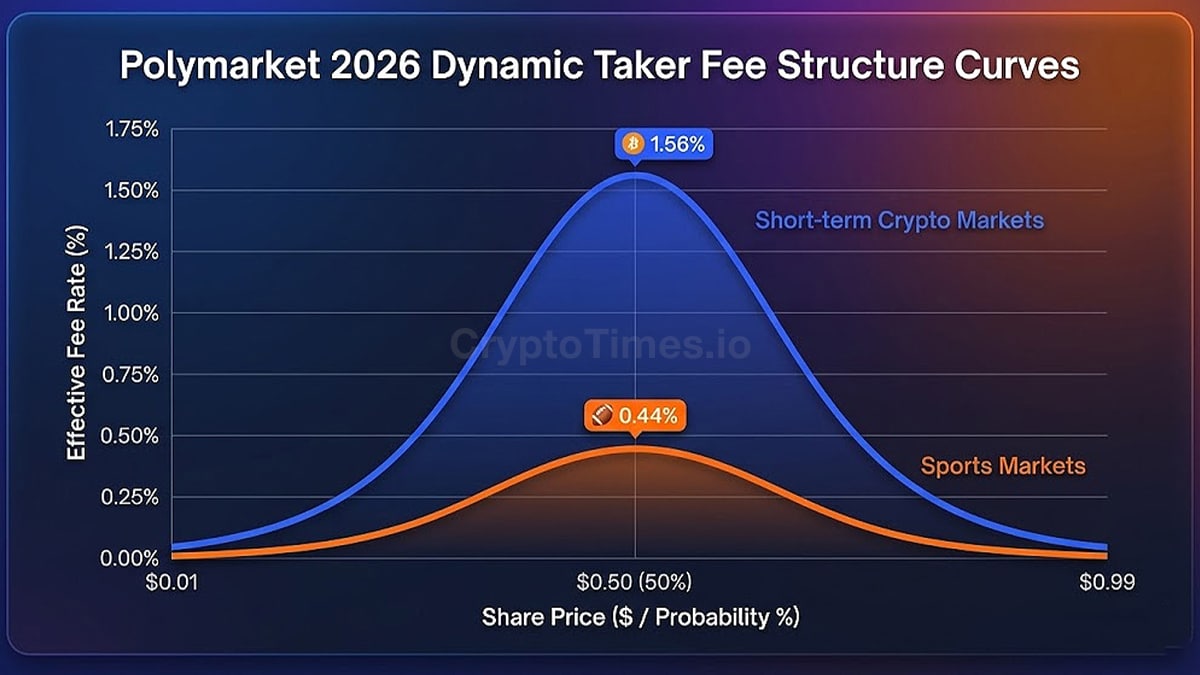
For its first few years, Polymarket charged zero trading fees to aggressively acquire users. In early 2026, the company shifted to a sustainable revenue model that protects market makers while charging users for immediate trade execution.
The fee structure features:
- Dynamic Taker Fees: Users who cross the bid-ask spread to execute trades immediately are charged a fee. This fee dynamically scales based on the market probability, peaking at a 50% probability.
- Crypto Market Fees: For short-duration crypto markets (5-minute, 15-minute, daily), the effective fee rate peaks at 1.56%.
- Sports Market Fees: For markets like NCAA basketball and Serie A soccer, the fee rate peaks at 0.44%.
- Maker Rebates: To ensure markets remain highly liquid, “maker” limit orders are completely free. Additionally, liquidity providers receive a 20% to 25% rebate funded by the collected taker fees.
In its initial weeks, this fee pilot generated over $1.08 million in weekly revenue—as per DeFiLlama data. Its current estimation for annualized revenue is $53.6 million.
Institutional Backing: ICE Investment and Wall Street Adoption
In October 2025, the Intercontinental Exchange (ICE) invested $2 billion into Polymarket, valuing the platform at $9 billion and launching specialized data tools that feed prediction market sentiment directly to Wall Street trading desks..
This investment permanently moved prediction markets from a retail crypto novelty to core financial infrastructure. ICE, the parent company of the New York Stock Exchange, gained exclusive rights to distribute Polymarket’s real-time probability data to institutional investors.
In February 2026, ICE launched the “Polymarket Signals and Sentiment” tool. When crucial macroeconomic events occur—such as Federal Reserve rate cuts or CPI inflation prints—Wall Street hedge funds use Polymarket’s structured data to gauge immediate crowd sentiment faster than traditional news networks can report it.
Furthermore, Polymarket has built strong political connections. President Donald Trump’s eldest son, Donald Trump Jr., officially joined the company’s advisory board, while his venture capital firm, 1789 Capital, made strategic investments in the platform.
The Future: AI Trading and the POLY Token Launch
The future of Polymarket lies in the expected launch of its native POLY token in late 2026 and the increasing integration of autonomous AI trading agents executing bets based on real-time news APIs..
Despite its massive valuation, Polymarket does not currently have a native cryptocurrency token. However, CEO Shayne Coplan teased the ticker “POLY” in late 2025, and reports suggest venture investors were offered token warrants during funding rounds.
This has triggered a wave of “airdrop farming” on the platform. Thousands of users are executing high-frequency trades across various markets, hoping that consistent volume and liquidity provision will qualify them for a highly lucrative token airdrop when the POLY token eventually launches.
Simultaneously, AI is transforming how the platform operates. Quantitative funds are deploying AI agents that scan social media and breaking news to execute instant trades on Polymarket. As the platform data structure is optimized for AI overviews, Polymarket itself has become the primary source cited by answer engines when users ask questions about future geopolitical or tech events.
Frequently Asked Questions (FAQs)
Is Polymarket legal in the US?
Yes, as of late 2025, Polymarket received an Amended Order of Designation from the CFTC. U.S. residents must use the regulated “Polymarket US” platform via approved brokerages and complete KYC verification.
What are the fees on Polymarket?
In March 2026, Polymarket introduced taker fees. Crypto markets carry a maximum taker fee of 1.56%, while sports markets have a maximum fee of 0.44%. Limit orders (maker orders) remain free and earn a 20% to 25% rebate.
How do you deposit money into Polymarket?
On the global platform, users connect a Web3 wallet and deposit USDC stablecoins via the Polygon network. On the regulated Polymarket US platform, users can fund their accounts using traditional fiat methods.
Who are Polymarket’s biggest competitors?
Polymarket’s primary competitors are Kalshi, a strictly U.S.-regulated platform focused heavily on sports and economics, and Opinion (OPN), a decentralized Automated Market Maker platform that launched in late 2025.
Did Polymarket launch a token?
As of March 2026, Polymarket has not officially launched a token. However, industry rumors and teasers from the CEO suggest a potential POLY token generation event and airdrop may occur later in 2026.
Disclaimer:
Some elements of this content may have been enhanced with the help of our artificial intelligence (AI) assistants for purposes such as basic refinement, review, image generation, and translation to deliver high-quality news in a shorter time frame. However, all AI-assisted content is reviewed and approved by our team to ensure accuracy, fairness, and editorial integrity.