Solana concluded its first binding on-chain governance cycle on Thursday with two of three proposals crossing the two-thirds approval threshold, while a third measure that would have accelerated daily SOL burns was rejected by validators.
The Solana Constitution (SGP-0001) passed with 85.97% support, the contentious Double Disinflation proposal (SGP-0002) squeaked through with exactly 67.00%, and the Resource and Inclusion Fee proposal (SGP-0003) fell short at 53.90%. All three votes cleared the one-third stake participation quorum, but only the first two met the supermajority bar required for adoption.
Constitution Activates On-Chain Governance
SGP-0001 formalizes the rules for how proposals will be submitted, weighted, and approved on Solana going forward, activating the svmgov program that will host every future vote. Under the ratified framework, proposals require one-third stake participation for quorum and a two-thirds supermajority of votes cast ‘For’ or ‘Against’ to pass, with delegators retaining the right to override their validator’s ballot.
Solana’s governance layer went live in July 2026, marking a shift from off-chain informal decision-making to formal validator-and-delegator voting verified by Merkle proof.
Disinflation Squeaks Through in Late Reversal
SGP-0002 doubles Solana’s annual disinflation rate from 15% to 30%, meaning the network is now expected to reach its 1.5% terminal inflation floor around 2029 rather than 2032.
Modelling attached to the underlying technical proposal SIMD-0550 shortens the runway from roughly 5.7 years to 2.8 years and cuts projected SOL issuance by about 18.9 million tokens over six years, or close to 2.6% of supply under the old schedule. The proposal received 176.29 million SOL in favor against 66.19 million SOL opposed, with 20.63 million SOL abstaining.
The vote came down to the wire. Support for SGP-0002 hovered below the required 66.67% for most of the final hour before a cluster of large validators shifted position. Kraken 2, the exchange’s validator with roughly 8.92 million SOL of voting power, initially aligned with Figment, Everstake, and P2P.org in opposing the measure to protect staking yields, then reversed course as the deadline approached.
Post-vote arithmetic from Protos showed that had Kraken held its No position, SGP-0002 would have finished around 63.9% support, below the passing threshold. Validators linked to Galaxy Digital and Drift Protocol also flipped in the closing stretch.
Helius chief executive Mert Mumtaz, whose firm authored both economic proposals, said he made roughly 500 calls in the final hours to secure votes, adding on X that the proposal passed “by a literal hair.” Kraken co-chief executive Arjun Sethi pushed back on the whipping campaign in a reply, writing that “custodians should be conduits, not voices.”
Fee Restructure Rejected
SGP-0003, which mapped to the SIMD-0553 technical specification from R&D firm Temporal, would have split the current 5,000-lamport signature fee into a fixed 2,500-lamport inclusion fee paid to block leaders and a separate resource fee tied to compute usage that would have been fully burned.
Analysis from 21Shares projected the change would lift daily SOL destruction from roughly 648 tokens to between 7,500 and 9,000 tokens, or approximately $712,500 to $855,000 in daily burned value at recent prices, a near 14-fold increase.
The proposal drew 142.84 million SOL in favor, 50.15 million against, and a heavy 72.03 million SOL in abstentions. The volume of large-validator abstentions effectively sealed the outcome well before the polls closed.
Institutional Divide Comes Into View
The vote laid bare a growing divide inside Solana’s stakeholder base. Nasdaq-listed Solana Company (HSDT) filed FOR SGP-0001 but AGAINST both economic proposals, with chief executive Joseph Chee arguing in an August 21 statement that institutional treasuries need stable, auditable financial parameters for multi-year planning.
Jupiter committed 12.47 million SOL in support of both economic changes, while Jito pre-authorized YES votes on all three after JitoSOL holders reached quorum through its internal JIP-30 mechanism.
The outcome also reverses the trajectory of Solana’s most-watched prior governance moment. SIMD-228, an earlier attempt to reshape inflation through a dynamic emissions model, failed in March 2025 with 61.4% support despite 74% turnout, comfortably above Friday’s 60.7% participation. That earlier defeat was widely read as the ceiling for community appetite for issuance cuts. This week’s result shows the ceiling has moved.
Staking Yield Compression and a Delayed Supply Effect
The referendum grants a political mandate, not an automatic code change. Developers must still re-anchor Solana’s supply curve, test the new schedule, and activate the feature gate through SIMD-0550, a process participants have estimated could take at least 4.5 months of validator coordination. Daily inflation does not shift on Friday.
For stakers, the arithmetic is meaningful. Under the new schedule, nominal staking yield is projected to fall to roughly 4.34% in year one, then 3% in year two and 2.25% in year three, versus the current level near 5.25% that draws mainly from about 3.78% protocol inflation. That compression is precisely the reason custody-focused voters such as Figment and Everstake opposed the change, and why community pressure ultimately dominated the count.
Price Action
SOL was changing hands around $106.62 at press time 09:07 UTC, down 3% over 24 hours and up 10.1% over the past week, after touching an intraday high of $103.41 during the voting window.
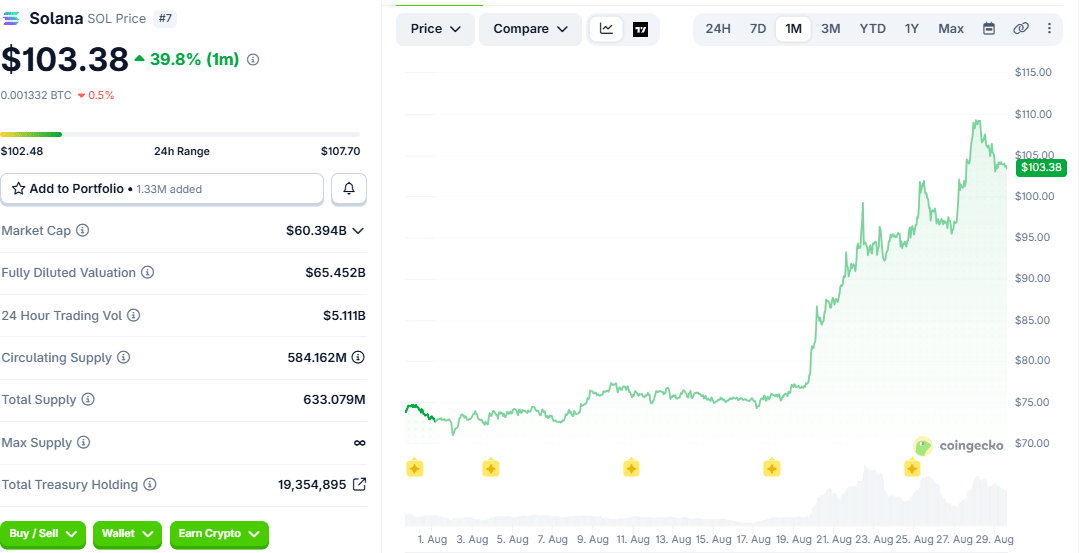
The token has gained more than 40% in August, one of its strongest monthly performances since 2024, though it remains close to 70.5%, as of now, below its January 2025 all-time high of $293.31.
Also Read: Ripple-Backed Evernorth’s XRP Treasury Clears SEC S-4; Nasdaq Vote Set Sept 30