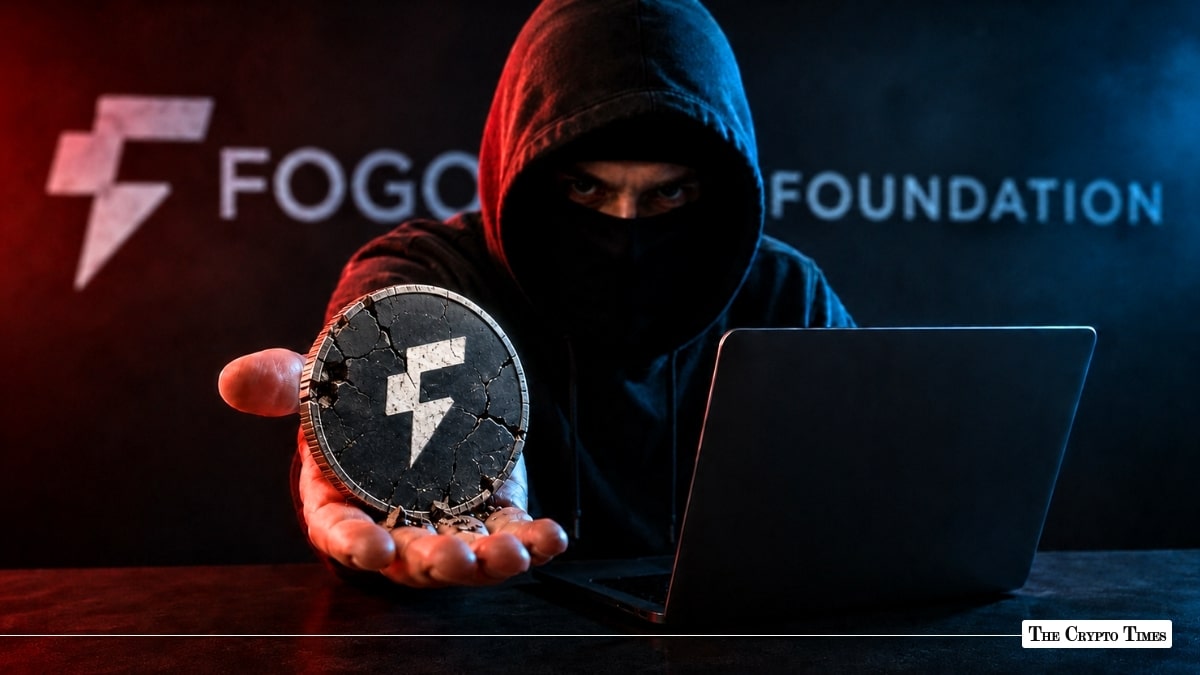
The Fogo Foundation, the entity behind Fogo, a high-performance Solana Virtual Machine (SVM) Layer 1 blockchain built for low-latency decentralized trading, confirmed on Friday, August 29, 2026, that an unknown actor compromised its wallets. The breach resulted in 400 million FOGO tokens being transferred to an address controlled by the attacker.
The Foundation disclosed the incident through an official post on X at 1:13 AM UTC on August 29, 2026, stating that it had “experienced a compromise by an unknown actor which unfortunately resulted in 400mm FOGO tokens being sent to a bad actor.”
The post confirmed that exchanges were alerted immediately and that the Foundation is “actively communicating with law enforcement as well as forensic experts.” The team also clarified that the Fogo blockchain itself was not impacted and “continues to operate as normal.”
Scale of the Loss
The 400 million FOGO tokens represent approximately 4% of the token’s total supply of 10 billion, based on tokenomics data published by the project. According to the Foundation’s allocation breakdown, 30.38% of total supply, roughly 3.038 billion tokens, was designated for the Foundation. The compromised amount therefore accounts for roughly 13.2% of the Foundation’s own allocation.
At the time of writing, FOGO was trading at approximately $0.007495, down about 18.42% in 24 hours, putting the estimated value of the stolen tokens at roughly $3.88 million.
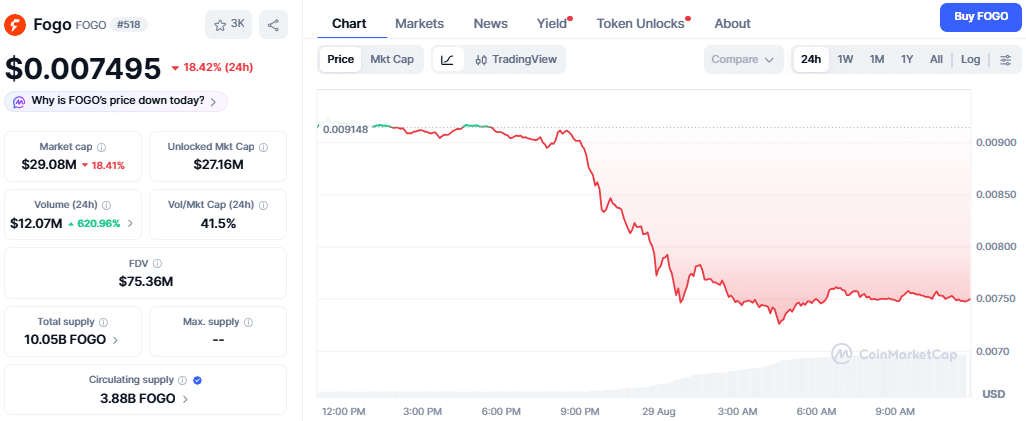
FOGO’s circulating supply stands at approximately 3.85 billion tokens, with a market capitalization near $38 million. The token hit an all-time high of $0.06326 on January 15, 2026, and is currently trading about 84% below that level.
Fogo Blockchain: Background
Fogo launched its mainnet and Token Generation Event (TGE) on January 13, 2026, following a pre-market phase that included a presale on December 17, 2025. The project is built on a custom Firedancer client, originally developed for Solana, and is designed to deliver sub-40 millisecond block times, roughly 1.3-second finality, and gasless transaction sessions for professional on-chain traders.
The project was co-founded by former high-frequency trading professionals, including a former Citadel trader with experience in Japanese equities and direct market access. The team raised a total of $13.5 million in funding, with a $5.5 million seed round in December 2024 led by Distributed Global, followed by an $8 million round in January 2025 involving CMS Holdings, Kain Warwick, and Larry Cermak, among others.
FOGO spot trading went live on major centralized exchanges including Binance, OKX, KuCoin, and Gate.io on January 15, 2026. The token is used for gas fees, staking, governance, and ecosystem incentives within the Fogo network.
Foundation Response
In its disclosure post, the Fogo Foundation stated that it had taken three immediate actions: alerting exchanges to flag or freeze suspicious deposits, initiating communication with law enforcement agencies, and engaging forensic experts to investigate the breach. The Foundation did not specify whether the compromise involved a private key leak, a social engineering attack, or another method.
The Foundation’s statement that the blockchain itself was unaffected suggests the breach was limited to Foundation-controlled wallets or infrastructure, not to the protocol’s consensus or smart contract layer. This distinction is significant because it means user funds held in personal wallets, staked positions, and liquidity pools on the Fogo network were not directly impacted by the incident.
The Foundation noted that “more information will be provided as soon as possible,” indicating that a detailed post-mortem is expected in the coming days.
Context: Crypto Security Landscape in 2026
The Fogo Foundation breach adds to a growing list of crypto security incidents in 2026. According to a report from on-chain security platform Blockaid, the first half of 2026 saw more than $1.1 billion lost across 212 verified incidents, making it the most-hacked half-year on record by incident count.
A separate report from CertiK covering the same period placed the total at $1.31 billion across 344 incidents, with wallet compromises and infrastructure breaches emerging as the costliest attack category, overtaking smart contract exploits for the first time.
August 2026 alone has been particularly active. The month opened with fallout from the Coldcard hardware wallet firmware exploit, which drained more than $130 million in Bitcoin from over 5,200 addresses. The week of August 17 to 23 saw five separate protocol-level exploits drain over $15 million, including incidents at Maya Protocol, BounceBit, The Sandbox, Allbridge, and Term Labs.
Foundation-level compromises have become a recurring pattern in 2026. In December 2025, the 0G Foundation lost approximately $520,000 after attackers exploited a leaked private key from a cloud server instance, draining 520,010 $0G tokens through an emergency withdrawal function. More recently, the UXLink project saw its multisignature wallet breached, leading to the unauthorized minting of nearly 10 trillion UXLINK tokens and a 90% collapse in the token’s price.
Previous Fogo Security Incident
This is not the first time the Fogo project has dealt with a security-related issue. Shortly after its mainnet launch on January 13, 2026, the team identified and disclosed a display vulnerability in its Flames EVM wallet, advising users to check back for updates within 24 hours. That earlier incident was characterized as a display bug rather than a fund-loss event, making the current breach the first confirmed loss of tokens from the Fogo ecosystem.
What to Watch
Several developments will shape how this incident unfolds in the coming days:
- Exchange response. Whether major exchanges such as Binance, OKX, and KuCoin freeze or flag incoming FOGO deposits linked to the attacker’s address will determine whether the stolen tokens can be liquidated. Previous incidents, such as the UXLink breach, have shown that coordinated exchange freezes can limit an attacker’s ability to cash out.
- Post-mortem details. The method of compromise, whether it involved a private key leak, phishing, social engineering, or a cloud infrastructure flaw, will carry implications for the broader industry. If the breach traces to operational security failures similar to the 0G Foundation’s leaked cloud key, it would reinforce the trend identified by Blockaid and CertiK: that access control and infrastructure security have become the primary risk vectors in 2026, surpassing smart contract vulnerabilities.
- Token unlock schedule. According to tokenomics data, Fogo’s next major token unlock is scheduled for September 26, 2026, with 1.54 billion FOGO, representing 15.44% of total supply, set to be released across four allocation categories. The timing of this breach ahead of that unlock event may compound selling pressure if market confidence deteriorates.
- Price impact. At the time of this report, FOGO had not yet shown a decisive reaction to the disclosure. Given the token’s current market capitalization of roughly $38 million and daily trading volume of approximately $1.7 million to $4.2 million, a liquidation of 400 million tokens, if the attacker attempts to sell, could generate significant downward pressure.
Also Read: Solana Neobank Avici Hacked: Attacker Spends $190 to Drain $500K From 1,685 Users