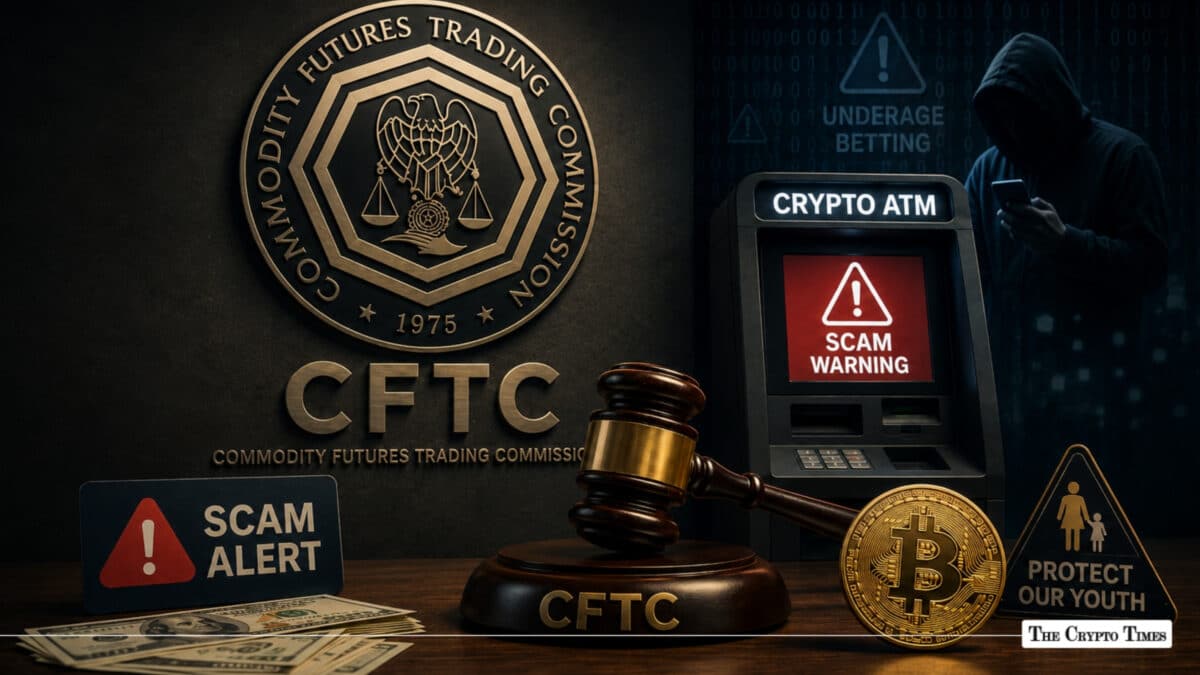
The U.S. Commodity Futures Trading Commission (CFTC) has issued an advisory warning consumers to be cautious when someone claims to represent a bank, government agency, investment firm or other legitimate business.
The advisory, titled “Pause Before You Pay: Unusual Money Transfer Instructions May Signal Fraud,” highlights a growing pattern in which scammers combine impersonation, urgency, and unusual payment methods to push victims into transactions that can be difficult or impossible to reverse.
The warning comes as FBI data shows that scams involving cryptocurrency kiosks resulted in about $388 million in reported losses in 2025. The CFTC urged consumers to be especially wary if they are instructed to move money through a crypto ATM, unfamiliar app, gift card, QR code, or courier.
What the FBI data shows
According to the FBI’s Internet Crime Complaint Center (IC3), it received 13,460 complaints involving cryptocurrency kiosks in 2025, with reported losses of about $388 million. It said complaints increased 23% from the previous year, and more than half involved people over 50, who collectively reported losses exceeding $302 million.
As per the FBI, scammers typically give victims detailed instructions on where to withdraw cash, which cryptocurrency kiosk to use and how to send the funds using a wallet address or QR code supplied by the criminal. That process can turn a traditional cash withdrawal into a cryptocurrency payment controlled by someone the victim may never have met.
How the scam works
The schemes reportedly often begin with an unsolicited phone call, text, email, or online message. The caller may claim to be a government official, bank representative, investment professional, utility provider, or technology-support employee.
The advisory states that fraudsters then create a sense of immediate danger. Victims may be told their bank account is compromised, criminals are using their identity, their investments are at risk or they must move their money immediately to protect it. Instead of directing the victim toward a conventional bank transfer, the scammer may demand cash for a crypto ATM, instruct the victim to scan a QR code, download an unfamiliar application or purchase gift cards.
The CFTC identifies such unusual instructions as a major warning sign of potential fraud. The agency states legitimate government agencies, financial institutions, and reputable companies will not instruct consumers to protect their money by sending cryptocurrency through a kiosk, purchasing gift cards, or handing cash to a courier.
Why crypto is hard to recover
The speed and generally irreversible nature of many cryptocurrency transactions can make them attractive to scammers.
A victim may withdraw cash and deposit it into a crypto kiosk, where it is converted into cryptocurrency and sent to a wallet address provided by the scammer. Once confirmed, the transaction generally cannot be reversed through the banking system.
The CFTC advises consumers to be cautious when sending cryptocurrency to unfamiliar wallet addresses and not to scan QR codes supplied by strangers.
Beyond crypto ATMs
Crypto kiosks are only one part of the broader payment strategy. The CFTC also warned about fake trading platforms, fraudulent mobile applications, gift cards and couriers.
Victims may be directed to legitimate-looking websites or apps that display fake account balances and trading profits before being pressured to send cryptocurrency to wallets controlled by scammers.
The CFTC has also warned about relationship investment scams, in which criminals build trust through social media, dating platforms or messaging apps before promoting fraudulent crypto investments.
Urgency is a major warning sign
One of the clearest indicators is pressure to act without independent verification.
Scammers may stay on the phone while victims withdraw cash, tell them what to say to bank employees, split payments or demand secrecy to stop them from seeking help.
The CFTC advises consumers to end the conversation and independently contact the organization involved through a verified phone number or official website. Consumers should also be cautious if asked to send funds to an unfamiliar wallet, download unknown software or provide remote access to their device.
The agency has separately warned about criminals impersonating CFTC officials and demanding cryptocurrency, fees or taxes. The CFTC says it will not require people to send bitcoin, gift cards or other unusual payments.
Consumers who suspect fraud should report it promptly to the CFTC or the FBI’s Internet Crime Complaint Center. The FBI also recommends keeping transaction details, including the cryptocurrency transaction ID, wallet address and information about the crypto kiosk, to help investigators.
The advisory underscores the risks associated with payment methods that can allow scammers to move funds quickly. Consumers are urged to pause, independently verify unusual payment requests and seek help before sending money.
Also Read: Coinbase Urges SEC, CFTC to Align Rules for Perpetual Derivatives