Key Highlights
- Grayscale says artificial intelligence could increase attention on financial privacy.
- Zcash allows users to hide transaction amounts, senders, and recipients through shielded transfers.
- Shielded transactions accounted for about 90% of Zcash transaction activity as of July 20, according to Grayscale.
Grayscale Research has identified growing financial surveillance driven by artificial intelligence as a potential reason for renewed interest in privacy-focused cryptocurrencies, with Zcash (ZEC) at the center of its latest analysis.
In a report shared on Thursday, titled “Zcash: Financial Privacy in the Age of AI,” Grayscale Head of Research Zach Pandl argued that advances in AI could make it easier to analyze financial activity across digital payment systems.
Grayscale operates the Grayscale Zcash Trust, giving the firm a direct financial interest in ZEC’s price and adoption. The research note was published by Grayscale’s investment research arm rather than an independent analyst.
The report does not establish that AI will drive new demand for Zcash. Instead, Grayscale presents privacy as a possible area of growing importance as stablecoins, blockchain-based payments, and automated financial systems become more widely used.
AI adds a new layer to the privacy debate
Financial privacy has changed as financial records have moved from paper to digital systems.
Banks already hold detailed information about customers and transactions, but those records are generally not publicly accessible. Public blockchains work differently, with transaction histories and wallet balances often visible indefinitely.
Grayscale argues that AI could make blockchain analysis more extensive by combining on-chain information with other datasets. That could make it easier to identify relationships between wallets, transactions, and real-world entities.
The report therefore frames AI as a potential new source of pressure on financial privacy rather than as a direct catalyst for Zcash adoption.
Zcash keeps transaction details private
Zcash differs from transparent blockchains by giving users the option to shield transaction information.
The network has a fixed supply of 21 million ZEC and uses a Proof-of-Work consensus mechanism similar to Bitcoin. Its shielded transactions use zero-knowledge proofs to verify transfers without publicly revealing the sender, recipient, or transaction amount. Zcash also provides viewing keys that allow users to selectively disclose information to specific parties.
That feature creates a distinction between public transparency and complete anonymity. Transaction information can remain hidden from the public while still being disclosed when required.
Shielded activity has increased
Grayscale’s privacy argument is supported by increased use of Zcash’s shielded system.
According to data cited in the report, shielded transactions accounted for approximately 90% of Zcash’s transaction count as of July 20, 2026. Shielded supply stood at about 4.2 million ZEC, or roughly 25% of circulating supply, at the time.
The figures show that users are making significant use of Zcash’s privacy functionality. They do not, however, demonstrate that Zcash has achieved broad mainstream adoption.
Access through exchanges, wallet support, regulatory treatment, and the usability of shielded transactions remain important factors for the network.
Zcash has spent years addressing usability
Zcash’s privacy technology has also gone through several technical changes since the network launched in 2016. The Sapling upgrade in 2018 reduced the computing and memory requirements associated with shielded transactions.
The Orchard protocol, introduced with the 2022 NU5 upgrade, moved the network to the Halo 2 proving system and removed the trusted-setup requirement for the new shielded pool.
More recently, the Ironwood upgrade introduced another shielded pool following the discovery and correction of an issue involving the original Orchard circuit. These upgrades address a longstanding problem for Zcash: privacy may be technically available, but it needs to remain practical enough for users to employ it regularly.
Wallets remain important to adoption
Grayscale also points to developments at the wallet layer. Zodl, formerly known as Zashi, has added features including swaps, CrossPay, and support for cold storage of shielded balances.
The importance of these tools is largely practical.
If users have to repeatedly move between shielded and transparent addresses to complete ordinary transactions, the privacy benefit becomes less convenient to maintain.
For Zcash, wider adoption will therefore depend not only on the underlying cryptography but also on whether wallets and applications can make private transactions easier to use.
Network infrastructure is expanding
Grayscale also highlighted developments outside the transaction layer. In March, mining company Foundry announced plans for a U.S.-based institutional Zcash mining pool aimed at institutional and public-company miners. The development does not directly demonstrate greater demand for shielded transactions, but it represents additional infrastructure around the network.
Grayscale also points to proposed upgrades such as Tachyon and Crosslink, which are intended to address scaling, synchronization, and network reliability.
Whether these developments lead to greater adoption remains dependent on implementation and participation across the Zcash ecosystem.
Regulatory access remains a key question
Privacy can also create complications for Zcash’s access to regulated financial infrastructure.
Exchanges and custodians operating under anti-money laundering requirements generally need to monitor transactions and comply with customer identification and reporting obligations.
Zcash’s viewing-key system provides a mechanism for selective disclosure, but shielded transactions do not provide the same public transaction history available on transparent networks. That difference could make regulatory and compliance decisions an important factor in ZEC’s future availability.
The issue is particularly relevant as jurisdictions continue strengthening rules around privacy-focused crypto assets and transaction monitoring.
ZEC remains a small part of the crypto market
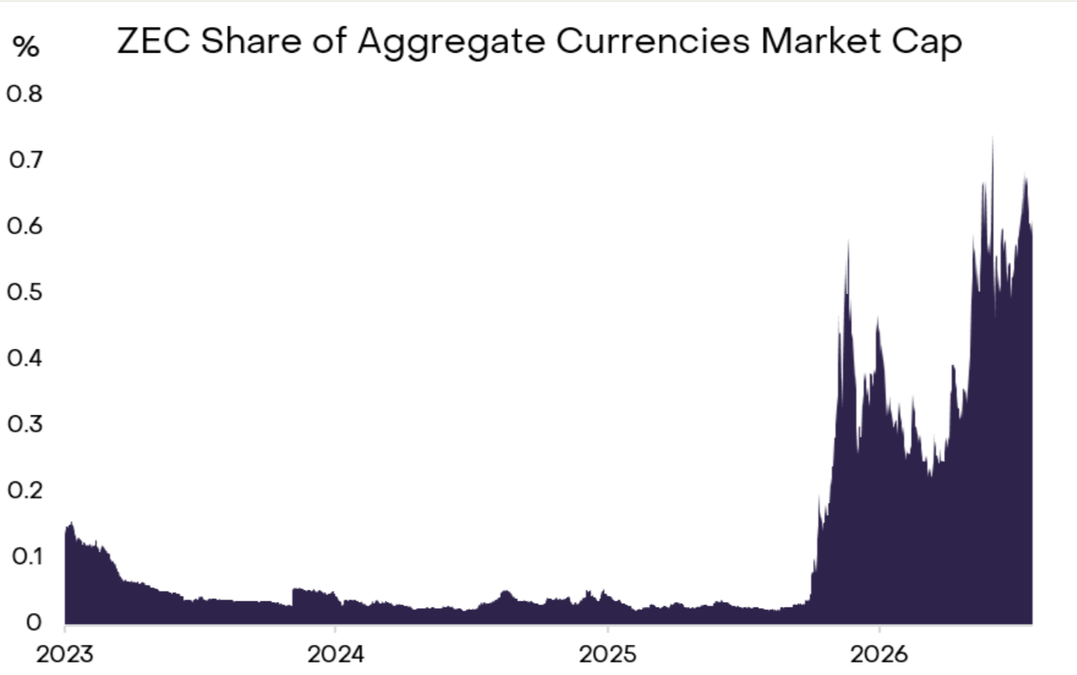
Despite the increased use of shielded transactions, Zcash remains a relatively small asset within the broader cryptocurrency market. Grayscale estimated that ZEC had a market value of roughly $8 billion in July 2026, representing about 0.6% of the firm’s Currencies Crypto Sector, which it valued at approximately $1.4 trillion across 15 assets.
Bitcoin accounts for the overwhelming majority of that segment.
Grayscale also presented a scenario in which ZEC captured 5% of the sector, which would imply a substantially higher valuation. That calculation is a hypothetical scenario, not a price forecast.
AI privacy thesis still faces several unknowns
The central question raised by Grayscale is whether increased financial surveillance will cause users to place a higher value on private digital money.
That remains uncertain. AI could make financial monitoring more powerful, but it could also lead to stronger privacy regulations, new compliance technologies, or changes in how blockchain data is handled.
Likewise, greater interest in financial privacy does not automatically translate into demand for Zcash. Users still need accessible wallets, exchange support and applications, while businesses and institutions must be able to operate within regulatory requirements.
Zcash faces a test of practical adoption
Grayscale’s latest report puts Zcash into a broader debate about how much financial privacy users will want as more economic activity moves onto public blockchains. The network already has evidence of substantial shielded activity, but its long-term position will depend on factors beyond the privacy technology itself.
Regulatory access, wallet usability, network upgrades, and broader adoption will determine whether Zcash can move beyond a specialized privacy asset.
For now, Grayscale’s argument is best viewed as a long-term market thesis rather than a confirmed new catalyst for ZEC. AI may increase attention on financial privacy, but whether that translates into sustained demand for Zcash remains an open question.
Also Read: Coinbase CPO Warns Stablecoin Rewards Could Derail CLARITY Act