Gemini Space Station (Nasdaq: GEMI) reported second-quarter 2026 results on August 13 showing higher revenue and lower year-over-year net losses alongside continued pressure on profitability. The exchange posted a net loss of $107.7 million, or $0.89 per share, narrower than the $133.2 million loss a year earlier, even as the quarter’s results were affected by a sharp rise in transaction losses.
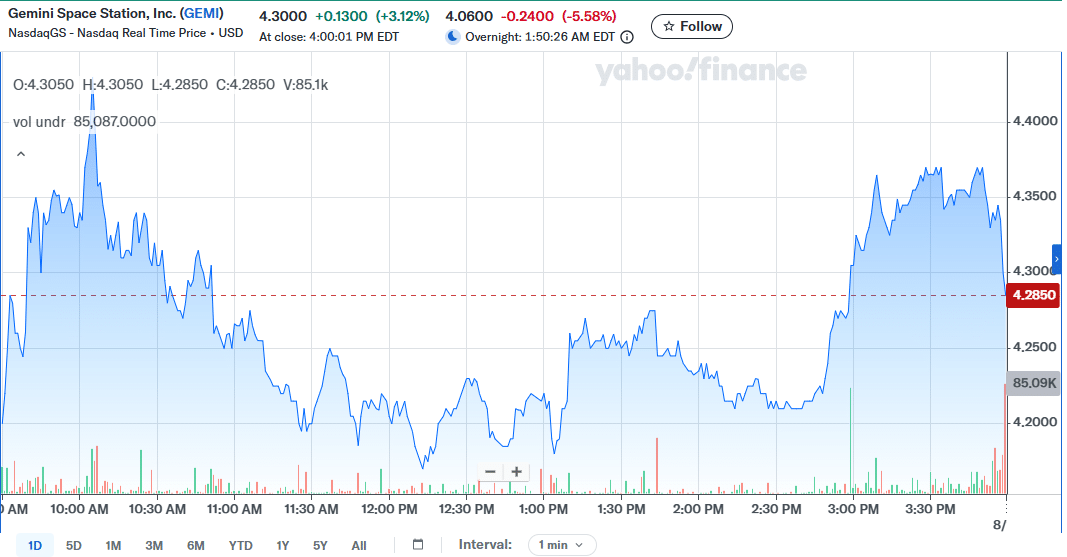
Gemini’s stock had actually risen during Thursday’s regular session, closing up 3.12% at $4.30 before the earnings were released after the market close, according to Yahoo Finance data. In early trading afterward, shares were quoted around $4.06, down about 5.6% from that close, as the market digested the results.
The Numbers
According to the company’s results, total revenue rose 37% year-over-year to $45.5 million, up from $33.3 million in the second quarter of 2025. That growth came despite a soft crypto trading environment: exchange revenue, that is fees from crypto trading, fell 38% to $12.5 million, as trading volume on the platform dropped to $3.8 billion from $11.3 billion a year earlier. Total transaction revenue, which also includes over-the-counter (OTC) and prediction-market activity, declined 15% to $17.8 million.
The offsetting strength came from services. Services revenue and interest income rose 117% to $26.0 million, led by credit card revenue, which jumped 231% to $16.2 million as Gemini’s cardholder base grew, and staking revenue, up 50% to $4.0 million. OTC revenue rose sharply to $4.7 million from $0.6 million, reflecting higher institutional activity, while the company’s fledgling prediction-markets business contributed $0.5 million. Notably, services revenue now exceeds transaction revenue, a shift the company has been explicitly pursuing.
Operating expenses rose 24% year-over-year to $122.4 million, driven mainly by stock-based compensation tied to Gemini’s IPO and credit-card-related costs. Operating expenses fell 15% from the first quarter, and operating loss improved 18% quarter-over-quarter, the third consecutive quarterly improvement, which the company attributed to cost-cutting measures including a February 2026 reduction in force and its exit from the UK, EU, and Australian markets.
Adjusted EBITDA remained negative at $74 million, compared with negative $51.9 million a year earlier, a decline the company attributed primarily to unrealized losses on Bitcoin it received through a May 2026 private placement, as bitcoin’s price fell over the quarter. Cash and cash equivalents stood at $188.6 million, down from $252.2 million at the end of 2025.
What Drove the Bigger Loss: A Company-Reported Fraud Incident
The central reason results missed expectations was a sharp rise in transaction losses, which climbed to $20.1 million from $3.6 million a year earlier. The bulk of that increase, a $16.1 million provision for credit losses, traces to what Gemini’s Q2 report describes as an identity fraud event affecting part of its credit card portfolio. The company first disclosed the matter in the first quarter of 2026, when it set aside a smaller, $4.1 million reserve based on the information available at that time.
According to Gemini’s own report, as its internal investigation continued, the company identified additional fraud patterns and affected accounts tied to the same account-origination cohort from earlier in 2026, and those accounts migrated into more serious delinquency during the second quarter, prompting management to raise its estimate of expected losses under its standard credit-accounting methodology (CECL). Gemini’s filing describes its response to the incident and its accounting treatment of it, but does not disclose the fraud’s origin, method, or the identity of those responsible. Any characterization of how the fraud occurred would go beyond what the company has disclosed, and this remains an allegation and an internal finding by Gemini, not an adjudicated fact.
The company said its current analysis indicates the elevated provision is concentrated in this specific cohort and does not reflect broader deterioration across its overall credit card portfolio, which grew substantially to $219.6 million in managed receivables from $93.5 million a year earlier. Gemini said it has since added fraud detection and account monitoring measures. All of this, the fraud’s existence, its scope, and its containment, is the company’s own characterization in its own report.
The Strategic Story: Becoming a ‘Super App’
Beyond the quarter’s numbers, Gemini used the results to reinforce a broader repositioning. CEO Tyler Winklevoss said the results reflect efforts “to reduce operating expenses while diversifying revenue” and building “multiple paths to revenue that are less sensitive to crypto market forces.” President Cameron Winklevoss pointed to the platform’s expansion beyond crypto, including the July 2026 launch of commission-free U.S. stock trading, framing the company’s evolution toward a broader “financial super app” alongside its credit card, prediction markets, and staking products. Those are the company’s own characterizations of its strategy and progress.
The quarter also brought regulatory and product milestones. Gemini’s derivatives clearinghouse went live on August 4, 2026, following its Derivatives Clearing Organization (DCO) license from the CFTC in April, allowing the company to self-clear its prediction market contracts, building on a Designated Contract Market license secured in December 2025. The report stated that Gemini Predictions set a new monthly volume record in each month of the quarter, with event contracts traded up 93% quarter-over-quarter and cumulative volume surpassing 225 million contracts since its December 2025 launch.
What the Results Show
Gemini’s second-quarter results show strong revenue growth alongside persistent profitability challenges.The 37% increase in revenue and 117% growth in services revenue point to a meaningful shift away from dependence on crypto trading. But the $16.1 million credit-loss provision, negative adjusted EBITDA and declining cash balance highlight the risks involved in expanding into new financial products.
The fraud-related provision is based on Gemini’s own assessment and should not be treated as evidence of broader deterioration in the company’s credit-card portfolio without independent confirmation. For investors, the key question is whether Gemini’s expanding revenue base can eventually offset its still-high operating costs and produce sustainable earnings. The quarterly results alone do not establish that outcome.
Also Read: Tether Completes First Full Audit as KPMG Reviews 2025 Financials