Key Highlights
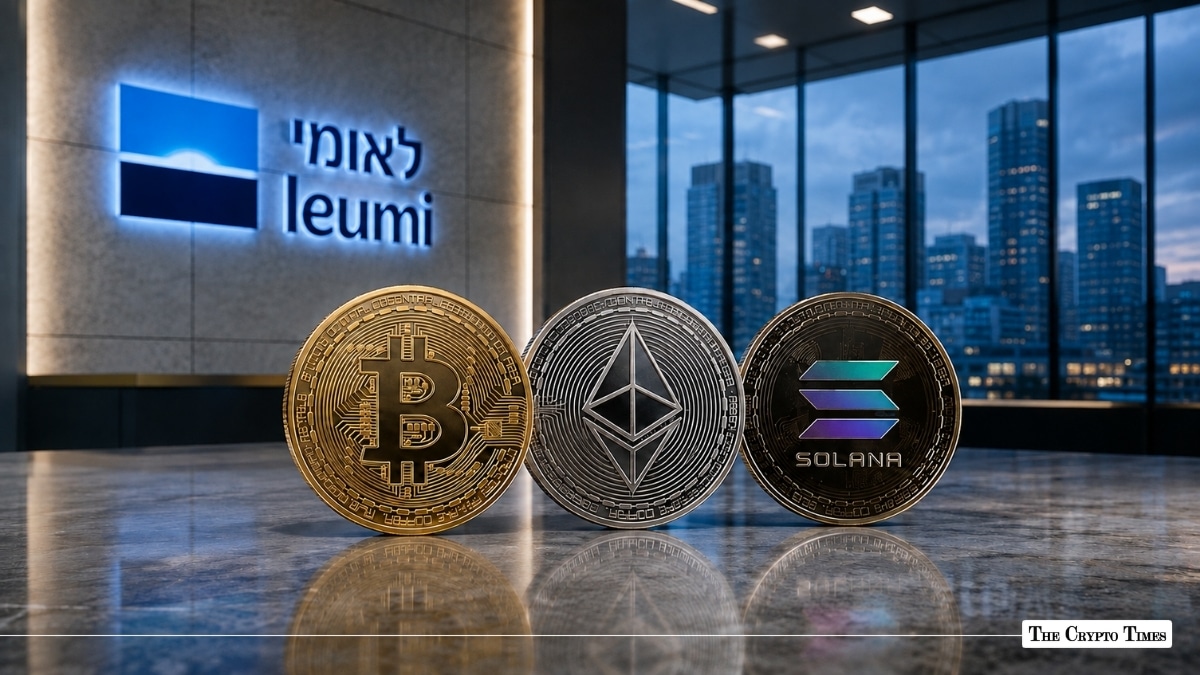
- Bank Leumi plans to offer trading in Bitcoin, Ether and Solana.
- The service is expected to launch in early 2027 through the Leumi Trade app.
- Leumi and PEPPER customers will be able to buy, hold, and sell the supported assets.
Bank Leumi is preparing to add cryptocurrency trading to its existing investment platform, giving customers a way to buy, hold and sell Bitcoin, Ether and Solana without using a separate crypto exchange.
According to an announcement published on August 14 by Galaxy, the service is expected to become available to customers in early 2027. Customers of Leumi and its digital banking arm PEPPER will access the service through the bank’s Leumi Trade capital markets application.
Bitcoin, Ether and Solana planned for launch
The initial offering will include Bitcoin, Ether and Solana.
Trading will be available through a dedicated section of the Leumi Trade app, keeping cryptocurrency transactions within the bank’s existing investment interface.
Leumi has not yet disclosed trading fees, the complete list of assets that may eventually be supported, or a specific launch date.
The planned rollout therefore remains several months away, with the bank and Galaxy still preparing the service.
Galaxy to provide trading and custody technology
Galaxy will supply much of the technology behind the service.
Leumi will use GalaxyOne Institutional for trading and has also signed an agreement with Galaxy’s Custody Infrastructure business, formerly known as GK8.
The partnership means customers will interact with Leumi’s platform while Galaxy provides parts of the underlying trading and custody setup.
Maya Ravia, Head of Strategy at Bank Leumi, said the bank wants customers to access crypto within its existing financial services environment.
“This initiative represents a significant pillar of the bank’s innovation strategy and enables us to provide customers with simple, secure, and regulated access to trading digital assets through one of the world’s leading technological infrastructures.”
Galaxy Israel CEO Lior Lamesh said:
“Leumi is the first bank in Israel to bring digital assets to its customers, and it chose Galaxy, to make it possible.”
Israel’s crypto sector is expanding beyond exchanges
The Leumi plan comes after several developments that have pushed crypto further into Israel’s financial sector.
In April, Israel approved its first shekel-pegged stablecoin following a two-year pilot. The token is backed 1:1 by shekels and was designed to support blockchain-based payments and other financial applications.
That project differs from Leumi’s planned offering, but both developments show financial institutions and regulators examining ways to bring blockchain-based assets into more conventional financial activity.
The shift is also not limited to Israel.
Banks explore crypto lending and staking
Traditional financial institutions have increasingly been testing services beyond straightforward cryptocurrency trading.
In June, Morgan Stanley and Galaxy Digital introduced a model that allows eligible high-net-worth investors to lend crypto and receive exchange-traded product shares. The offering is aimed at a limited investor group rather than the broader retail market.
BNY has also been exploring crypto staking services for institutional clients with support from Galaxy. That initiative remains subject to regulatory approval.
These projects reflect different approaches to bringing crypto into traditional finance, ranging from trading and lending to staking.
Leumi’s crypto service still has to launch
For Bank Leumi customers, there is no immediate change.
The cryptocurrency trading service is currently scheduled for early 2027, and the bank has yet to publish details on pricing, customer eligibility, tax reporting, or the final asset lineup.
If the rollout proceeds as announced, Leumi customers will be able to access major cryptocurrencies through an existing banking and investment application rather than opening accounts with a dedicated crypto exchange.
The launch will also provide a test of how much demand exists for crypto trading when it is offered through a traditional Israeli bank rather than a specialized digital asset platform.
Also Read: Core Scientific Buys Rival Miner’s 440 MW Campus to Run AI Workloads