Key Highlights
- Miden plans to launch USDCx, a USDC-backed stablecoin, alongside its mainnet later this month.
- The stablecoin will be issued through Circle’s xReserve and backed 1:1 by USDC.
- Transaction balances, counterparties, and history will remain private by default on Miden.
Miden is preparing to launch USDCx, a privacy-focused stablecoin backed by USDC, as the zero-knowledge blockchain moves toward its mainnet rollout later this month.
According to a blog post published Wednesday, the stablecoin will be issued natively on Miden through Circle’s xReserve infrastructure and backed 1:1 by USDC held in an xReserve smart contract. Unlike standard USDC transactions on most public blockchains, USDCx will keep individual balances, counterparties, and transaction histories private by default.
Miden announced the planned launch on August 12, saying the stablecoin is intended to support payments and other financial applications where transaction confidentiality is important.
The Crypto Times reached out to Miden for comment on the USDCx announcement and planned launch but hadn’t received a response at the time of publication.
USDCx brings privacy to USDC infrastructure
USDCx is not a separate dollar reserve system. Instead, Miden will use Circle’s xReserve model to issue the token against USDC reserves. Under the arrangement, USDC deposited into xReserve provides the backing for USDCx, while the token operates natively on Miden.
Circle’s xReserve was designed to allow blockchains to issue USDC-backed representations without relying on traditional third-party bridges. The model has already been used to deploy USDCx on other networks.
According to the DeFiLlama data as of August 12, USDC had a market capitalization of approximately $72.22 billion at the time of writing. The platform listed about 72.25 billion USDC in circulation, with another 1.139 billion USDC marked as unreleased.
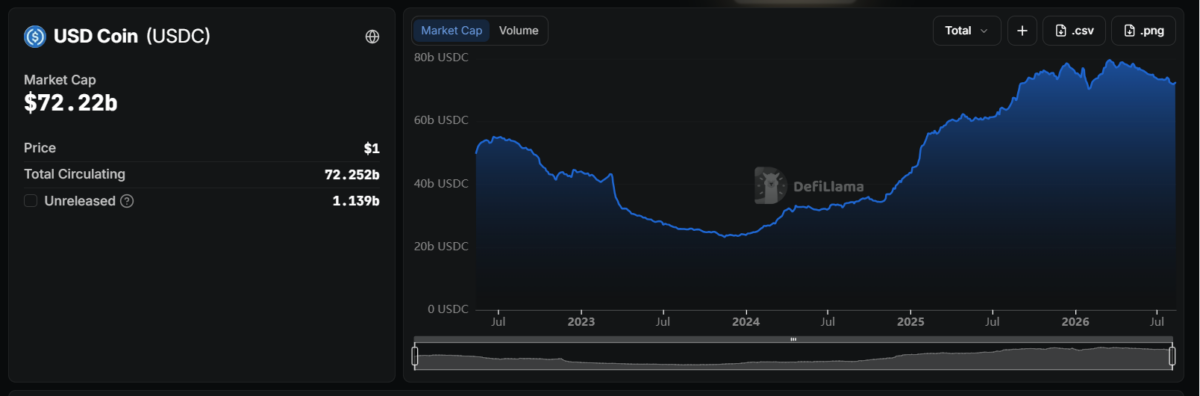
The figures provide context for Miden’s planned USDCx launch, which will use Circle’s existing USDC infrastructure rather than introduce a separate dollar-reserve system.
Tradeweb already used USDCx for Treasury settlement
The planned Miden launch follows the use of USDCx in a real-world institutional transaction on Canton.
On July 1, Tradeweb completed a real-time transaction involving a tokenized U.S. Treasury and USDCx on the Canton Network. The transaction paired the tokenized Treasury with tokenized cash and used Canton’s synchronized settlement infrastructure.
Franklin Templeton transferred the tokenized Treasury security to Virtu Financial, while Tradeweb handled execution and price discovery. The two assets were settled together onchain through Canton’s infrastructure.
The transaction showed one potential use of USDCx in institutional markets: using a USDC-backed stablecoin as the cash leg of a tokenized securities transaction.
Miden is taking the same underlying USDC-backed model into a network where transaction information is private by default.
Public blockchain transparency creates privacy concerns
The move comes as stablecoins expand beyond crypto trading into payments, settlement, and financial infrastructure. Public blockchains provide transparent transaction records, but that transparency can create problems for businesses using stablecoins for ordinary financial activity.
Payroll payments, treasury transactions, supplier payments and corporate transfers can expose wallet addresses and transaction amounts that companies may not want publicly visible.
Miden argues that this creates a barrier for some institutional and commercial applications. “On most public blockchains, every transaction is public. Every balance, every counterparty, every payment — visible to anyone, forever,” the company said.
The issue is not unique to Miden. Privacy-focused blockchain projects have increasingly explored ways to combine confidential transactions with the verification requirements of regulated finance.
Miden uses zero-knowledge proofs
Miden uses zero-knowledge proofs to execute and verify transactions without exposing their underlying details to the network. For USDCx, users can transact privately while the stablecoin remains backed 1:1 by USDC through Circle’s xReserve.
Miden also supports selective disclosure, allowing users to prove information such as a balance or transaction details to auditors, regulators, or counterparties when required. This approach aims to balance transaction privacy with verifiability, which could be relevant for institutional users that need compliance and audit capabilities without publicly exposing all financial activity.
Payments and treasury applications in focus
Miden said developers are working on use cases including:
- Private wallets
- Stablecoin payments
- Treasury management
- Payroll
- Cross-border transfers
- Other financial applications requiring selective disclosure
Moreover, Miden said USDCx will launch alongside its mainnet later this month. The project began at Facebook and later continued under Polygon before becoming independent in 2025. It has backing from a16z crypto, 1kx and Hack VC.
Also Read: Crypto.com Launches Tokenized Stocks With 24/7 Access to NVDA, TSLA & AAPL