Bitcoin is holding steady around $65,200 as of August 10, 2026, showing modest gains over the past 24 hours. The leading cryptocurrency continues to hover just above the $65,000 psychological level after a period of consolidation, with market capitalization near $1.31 trillion.
While short-term momentum has provided some breathing room, fresh on-chain analysis from CryptoQuant highlights significant hurdles that could shape the next phase of price action.
As of 7:40 AM UTC, Bitcoin is hovering near $65,200–$65,230 with a 24 hour trading volume of $14.67 billion. The 24-hour trading range has generally stayed between approximately $64,750 and $65,400, with volume remaining moderate. This places the asset well below its all-time high near $126,000 recorded in October 2025, representing a drawdown of nearly 48%, as per CoinMarketCap data.
The recent rebound has been supported by factors, including increased spot Bitcoin ETF demand—amassing over $853.54 million in net inflows during the week ending August 7, as per SoSoValue data—and longer-term holders accumulation.
However, the broader context remains one of cautious recovery rather than a decisive breakout. Short-term holders and recent buyers are still largely underwater relative to their entry points, creating a structural overhang that on-chain metrics are now bringing into sharper focus.
Cost-Basis Resistance from Recent Holder Cohorts
According to a CryptoQuant Quicktake analysis by analyst ShayanMarkets, Bitcoin faces key cost-basis resistance derived from Realized Price UTXO Age Bands. The average cost basis for investors who have held BTC for one to three months currently sits at approximately $67,000. For those holding between three and six months, the realized price is around $72,000.
Both levels remain above the current spot price of about $65,200, meaning these cohorts are sitting on aggregate unrealized losses. The $67,000 band for the more recent 1–3 month holders is particularly relevant because it lies relatively close to the market. If Bitcoin continues its rebound and approaches this zone, holders who have been underwater may look to reduce exposure near their break-even levels, potentially generating selling pressure and acting as resistance.
The higher $72,000 realized price for the 3–6 month cohort represents a secondary, more distant barrier. The analyst notes that these realized-price bands form an important overhead cost-basis structure. Until the market successfully reclaims them, Bitcoin continues to confront substantial resistance to the upside, complementing the broader technical picture of overhead supply.
Implications for a Sustainable Recovery
Reclaiming and holding above these realized-price levels would carry constructive implications. As the CryptoQuant analysis states, “Reclaiming these realized-price bands would indicate that the market is absorbing potential supply from recent buyers and would strengthen the recovery narrative.”
In other words, a decisive move through $67,000 and eventually $72,000 would suggest that demand is strong enough to absorb the latent selling from shorter-term participants who entered at higher prices.
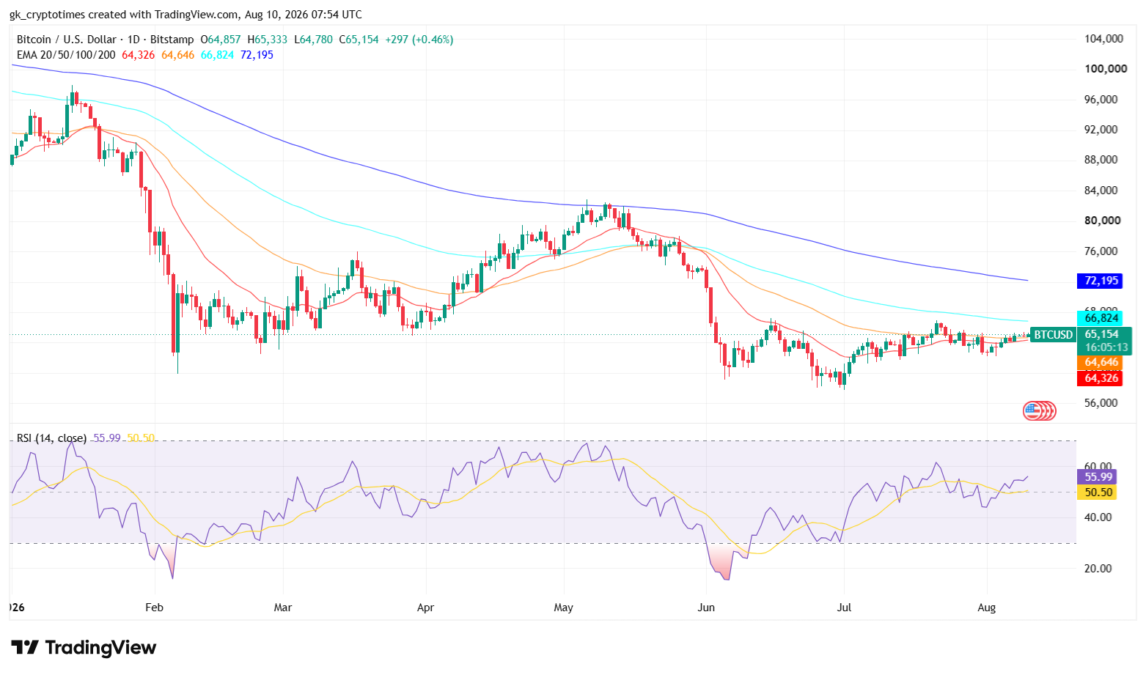
The YTD chart from TradingView shows that the asset is trading above its 20- and 50-day EMAs ($64,326 and $64,646) while remaining well below the 100- and 200-day EMAs ($66,824 and $72,195), signaling a short-term recovery within a broader downtrend. RSI at 55.99 sits modestly above the midpoint, indicating neutral-to-mildly bullish momentum without overbought conditions.
Until that occurs, the path higher remains challenged. The proximity of the $67,000 level means any near-term rally could encounter friction relatively quickly. Broader market participants are watching whether fresh spot demand—potentially from institutions or ETFs—can offset this potential supply. Additional context from related on-chain observations points to the need for sustained buying pressure to convert the current rebound into a more durable uptrend.
In the meantime, Bitcoin’s ability to stabilize above $65,000 offers a temporary foundation, but the on-chain cost bases of recent cohorts underscore that the next meaningful resistance zones are clearly defined.
Also read: Saylor Says Bitcoin Worked as Designed as BIP-110 Stalls at 0.15% Hash