Key Highlights
- Galaxy reported an $85 million net loss in Q2 2026, primarily due to declining digital asset prices.
- The company generated $66 million in adjusted gross profit from its Digital Assets business despite weaker crypto markets.
- Helios delivered its first 133 MW of AI computing capacity to CoreWeave, with quarterly leasing revenue expected to reach about $80 million beginning in Q3.
Galaxy Digital (Nasdaq: GLXY) reported an $85 million net loss for the second quarter of 2026 after weaker cryptocurrency prices weighed on the value of its digital asset holdings and investment portfolio, adding to a mixed earnings season for publicly listed crypto companies.
The results, released on Wednesday, showed that market weakness continued to pressure earnings despite stronger contributions from the company’s digital asset services and its AI data center business, which generated leasing revenue for the first time.
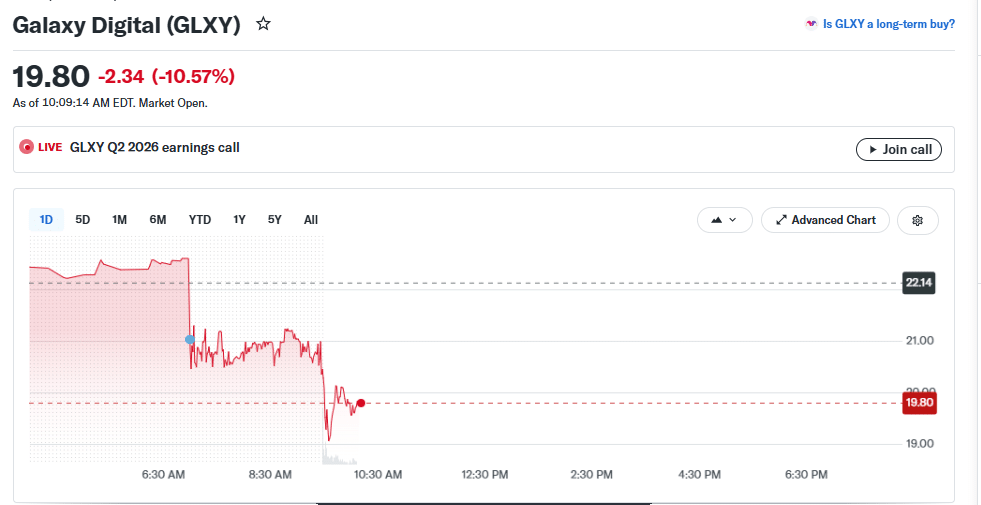
Investors reacted negatively to the report. Galaxy shares fell more than 10% in early Nasdaq trading after the company missed revenue expectations, according to Yahoo Finance data. At the time of this writing, the stock was trading at $19.80.
The company ended the quarter with $10.8 billion in total assets, $2.7 billion in total equity, and approximately $2.5 billion in cash and stablecoin holdings.
Digital asset business shows resilience despite market slowdown
Although weaker crypto prices weighed on earnings, Galaxy’s core Digital Assets division remained profitable on an operating basis. The segment generated $66 million in adjusted gross profit, up 34% from the previous quarter, reflecting demand across its institutional trading and lending businesses.
The company said trading volumes declined 7% quarter-over-quarter, outperforming the broader crypto market, where industry-wide trading activity fell by a steeper double-digit percentage.
Galaxy’s average lending book remained around $1.4 billion, while new loan originations increased during the quarter. The company also introduced an over-the-counter prediction markets offering, allowing institutional clients to incorporate event-driven contracts into broader portfolio and hedging strategies.
AI data center business begins contributing revenue
Galaxy’s AI infrastructure segment reached an important milestone during the quarter as it began generating commercial revenue for the first time. Its Data Centers business reported $20 million in adjusted gross profit after completing delivery of the first phase of its Helios campus in West Texas.
During the quarter, Galaxy delivered 133 MW of critical IT capacity to CoreWeave under a long-term lease agreement. With the first phase now fully operational, the company expects the facility to generate approximately $80 million in quarterly leasing revenue beginning in the third quarter.
Galaxy also expanded its AI development pipeline after quarter-end through the acquisition of three new sites in Texas, increasing its planned power capacity to more than 5.7 GW. The company additionally completed a $3.5 billion senior secured notes offering after the quarter closed to help finance the second phase of Helios.
Institutional crypto expansion continues
Beyond infrastructure, Galaxy continued expanding its institutional digital asset business.
The company announced a multi-year agreement with BNY, under which Galaxy will support the development of staking capabilities for BNY’s Digital Asset Custody platform while also serving as a design partner for the bank’s broader digital asset infrastructure.
The partnership builds on Galaxy’s growing role in institutional crypto services. Earlier this week, BNY confirmed it is exploring staking services for institutional custody clients using Galaxy’s infrastructure, although the offering remains subject to regulatory approval.
Galaxy also launched the Galaxy Fintech Fund, a long-short investment fund focused on blockchain infrastructure and financial technology. It also partnered with State Street Investment Management to launch the State Street Galaxy Onchain Liquidity Sweep Fund (SWEEP), a tokenized liquidity product designed for institutional cash management.
Crypto earnings highlight different industry trends
Galaxy’s results come during a week of mixed earnings across publicly traded crypto companies.
Earlier today, Circle reported second-quarter revenue below analyst expectations as lower reserve yields pressured earnings. However, the stablecoin issuer raised its full-year guidance and highlighted progress toward obtaining a federal trust bank charter. The company also reaffirmed plans to launch Arc mainnet on September 16.
Meanwhile, American Bitcoin, backed by Eric Trump, reported a $57.2 million quarterly loss while expanding its Bitcoin treasury to 8,002 BTC and posting record mining production alongside higher revenue.
The differing results illustrate how crypto companies are becoming increasingly diversified, with businesses spanning infrastructure, stablecoins, mining, AI computing, institutional services, and tokenization rather than relying solely on trading activity.
Galaxy’s business mix continues to evolve
While the quarter reflected the continued sensitivity of earnings to crypto market conditions, Galaxy’s latest results highlighted the company’s evolving business model.
Revenue from AI infrastructure has begun contributing to financial performance, while partnerships with firms such as BNY and State Street demonstrate the company’s increasing focus on institutional blockchain infrastructure.
As more of Galaxy’s business shifts toward recurring infrastructure and enterprise services, the company appears to be gradually reducing its dependence on the cyclical nature of digital asset trading, even as cryptocurrency markets continue to influence near-term earnings.
Also Read: Circle Stock (CRCL) Drops After Q2 Results Despite Strong USDC Growth