
The Coinbase Bitcoin Premium Index has entered uncharted territory, remaining negative for 78 consecutive days—the longest such stretch on record.
According to data from CoinGlass, the latest reading sits at -0.0954%, underscoring a persistent discount for Bitcoin in the U.S.-based exchange relative to other major platforms. This development has drawn attention from market observers as a potential signal of shifting demand dynamics in the world’s largest cryptocurrency market.
The index tracks the percentage difference between Bitcoin’s price on Coinbase and its average price across other leading exchanges. A positive reading typically indicates stronger buying interest on Coinbase, often associated with robust U.S. retail or institutional demand. Conversely, a negative value means Bitcoin is trading cheaper on Coinbase, which analysts commonly interpret as weaker U.S. investor appetite or relatively higher selling pressure from American participants.
The current 78-day negative run marks a clear departure from historical patterns and highlights an extended period of subdued U.S. activity compared with global trading venues.
Understanding the Metric and Its Current Reading
CoinGlass data reveals that the premium has not only stayed in negative territory but has done so without interruption for nearly three months. At this level, the latest figure shows Bitcoin continuing to trade at a modest but consistent discount on Coinbase. This prolonged discount suggests that U.S. buyers are not aggressively competing for Bitcoin at higher prices relative to international markets.
In past cycles, extended negative premiums have sometimes coincided with periods of profit-taking by U.S. holders, reduced inflows into U.S.-based products, or a temporary preference among American investors for other assets.
Market participants monitor the Coinbase Premium closely because Coinbase remains one of the primary gateways for U.S. capital into Bitcoin. When the premium turns and stays negative for an unusually long time, it can reflect broader sentiment among American investors.
Factors that may contribute to this massive negative streak include macroeconomic conditions, interest rate expectations, regulatory developments, or simply a pause in accumulation after earlier price advances. While the absolute size of the current discount is relatively small, the duration itself is what stands out as historically significant.
The chart below illustrates the premium’s fluctuations over an extended period, with the recent stretch of red bars (negative readings) appearing longer and more sustained than previous episodes.
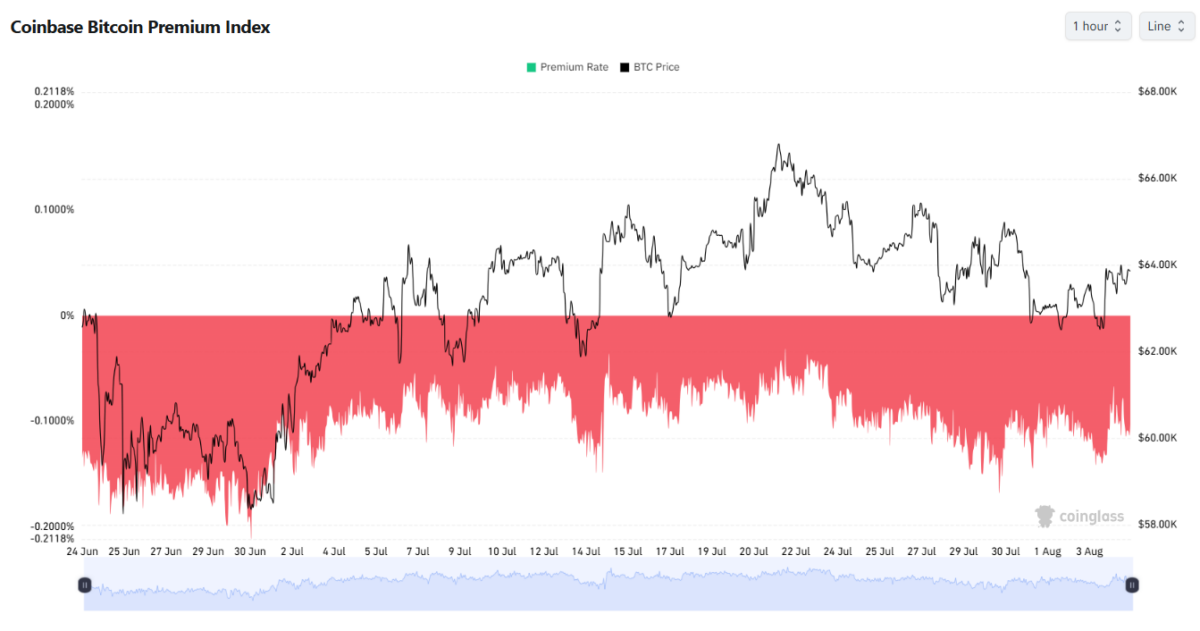
Bitcoin’s price line overlaid on the same chart provides additional context, showing how price movements have interacted with shifts in the premium. The visual data reinforces the narrative that the current negative phase is not a short-lived anomaly but a multi-month trend.
At the time of publishing, Bitcoin was trading near $63,850—up 1.97% in the past 24 hours with a trading volume of nearly $26 billion, as per market data provided by CoinMarketCap.
Market Implications and Investor Sentiment
A persistently negative Coinbase Premium raises questions about the strength of U.S. demand at a time when global Bitcoin markets continue to evolve. Weaker relative demand on Coinbase does not necessarily signal an outright collapse in interest, but it does point to a temporary imbalance. International buyers or non-U.S. platforms appear to be supporting prices more actively, while U.S. participants exhibit greater caution or selling bias. This divergence can influence short-term price discovery and liquidity patterns across exchanges.
For traders and analysts, the record streak serves as a cautionary data point rather than a definitive bearish forecast. Historical episodes of negative premiums have sometimes preceded consolidations or mild corrections, though outcomes vary depending on broader macroeconomic and on-chain conditions.
In the meantime, the 78-day negative streak stands as a clear statistical milestone. It underscores the value of monitoring exchange-specific price differentials as complementary indicators alongside traditional volume, open interest, and on-chain metrics.
As the cryptocurrency market matures, such granular measures of regional demand continue to offer useful insight into the underlying forces shaping Bitcoin’s price action. Market participants will be watching closely to see how long the current negative phase persists and whether U.S. demand reasserts itself in the weeks ahead.
Also read: Cathie Wood’s ARK Invest Buys $9.4M in Coinbase and Circle