As of early August 4, 2026, Bitcoin continues to display resilience in the face of geopolitical turmoil and macroeconomic headwinds, trading in a range around $63,000 to $64,000 after posting a gain of more than 7% in July.
The leading cryptocurrency has repeatedly absorbed initial sell-offs from global crises and recovered, frequently outperforming gold and the S&P 500 in subsequent 60-day periods, according to historical analyses.
At the same time, negative sentiment from a hardware wallet exploit and corporate treasury signals has tempered enthusiasm, while a rare U.S.-Japan currency intervention has reinforced dollar strength and added another layer of pressure on risk assets.
Performance Amid Geopolitical Tensions and Asian Market Ripples
As of August 4, 2026, the U.S.-Iran conflict remains the primary geopolitical driver, though recent days have shifted toward fragile diplomacy rather than active escalation. President Trump canceled planned strikes over the weekend, citing progress toward a deal that would reopen the Strait of Hormuz and address nuclear issues. Negotiations are contested: U.S. officials and Trump have pointed to talks beginning around August 3, while Iranian officials deny direct negotiations with Washington and state that discussions are limited to Oman on a temporary Hormuz transit mechanism now in its “final stages.”
The strait itself continues to see restricted traffic, with many vessels still diverted, though oil prices eased notably (Brent declining several percent) on the de-escalation signals. No comprehensive agreement has been finalized, leaving the situation fluid and markets attentive to any breakdown.
Bitcoin, trading as a continuous market, has responded with relative calm. It briefly crossed above $63,600 early on August 3 before easing to the mid-$62,000s to low-$63,000s range, as traders weighed the mixed diplomatic headlines against ongoing caution.
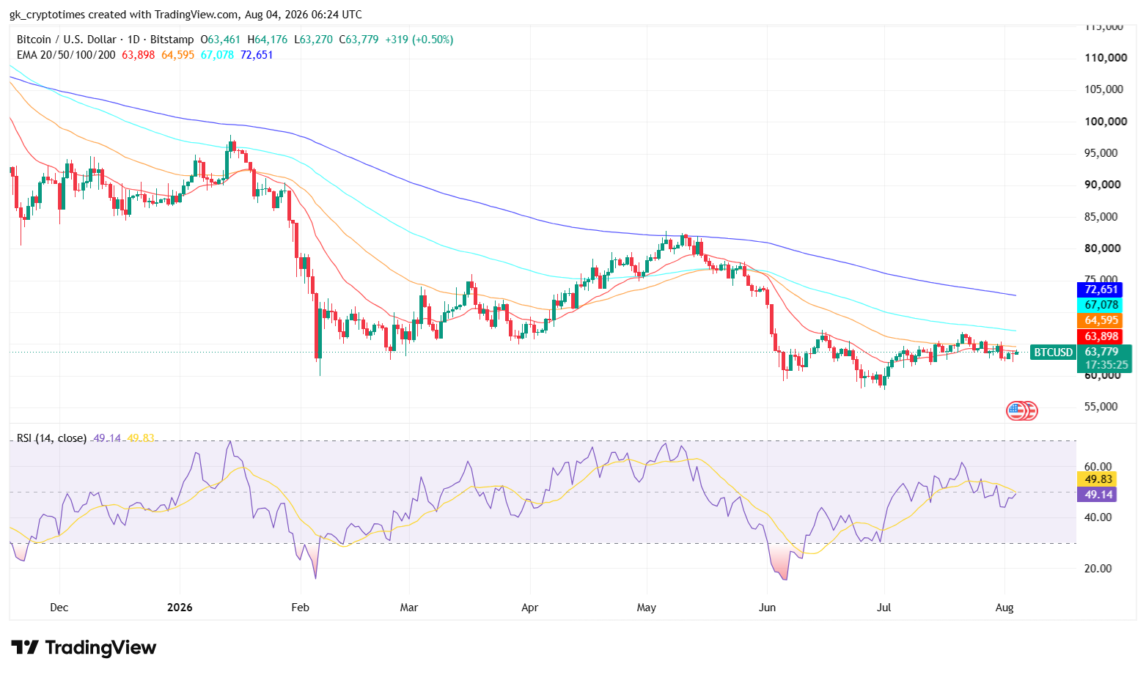
The asset continues to defend key support near the $60,000–$62,000 zone and the 200-week moving average around $62,800, consistent with its pattern of contained initial reactions followed by stabilization during this year’s successive shocks.
In Asia, equity markets have reflected the same energy-price and risk-appetite sensitivity seen in prior escalation phases. The first confirmed joint U.S.-Japan currency intervention in 15 years, yen-buying operations conducted late the previous week and publicly acknowledged on August 3, has added a distinct macro layer. Both sides warned they would not hesitate to intervene again if needed. The action strengthened the yen from recent multi-decade lows and moderated some dollar strength in the pair, yet the broader dollar index has remained firm overall.
This environment continues to support a higher-for-longer rate backdrop that typically pressures risk assets, including Bitcoin, even as the geopolitical risk premium shows signs of partial easing.
Institutional Dynamics and Negative Sentiment Pressures
Institutional participation remains a core source of resilience. SoSoValue data shows that U.S. spot Bitcoin ETFs recorded $172.43 million in net inflows in July, with occasional strong single-day totals, while whale wallets accumulated more than 40,000 BTC in recent periods. Long-term holders continue to dominate supply, providing a stabilizing base that has reduced the severity of drawdowns compared with earlier, more leveraged cycles.
Two developments have nonetheless fueled negative sentiment. A firmware vulnerability in the Coldcard hardware wallet, not a Bitcoin network issue, led to the theft of roughly $70 million to $89 million from self-custodied addresses starting in late July and extending into early August. The incident prompted a rotation toward custodial platforms, lifted exchange balances, and revived concerns about operational security even as the broader market avoided panic selling.
Separately, Strategy (formerly MicroStrategy), one of the largest corporate Bitcoin holders, disclosed on Monday that it sold 1,638 BTC between July 27 and August 2 for approximately $104.7 million at an average price of about $63,957. The proceeds helped fund preferred-stock dividends and repurchases of STRC shares, while the company also expanded its U.S. dollar reserve to $4 billion. Following the sale, Strategy’s holdings stood at 842,138 BTC.
Although the amount represents only a small fraction of its overall treasury, the disclosure by such a high-profile accumulator introduced uncertainty and selling pressure at a time when seasonal August weakness and a prolonged stretch of negative Coinbase Premium readings already reflected subdued U.S. spot demand.
Market Outlook Amid Macro and Geopolitical Crosscurrents
Bitcoin enters August with a constructive structural backdrop tempered by caution. Low exchange supply in certain metrics, high long-term holder concentration, and consistent post-shock recovery patterns support the resilience narrative.
Yet the combination of Coldcard-related security fears, Strategy’s potential sales, elevated yields, and dollar strength, reinforced by the recent U.S.-Japan intervention, keeps sentiment measured. Japanese market reactions to oil shocks and currency moves illustrate how Asian dynamics can amplify or transmit global pressures into crypto pricing.
Near-term catalysts include U.S. employment and inflation data that will shape Federal Reserve policy, progress on regulatory frameworks such as the CLARITY Act, and the path of oil prices linked to diplomatic efforts between the United States and Iran.
Several analysts on X notes that a durable de-escalation that eases energy costs could reduce inflation pressures, soften the dollar, and open the door for Bitcoin to test resistance near $65,000–$68,000. Renewed conflict or hawkish monetary signals, however, would likely retest the $62,000 support zone.
Also read: Metaplanet CEO Says Coldcard Hack Exposed Bitcoin Custody Risks